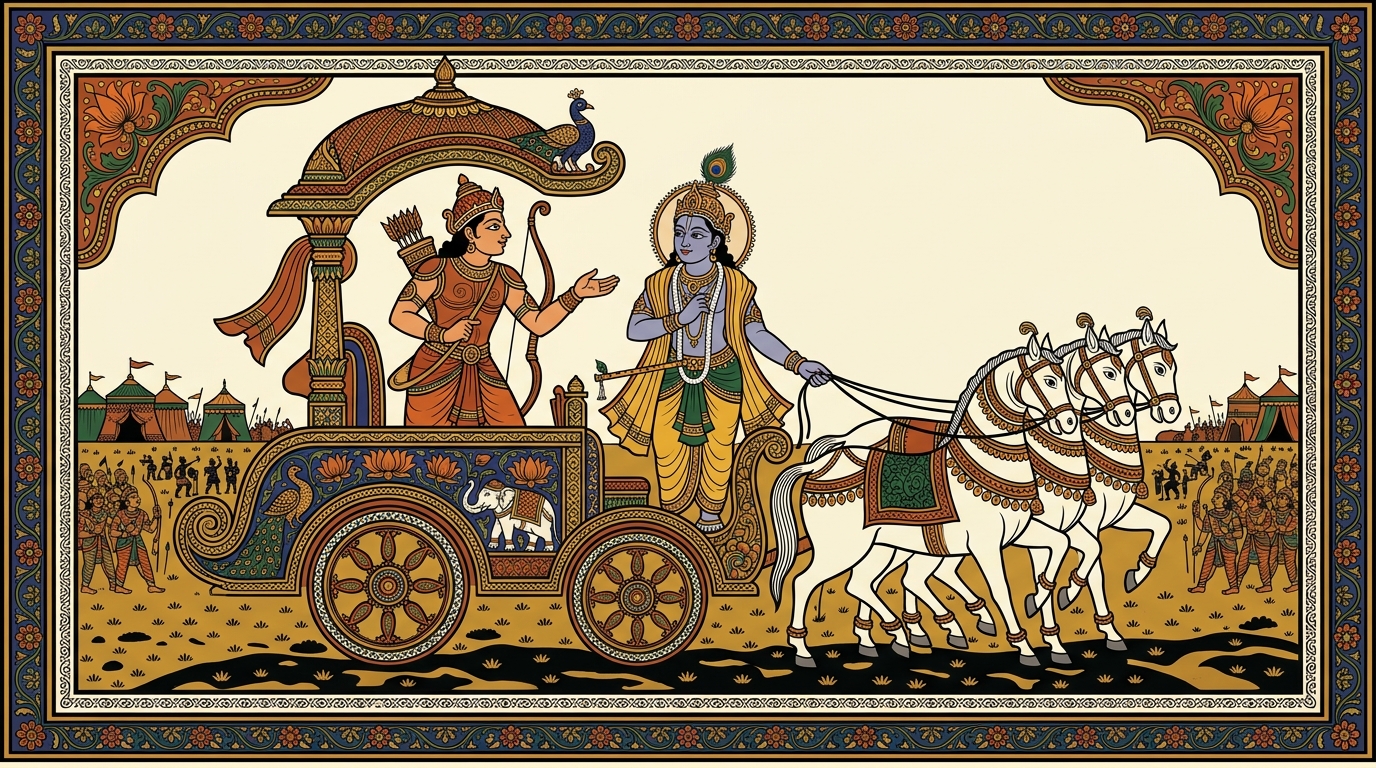
The Yoga of Liberation
मोक्षसंन्यासयोग
This is the grand finale! Krishna brings all his teachings together like the last chapter of an amazing book. He reminds Arjuna about duty, devotion, and knowledge. Then he says the most beautiful words — "I love you dearly, so I have shared this deepest wisdom with you. Now think about it carefully and do what your heart tells you." Arjuna's doubts vanish, and he picks up his bow, ready to face whatever comes.
All 78 verses — Sanskrit and English, side by side. Read with illustrations →
| # | Sanskrit | English |
|---|---|---|
| Verse 18.1 | संन्यासस्य महाबाहो तत्त्वमिच्छामि वेदितुम्। त्यागस्य च हृषीकेश पृथक्केशिनिषूदन॥ saṁnyāsasya mahābāho tattvamicchāmi veditum | tyāgasya ca hṛṣīkeśa pṛthakkeśiniṣūdana || | Arjuna Arjuna has one last set of questions before the great teaching ends. He says to Krishna: "O mighty-armed one, you keep using two words: sannyāsa, which means giving up selfish action, and tyāga, which means giving up the rewards of what we do. They sound almost the same to me, but I sense they are different. Please, O Lord of the senses, tell me the real truth of each one, separately, so I understand them clearly." |
| Verse 18.2 | काम्यानां कर्मणां न्यासं संन्यासं कवयो विदुः। सर्वकर्मफलत्यागं प्राहुस्त्यागं विचक्षणाः॥ kāmyānāṁ karmaṇāṁ nyāsaṁ saṁnyāsaṁ kavayo viduḥ | sarvakarmaphalatyāgaṁ prāhustyāgaṁ vicakṣaṇāḥ || | Krishna Krishna takes the two words apart, just as Arjuna asked. He says: "The wise seers tell us that sannyāsa means letting go of all actions that you do only to get something for yourself, actions driven by craving. And the clear-seeing ones say that tyāga means something a little different: it means doing your actions, but giving up your grip on the rewards. You still act. You simply stop clinging to what the action will bring you." |
| Verse 18.3 | त्याज्यं दोषवदित्येके कर्म प्राहुर्मनीषिणः। यज्ञदानतपःकर्म न त्याज्यमिति चापरे॥ tyājyaṁ doṣavadityeke karma prāhurmanīṣiṇaḥ | yajñadānatapaḥkarma na tyājyamiti cāpare || | Krishna Krishna shows Arjuna that even wise people disagree about this. "Some deep thinkers say that all action should be given up, because every action has some fault in it, like a smudge on clean cloth. But others, also wise, say no, the good actions of sacrifice, giving, and self-discipline must never be given up; those, at least, we should always keep doing." He sets both opinions side by side, so Arjuna can see the puzzle before hearing the answer. |
| Verse 18.4 | निश्चयं शृणु मे तत्र त्यागे भरतसत्तम। त्यागो हि पुरुषव्याघ्र त्रिविधः सम्प्रकीर्तितः॥ niścayaṁ śṛṇu me tatra tyāge bharatasattama | tyāgo hi puruṣavyāghra trividhaḥ samprakīrtitaḥ || | Krishna Now Krishna steps in to settle the argument. He says: "O best of the Bharatas, listen carefully to my own firm verdict about tyāga, the giving up of the fruits of action. O tiger among men, hear this — tyāga itself is not a single thing. It comes in three kinds, and I will show them all to you clearly." He promises Arjuna a real answer, not just more debate. |
| Verse 18.5 | यज्ञदानतपःकर्म न त्याज्यं कार्यमेव तत्। यज्ञो दानं तपश्चैव पावनानि मनीषिणाम्॥ yajñadānatapaḥkarma na tyājyaṁ kāryameva tat | yajño dānaṁ tapaścaiva pāvanāni manīṣiṇām || | Krishna Now Krishna gives his first clear ruling. He says: "The actions of sacrifice, of giving, and of self-discipline must never be given up — they should always be done. For sacrifice, giving, and self-discipline are exactly the things that purify even the wise. They wash the heart clean, the way clear water washes a window until the light pours through." Far from being flaws, these good actions make a person better. |
| Verse 18.6 | एतान्यपि तु कर्माणि सङ्गं त्यक्त्वा फलानि च। कर्तव्यानीति मे पार्थ निश्चितं मतमुत्तमम्॥ etānyapi tu karmāṇi saṅgaṁ tyaktvā phalāni ca | kartavyānīti me pārtha niścitaṁ matamuttamam || | Krishna Krishna now joins the two ideas into one perfect rule. He says: "Even these good actions, sacrifice, giving, and discipline, must be done, but done in a special way: by giving up the sticky attachment to them, and by giving up the rewards you hope they will bring. Do them, O son of Pṛthā, but hold them loosely. This is my settled and highest view." Keep the work; drop the clinging. |
| Verse 18.7 | नियतस्य तु संन्यासः कर्मणो नोपपद्यते। मोहात्तस्य परित्यागस्तामसः परिकीर्तितः॥ niyatasya tu saṁnyāsaḥ karmaṇo nopapadyate | mohāttasya parityāgastāmasaḥ parikīrtitaḥ || | Krishna Now Krishna shows the first of the three kinds of letting go — the wrong one. He says: "It is never right to give up a duty that has been laid out for you, a task that is truly yours to do. And if someone throws away their proper duty simply out of confusion, because their mind is clouded and they cannot see clearly, that kind of giving-up is called tamasic, the letting go that comes from darkness." Running away from your real work is not true renunciation at all. |
| Verse 18.8 | दुःखमित्येव यत्कर्म कायक्लेशभयात्त्यजेत्। स कृत्वा राजसं त्यागं नैव त्यागफलं लभेत्॥ duḥkham ity eva yat karma kāyakleśabhayāt tyajet | sa kṛtvā rājasaṁ tyāgaṁ naiva tyāgaphalaṁ labhet || | Krishna Suppose someone drops their duty just because it is hard: "this is too much trouble, my body will ache, I might get hurt." Krishna says that is the restless, rajasic kind of giving-up. It looks like letting go, but it is just running away from effort. And so it earns nothing. The person who quits out of fear of hard work never tastes the real reward that true letting go can bring. |
| Verse 18.9 | कार्यमित्येव यत्कर्म नियतं क्रियतेऽर्जुन। सङ्गं त्यक्त्वा फलं चैव स त्यागः सात्त्विको मतः॥ kāryam ity eva yat karma niyataṁ kriyate'rjuna | saṅgaṁ tyaktvā phalaṁ caiva sa tyāgaḥ sāttviko mataḥ || | Krishna Now Krishna shows the best kind of letting-go. When you do your duty simply because it ought to be done, not for a prize, not for praise, and you let go of clinging to it and of grabbing at the reward, that is the clear, sattvic way. You still do the work fully and well. You just don't tie your heart to what you'll get out of it. Do the whole task, then open your hands and let the result go. |
| Verse 18.10 | न द्वेष्ट्यकुशलं कर्म कुशले नानुषज्जते। त्यागी सत्त्वसमाविष्टो मेधावी छिन्नसंशयः॥ na dveṣṭy akuśalaṁ karma kuśale nānuṣajjate | tyāgī sattvasamāviṣṭo medhāvī chinnasaṁśayaḥ || | Krishna The true renouncer is calm and even toward work itself. He doesn't groan and hate a job just because it is unpleasant or hard. And he doesn't cling greedily to a job just because it is pleasant and easy. Filled with quiet clarity, wise, and free of doubt, he simply does what is in front of him, taking the hard with the easy, without fuss. He has stopped picking and choosing, and so his mind is steady. |
| Verse 18.11 | न हि देहभृता शक्यं त्यक्तुं कर्माण्यशेषतः। यस्तु कर्मफलत्यागी स त्यागीत्यभिधीयते॥ na hi dehabhṛtā śakyaṁ tyaktuṁ karmāṇy aśeṣataḥ | yas tu karmaphalatyāgī sa tyāgīty abhidhīyate || | Krishna Krishna is honest: nobody who lives in a body can stop doing things altogether. Even sitting, breathing, eating, and thinking are actions. So "giving up all action" is impossible. Then who is a real renouncer? The one who keeps acting but lets go of grasping at the fruits, the prizes and rewards. You can't stop doing. You can stop demanding something in return. That is what makes someone a true tyagi. |
| Verse 18.12 | अनिष्टमिष्टं मिश्रं च त्रिविधं कर्मणः फलम्। भवत्यत्यागिनां प्रेत्य न तु संन्यासिनां क्वचित्॥ aniṣṭam iṣṭaṁ miśraṁ ca trividhaṁ karmaṇaḥ phalam | bhavaty atyāgināṁ pretya na tu saṁnyāsināṁ kvacit || | Krishna Every action leaves a kind of fruit, and Krishna says there are three: the unwanted (sour and painful), the wanted (sweet and pleasant), and the mixed (a bit of both). For people who never let go — who chase rewards their whole lives — these fruits keep following them, sticking even after they leave this body. But for the one who has truly let go of grasping, no such fruit clings, ever. With the grabbing gone, the sticky strings are gone too. |
| Verse 18.13 | पञ्चैतानि महाबाहो कारणानि निबोध मे। साङ्ख्ये कृतान्ते प्रोक्तानि सिद्धये सर्वकर्मणाम्॥ pañcaitāni mahābāho kāraṇāni nibodha me | sāṅkhye kṛtānte proktāni siddhaye sarvakarmaṇām || | Krishna Krishna says, "Listen carefully, mighty Arjuna, for I will tell you something important." The old wise teaching called Sankhya, the teaching that counts up what is real, names five things that must come together for any action to get done. Not one of them works alone. In the next verse he will name all five. For now he wants Arjuna to pay close attention, because once you see the five, you stop thinking "I alone did it all," which is where pride begins. |
| Verse 18.14 | अधिष्ठानं तथा कर्ता करणं च पृथग्विधम्। विविधाश्च पृथक्चेष्टा दैवं चैवात्र पञ्चमम्॥ adhiṣṭhānaṁ tathā kartā karaṇaṁ ca pṛthagvidham | vividhāś ca pṛthakceṣṭā daivaṁ caivātra pañcamam || | Krishna Now Krishna names the five. First, the seat: the body, where action takes its stand. Second, the doer, the one who acts. Third, the instruments — the hands, eyes, ears, and tools, of many kinds. Fourth, the many different efforts, all the pushing and striving. And fifth, the divine — providence, the part beyond anyone's control, like rain or luck or grace. These five together bring about every single thing that gets done. Never one of them alone. |
| Verse 18.15 | शरीरवाङ्मनोभिर्यत्कर्म प्रारभते नरः। न्याय्यं वा विपरीतं वा पञ्चैते तस्य हेतवः॥ śarīravāṅmanobhiryatkarma prārabhate naraḥ | nyāyyaṁ vā viparītaṁ vā pañcaite tasya hetavaḥ || | Krishna Krishna says: whatever a person does — with the body, with words, or with the mind, whether it turns out right or wrong — five things together make it happen. No deed is ever the work of one person alone. The place, the doer, the tools, the effort, and a hand bigger than all of us all join in. So when something goes well, you need not puff up with pride; and when it goes wrong, you need not crush yourself with blame. |
| Verse 18.16 | तत्रैवं सति कर्तारमात्मानं केवलं तु यः। पश्यत्यकृतबुद्धित्वान्न स पश्यति दुर्मतिः॥ tatraivaṁ sati kartāramātmānaṁ kevalaṁ tu yaḥ | paśyatyakṛtabuddhitvānna sa paśyati durmatiḥ || | Krishna Now Krishna gives the lesson hidden in those five helpers. Whoever thinks "I alone am the doer" — that the little self by itself makes everything happen — has not truly looked. Their understanding is still untrained, like an eye that has not yet learned to see. They miss the bigger picture: that the real Self inside is calm and free, and that every deed is woven from many threads, not spun by one proud hand. |
| Verse 18.17 | यस्य नाहंकृतो भावो बुद्धिर्यस्य न लिप्यते। हत्वापि स इमाँल्लोकान्न हन्ति न निबध्यते॥ yasya nāhaṅkṛto bhāvo buddhiryasya na lipyate | hatvāpi sa imāṁllokānna hanti na nibadhyate || | Krishna Krishna describes a rare kind of person: one whose heart is free of "I, me, mine," whose understanding stays clean and is never stained by selfishness. Such a person, even when they must do a hard duty, even Arjuna fighting a war he did not want, does not act out of hate or greed, and so is not chained by it. The deed passes through them like light through clear glass, leaving no mark. It is the angry, grasping "I" that ties us in knots, not the duty itself. |
| Verse 18.18 | ज्ञानं ज्ञेयं परिज्ञाता त्रिविधा कर्मचोदना। करणं कर्म कर्तेति त्रिविधः कर्मसंग्रहः॥ jñānaṁ jñeyaṁ parijñātā trividhā karmacodanā | karaṇaṁ karma karteti trividhaḥ karmasaṅgrahaḥ || | Krishna Krishna takes any action apart to show what it is made of. Before a deed, three things stir it: knowing how (knowledge), the thing you want to know or do (the known), and you yourself (the knower). And inside the deed there are three more parts: the tool you use (the instrument), the work that gets done (the deed), and the one doing it (the doer). Like looking at a clock and finding its gears, Krishna shows that even something as simple as helping a friend is built from many quiet pieces working together. |
| Verse 18.19 | ज्ञानं कर्म च कर्ता च त्रिधैव गुणभेदतः। प्रोच्यते गुणसंख्याने यथावच्छृणु तान्यपि॥ jñānaṁ karma ca kartā ca tridhaiva guṇabhedataḥ | procyate guṇasaṅkhyāne yathāvacchṛṇu tānyapi || | Krishna Krishna says that three big things in life, knowledge, action, and the doer, each come in three different colours, depending on which of nature's three strands shines through them: sattva (the clear, light strand), rajas (the restless, fiery strand), and tamas (the dull, heavy strand). It is like learning that there are warm colours, cool colours, and grey ones, and that the same shape looks very different in each. "Listen carefully," he says, "and I will name them for you, one by one." |
| Verse 18.20 | सर्वभूतेषु येनैकं भावमव्ययमीक्षते। अविभक्तं विभक्तेषु तज्ज्ञानं विद्धि सात्त्विकम्॥ sarvabhūteṣu yenaikaṁ bhāvamavyayamīkṣate | avibhaktaṁ vibhakteṣu tajjñānaṁ viddhi sāttvikam || | Krishna Here is the first and best kind of knowledge, the sattvic kind. It is the way of seeing that finds one undying life shining inside every single creature, one whole, unbroken light, even though the bodies it lives in look so different and separate. The same spark that warms a tiger warms a sparrow, a buffalo, your noisy little brother, and you. Outside, a thousand shapes; inside, one glow. Krishna calls this the clearest, truest seeing there is. |
| Verse 18.21 | पृथक्त्वेन तु यज्ज्ञानं नानाभावान्पृथग्विधान्। वेत्ति सर्वेषु भूतेषु तज्ज्ञानं विद्धि राजसम्॥ pṛthaktvena tu yajjñānaṁ nānābhāvānpṛthagvidhān | vetti sarveṣu bhūteṣu tajjñānaṁ viddhi rājasam || | Krishna Now the second kind of knowledge, the rajasic kind. This is the way of seeing that looks at all the creatures of the world and sees only "many": countless separate beings, each one cut off from the rest, each its own little island with no thread joining them. It is not wrong about the differences; the differences are real. But it stops there, at the surface, and never notices the one light underneath. It is restless seeing, busy counting how everyone is different instead of resting in how everyone is the same. |
| Verse 18.22 | यत्तु कृत्स्नवदेकस्मिन्कार्ये सक्तमहैतुकम्। अतत्त्वार्थवदल्पं च तत्तामसमुदाहृतम्॥ yattu kṛtsnavadekasminkārye saktamahaitukam | atattvārthavadalpaṁ ca tattāmasamudāhṛtam || | Krishna Krishna describes the dullest, darkest kind of knowing. It is the kind that grabs hold of one tiny thing and treats it as if it were the whole world. It has no good reason behind it, it never reaches the real truth of anything, and it stays small and narrow. That sort of clinging, reasonless, trivial "knowing" is called tamasic, knowing wrapped in darkness. |
| Verse 18.23 | नियतं सङ्गरहितमरागद्वेषतः कृतम्। अफलप्रेप्सुना कर्म यत्तत्सात्त्विकमुच्यते॥ niyataṁ saṅgarahitamarāgadveṣataḥ kṛtam | aphalaprepsunā karma yattatsāttvikamucyate || | Krishna Krishna describes the clearest, purest kind of action. It is the work you do simply because it is yours to do, without clinging to it, without doing it only for things you like or skipping things you dislike, and without grabbing for any reward. Work done that way, calmly and for its own sake, is called sattvic action, action that comes from a clear and good heart. |
| Verse 18.24 | यत्तु कामेप्सुना कर्म साहङ्कारेण वा पुनः। क्रियते बहुलायासं तद्राजसमुदाहृतम्॥ yattu kāmepsunā karma sāhaṅkāreṇa vā punaḥ | kriyate bahulāyāsaṁ tadrājasamudāhṛtam || | Krishna Krishna describes the restless, fiery kind of action. It is work driven by craving, done to grab what you want, puffed up with ego and the pride of "see what I did," and pushed through with enormous strain and stress. Action done with all that hunger, showing-off, and exhausting struggle is called rajasic, action born of restless passion. |
| Verse 18.25 | अनुबन्धं क्षयं हिंसामनवेक्ष्य च पौरुषम्। मोहादारभ्यते कर्म यत्तत्तामसमुच्यते॥ anubandhaṁ kṣayaṁ hiṁsāmanavekṣya ca pauruṣam | mohādārabhyate karma yattattāmasamucyate || | Krishna Krishna describes the most reckless kind of action. It is the work someone rushes into out of pure confusion, never stopping to think what will come of it, how much will be wasted or ruined, who might be hurt, or whether they can even manage it at all. Action begun blindly like that, in delusion, is called tamasic, action born of darkness. |
| Verse 18.26 | मुक्तसङ्गोऽनहंवादी धृत्युत्साहसमन्वितः। सिद्ध्यसिद्ध्योर्निर्विकारः कर्ता सात्त्विक उच्यते॥ muktasaṅgo'nahaṁvādī dhṛtyutsāhasamanvitaḥ | siddhyasiddhyornirvikāraḥ kartā sāttvika ucyate || | Krishna Krishna describes the finest kind of doer: the kind of person you become, not only the work you do. This doer doesn't cling to things, doesn't go around bragging "look what I did," and is full of quiet steadiness and cheerful energy. Best of all, whether the work turns out a great success or a flat failure, this person stays calm and unshaken. Such a doer is called sattvic, a doer of clear goodness. |
| Verse 18.27 | रागी कर्मफलप्रेप्सुर्लुब्धो हिंसात्मकोऽशुचिः। हर्षशोकान्वितः कर्ता राजसः परिकीर्तितः॥ rāgī karmaphalaprepsurlubdho hiṁsātmako'śuciḥ | harṣaśokānvitaḥ kartā rājasaḥ parikīrtitaḥ || | Krishna Krishna now describes the restless kind of doer. This is a person on fire with craving, always hungry for the rewards of what they do, greedy and grasping, willing to push or hurt others to get their way, unclean in habit, and forever bouncing between wild delight when things go well and deep gloom when they don't. Such a doer is described as rajasic — a doer of restless passion. |
| Verse 18.28 | अयुक्तः प्राकृतः स्तब्धः शठो नैष्कृतिकोऽलसः। विषादी दीर्घसूत्री च कर्ता तामस उच्यते॥ ayuktaḥ prākṛtaḥ stabdhaḥ śaṭho naiṣkṛtiko'lasaḥ | viṣādī dīrghasūtrī ca kartā tāmasa ucyate || | Krishna Krishna describes the dullest, darkest kind of doer. This is a person who is scattered and never focused, coarse and rude, stubborn as a mule, dishonest, spiteful enough to spoil what others build, lazy, gloomy and always glum, and a champion at putting things off so long they never get done. Such a doer is called tamasic — a doer wrapped in darkness. |
| Verse 18.29 | बुद्धेर्भेदं धृतेश्चैव गुणतस्त्रिविधं शृणु। प्रोच्यमानमशेषेण पृथक्त्वेन धनञ्जय॥ buddherbhedaṁ dhṛteścaiva guṇatastrividhaṁ śṛṇu | procyamānamaśeṣeṇa pṛthaktvena dhanañjaya || | Krishna Krishna keeps going through his great list. He has already shown Arjuna that knowledge, action, and the doer each come in three colours — sattva (clear and calm), rajas (restless and grasping), and tamas (dull and dark). "Now," he says, "listen to two more: the buddhi, your deciding mind that tells right from wrong, and dhṛti, your firmness, the inner grip that holds you steady. These too come in three kinds, O Arjuna. I will set them out for you completely, one by one, leaving nothing out." |
| Verse 18.30 | प्रवृत्तिं च निवृत्तिं च कार्याकार्ये भयाभये। बन्धं मोक्षं च या वेत्ति बुद्धिः सा पार्थ सात्त्विकी॥ pravṛttiṁ ca nivṛttiṁ ca kāryākārye bhayābhaye | bandhaṁ mokṣaṁ ca yā vetti buddhiḥ sā pārtha sāttvikī || | Krishna Krishna describes the best kind of deciding mind. "The buddhi that knows when to step forward into action and when to step back, what truly should be done and what should not, what is worth fearing and what is not, and which things chain you down and which set you free — that clear-seeing mind, O Arjuna, is sāttvic." It is the mind that can tell, calmly and honestly, the difference between what really helps and what only looks helpful. |
| Verse 18.31 | यया धर्ममधर्मं च कार्यं चाकार्यमेव च। अयथावत्प्रजानाति बुद्धिः सा पार्थ राजसी॥ yayā dharmamadharmaṁ ca kāryaṁ cākāryameva ca | ayathāvatprajānāti buddhiḥ sā pārtha rājasī || | Krishna Krishna describes the second kind of deciding mind. "The buddhi that gets right and wrong mixed up, that cannot clearly tell what should be done from what should not — that confused mind, O Arjuna, is rājasic." It is not completely blind, but its wanting and its hurry blur its sight. It half-sees the truth and then bends it to fit what it already craves, so it keeps calling the wrong thing right. |
| Verse 18.32 | अधर्मं धर्ममिति या मन्यते तमसावृता। सर्वार्थान्विपरीतांश्च बुद्धिः सा पार्थ तामसी॥ adharmaṁ dharmamiti yā manyate tamasāvṛtā | sarvārthānviparītāṁśca buddhiḥ sā pārtha tāmasī || | Krishna Krishna describes the darkest kind of deciding mind. "The buddhi that is wrapped up in darkness, that thinks wrong is right and right is wrong, and that sees every single thing upside down — that mind, O Arjuna, is tāmasic." This is worse than the muddled mind. It does not just bend the truth; it flips it completely. It calls poison medicine and medicine poison, and walks confidently in exactly the wrong direction. |
| Verse 18.33 | धृत्या यया धारयते मनःप्राणेन्द्रियक्रियाः। योगेनाव्यभिचारिण्या धृतिः सा पार्थ सात्त्विकी॥ dhṛtyā yayā dhārayate manaḥprāṇendriyakriyāḥ | yogenāvyabhicāriṇyā dhṛtiḥ sā pārtha sāttvikī || | Krishna Krishna describes the best kind of firmness. "The dhṛti by which a person holds the mind, the breath, and the senses steady — through unwavering yoga, through practice that never strays off course — that firmness, O Arjuna, is sāttvic." It is not a tight, forced clinging but a quiet, even grip, the grip of someone who practises a little every day, so that mind and body settle and stay pointed in one steady direction. |
| Verse 18.34 | यया तु धर्मकामार्थान्धृत्या धारयतेऽर्जुन। प्रसङ्गेन फलाकाङ्क्षी धृतिः सा पार्थ राजसी॥ yayā tu dharmakāmārthāndhṛtyā dhārayate'rjuna | prasaṅgena phalākāṅkṣī dhṛtiḥ sā pārtha rājasī || | Krishna Krishna describes the second kind of firmness. "But the dhṛti with which a person clings tightly to duty, pleasure, and wealth — always craving their rewards, always hanging on — that firmness, O Arjuna, is rājasic." It really is a kind of holding-on; it can be strong and stubborn. But it grips for the sake of the prize. It keeps going only as long as it expects to get something back. |
| Verse 18.35 | यया स्वप्नं भयं शोकं विषादं मदमेव च। न विमुञ्चति दुर्मेधा धृतिः सा पार्थ तामसी॥ yayā svapnaṁ bhayaṁ śokaṁ viṣādaṁ madameva ca | na vimuñcati durmedhā dhṛtiḥ sā pārtha tāmasī || | Krishna Krishna describes the darkest kind of firmness. "The dhṛti by which a dull-minded person will not let go of sleep, fear, sorrow, gloom, and conceit — that firmness, O Arjuna, is tāmasic." This is the strangest firmness of all. It is strong, but it grips the wrong things. It holds tight to laziness and worry and self-pity and puffed-up pride, refusing to put them down, even though letting go would set the person free. |
| Verse 18.36 | सुखं त्विदानीं त्रिविधं शृणु मे भरतर्षभ। अभ्यासाद्रमते यत्र दुःखान्तं च निगच्छति॥ sukhaṁ tvidānīṁ trividhaṁ śṛṇu me bharatarṣabha | abhyāsādramate yatra duḥkhāntaṁ ca nigacchati || | Krishna Krishna says: "And now, best of the Bharatas, hear from me about happiness, for it too comes in three kinds. There is a happiness in which a person, after steady practice, comes to take real joy, and in that joy reaches the end of all sorrow." He is telling Arjuna that not every happy feeling is the same. Some kinds last and heal you; others fade and leave you emptier than before. So it is worth learning to tell them apart. |
| Verse 18.37 | यत्तदग्रे विषमिव परिणामेऽमृतोपमम्। तत्सुखं सात्त्विकं प्रोक्तमात्मबुद्धिप्रसादजम्॥ yattadagre viṣamiva pariṇāme'mṛtopamam | tatsukhaṁ sāttvikaṁ proktamātmabuddhiprasādajam || | Krishna Krishna describes the first kind — the sattvic happiness. "It is like poison at the very start, but in the end it turns out to be like nectar, the drink of deathlessness. This happiness is called sattvic, and it is born of the calm, settled clearness of one's own mind." In other words, the best joys often feel hard or even unpleasant when you begin — practising, studying, waiting — but if you keep going, they ripen into a deep, lasting gladness that no quick treat can match. |
| Verse 18.38 | विषयेन्द्रियसंयोगाद्यत्तदग्रेऽमृतोपमम्। परिणामे विषमिव तत्सुखं राजसं स्मृतम्॥ viṣayendriyasaṁyogādyattadagre'mṛtopamam | pariṇāme viṣamiva tatsukhaṁ rājasaṁ smṛtam || | Krishna Krishna describes the second kind — the rajasic happiness. "It comes from the senses meeting the things they crave, and it is like nectar at the very start, but in the end it turns out to be like poison. That happiness is known to be rajasic — born of restlessness and desire." This is the opposite of the first kind: it feels delicious the moment you grab it, but later it leaves you tired, empty, or sorry. The sweet beginning hides a bitter ending. |
| Verse 18.39 | यदग्रे चानुबन्धे च सुखं मोहनमात्मनः। निद्रालस्यप्रमादोत्थं तत्तामसमुदाहृतम्॥ yadagre cānubandhe ca sukhaṁ mohanamātmanaḥ | nidrālasyapramādotthaṁ tattāmasamudāhṛtam || | Krishna Krishna describes the third kind — the tamasic happiness. "It clouds and deludes the mind both at the beginning and in the end, and it arises from sleep, laziness, and carelessness. That is said to be tamasic happiness." This is the lowest kind: it never really makes you better, not at the start and not later. It is the dull comfort of doing nothing, dodging effort, and drifting through the day half-asleep — a fog that only leaves you smaller. |
| Verse 18.40 | न तदस्ति पृथिव्यां वा दिवि देवेषु वा पुनः। सत्त्वं प्रकृतिजैर्मुक्तं यदेभिः स्यात्त्रिभिर्गुणैः॥ na tadasti pṛthivyāṁ vā divi deveṣu vā punaḥ | sattvaṁ prakṛtijairmuktaṁ yadebhiḥ syāttribhirguṇaiḥ || | Krishna Krishna sums up the whole long teaching about the three gunas: "There is no being anywhere — not on the earth, nor in heaven among the gods — that is free from these three qualities born of nature." Every creature, even the bright gods above, is woven out of the same three threads: sattva (clarity), rajas (restlessness), and tamas (dullness). Nobody escapes them entirely. The whole point of the teaching is not to pretend the gunas aren't there, but to learn to choose more of the clear one and less of the dark one. |
| Verse 18.41 | ब्राह्मणक्षत्रियविशां शूद्राणां च परन्तप। कर्माणि प्रविभक्तानि स्वभावप्रभवैर्गुणैः॥ brāhmaṇakṣatriyaviśāṁ śūdrāṇāṁ ca parantapa | karmāṇi pravibhaktāni svabhāvaprabhavairguṇaiḥ || | Krishna Krishna explains why people do different kinds of work in the world. "O scorcher of foes, the duties of the brāhmaṇas (the seekers of knowledge), the kṣatriyas (the protectors), the vaiśyas (the farmers and traders), and the śūdras (those who serve) are divided up according to the qualities born of each person's own nature." He is saying that the work that suits us best grows out of our inborn nature, the particular mix of the three gunas inside us. Different people are built for different kinds of service, and each kind matters. |
| Verse 18.42 | शमो दमस्तपः शौचं क्षान्तिरार्जवमेव च। ज्ञानं विज्ञानमास्तिक्यं ब्रह्मकर्म स्वभावजम्॥ śamo damastapaḥ śaucaṁ kṣāntirārjavameva ca | jñānaṁ vijñānamāstikyaṁ brahmakarma svabhāvajam || | Krishna Krishna names the work that flows naturally from a brāhmaṇa — a seeker of sacred truth: "Calmness of mind, control of the senses, willing discipline, purity, patience, uprightness, knowledge, deep wisdom, and faith. This is the work born of the brāhmaṇa's own nature." These are not chores but qualities of character. The seeker's real work is to become quiet, honest, patient, clean, and wise, and to keep faith in what is sacred, and to live so steadily that others can lean on that calm. |
| Verse 18.43 | शौर्यं तेजो धृतिर्दाक्ष्यं युद्धे चाप्यपलायनम्। दानमीश्वरभावश्च क्षात्रं कर्म स्वभावजम्॥ śauryaṁ tejo dhṛtirdākṣyaṁ yuddhe cāpyapalāyanam | dānamīśvarabhāvaśca kṣātraṁ karma svabhāvajam || | Krishna Krishna now describes the work that flows naturally from a warrior-protector, a kshatriya. Their nature gives them bravery, blazing energy, firmness that will not bend, and skill. In a fight they do not turn and run. They are generous, sharing freely with those they protect, and they carry the spirit of a leader who guards everyone in their care. All of this, Krishna says, springs from a warrior's own inborn nature. It is the right work for them. |
| Verse 18.44 | कृषिगौरक्ष्यवाणिज्यं वैश्यकर्म स्वभावजम्। परिचर्यात्मकं कर्म शूद्रस्यापि स्वभावजम्॥ kṛṣigaurakṣyavāṇijyaṁ vaiśyakarma svabhāvajam | paricaryātmakaṁ karma śūdrasyāpi svabhāvajam || | Krishna Krishna goes on to the work that flows naturally from two more kinds of people. The vaishya — the farmer, herder, and trader — has the inborn work of growing food, caring for animals, and buying and selling honestly. The shudra — the helper and supporter — has the inborn gift of service, of looking after others and keeping things running well. Each of these is good and dignified work, and each rises straight from a person's own nature. No honest work is small. |
| Verse 18.45 | स्वे स्वे कर्मण्यभिरतः संसिद्धिं लभते नरः। स्वकर्मनिरतः सिद्धिं यथा विन्दति तच्छृणु॥ sve sve karmaṇyabhirataḥ saṁsiddhiṁ labhate naraḥ | svakarmanirataḥ siddhiṁ yathā vindati tacchṛṇu || | Krishna Krishna gives a wonderful promise. A person who loves and is devoted to their own work — whatever kind it is — reaches the very highest perfection. You do not need someone else's job to become great. You become great by pouring your whole heart into the work that is truly yours. "Listen," says Krishna, "and I will tell you how a person absorbed in their own work finds this perfection." |
| Verse 18.46 | यतः प्रवृत्तिर्भूतानां येन सर्वमिदं ततम्। स्वकर्मणा तमभ्यर्च्य सिद्धिं विन्दति मानवः॥ yataḥ pravṛttirbhūtānāṁ yena sarvamidaṁ tatam | svakarmaṇā tamabhyarcya siddhiṁ vindati mānavaḥ || | Krishna Krishna now reveals how ordinary work becomes the highest worship. The One from whom all living beings spring, the One who spreads through every corner of this whole world. A person can worship that very God simply by doing their own work well and offering it up. You do not need a special temple or a special day. Do your own honest work as a gift to the God who is everywhere, and through it you reach perfection. |
| Verse 18.47 | श्रेयान्स्वधर्मो विगुणः परधर्मात्स्वनुष्ठितात्। स्वभावनियतं कर्म कुर्वन्नाप्नोति किल्बिषम्॥ śreyānsvadharmo viguṇaḥ paradharmātsvanuṣṭhitāt | svabhāvaniyataṁ karma kurvannāpnoti kilbiṣam || | Krishna Krishna says something surprising. It is better to do your own work, even imperfectly, than to do someone else's work perfectly. The work that is born from your own nature is truly yours, and when you do that nature-given work, you take on no fault, no stain. So do not look at another person's role and wish it were yours. Your own work, done honestly, is the safest and best road for you. |
| Verse 18.48 | सहजं कर्म कौन्तेय सदोषमपि न त्यजेत्। सर्वारम्भा हि दोषेण धूमेनाग्निरिवावृताः॥ sahajaṁ karma kaunteya sadoṣamapi na tyajet | sarvārambhā hi doṣeṇa dhūmenāgnirivāvṛtāḥ || | Krishna Krishna gives a comforting truth. The work that is born with you, your own natural duty, should not be thrown away even if it has some faults. Why? Because every single thing we begin has some flaw in it, just as every fire comes wrapped in smoke. There is no perfectly spotless work anywhere. So do not wait for flawless work, and do not abandon your own work because it isn't perfect. Do it well anyway, smoke and all. |
| Verse 18.49 | असक्तबुद्धिः सर्वत्र जितात्मा विगतस्पृहः। नैष्कर्म्यसिद्धिं परमां संन्यासेनाधिगच्छति॥ asaktabuddhiḥ sarvatra jitātmā vigataspṛhaḥ | naiṣkarmyasiddhiṁ paramāṁ saṁnyāsenādhigacchati || | Krishna Krishna describes the person who has become truly free. Their mind does not cling to anything, anywhere. They have mastered themselves, and their hungry longings have melted away. Such a person, by letting go inside, reaches the highest freedom of all: the state where action no longer binds them. They still act, but nothing they do can chain them anymore, because their heart has released its grip on everything. |
| Verse 18.50 | सिद्धिं प्राप्तो यथा ब्रह्म तथाप्नोति निबोध मे। समासेनैव कौन्तेय निष्ठा ज्ञानस्य या परा॥ siddhiṁ prāpto yathā brahma tathāpnoti nibodha me | samāsenaiva kaunteya niṣṭhā jñānasya yā parā || | Krishna Krishna says: "Listen, and I will tell you in just a few words how a person who has reached perfection comes to Brahman, the vast endless Spirit. This is the topmost peak of all knowing: the place where the long climb of learning finally rests." He is about to describe the inner journey of a sage: not a path of the feet, but a path of the heart growing quiet and clear, step by step, until it touches the great Spirit that holds everything. |
| Verse 18.51 | बुद्ध्या विशुद्धया युक्तो धृत्यात्मानं नियम्य च। शब्दादीन्विषयांस्त्यक्त्वा रागद्वेषौ व्युदस्य च॥ buddhyā viśuddhayā yukto dhṛtyātmānaṁ niyamya ca | śabdādīnviṣayāṁstyaktvā rāgadveṣau vyudasya ca || | Krishna Krishna describes the first steps of the sage's inner climb. With a clear, clean mind — like a window someone has wiped until it sparkles — and with firm, steady resolve, the seeker gently takes charge of himself. He loosens his grip on the noisy pull of sounds, sights, tastes, and the rest of the things the senses chase. And he sets down the two heavy stones almost everyone carries: liking, which says "I must have this," and disliking, which says "I cannot stand that." With those put down, the heart grows light. |
| Verse 18.52 | विविक्तसेवी लघ्वाशी यतवाक्कायमानसः। ध्यानयोगपरो नित्यं वैराग्यं समुपाश्रितः॥ viviktasevī laghvāśī yatavākkāyamānasaḥ | dhyānayogaparo nityaṁ vairāgyaṁ samupāśritaḥ || | Krishna Krishna paints the daily life of the climbing sage. He chooses quiet, lonely places, away from the clamour of the crowd. He eats lightly, just enough, never stuffing himself. He keeps his words gentle, his body calm, and his mind from racing all over. Always he turns toward meditation, sitting and steadying his thoughts. And he leans, like a tired traveller leaning on a strong staff, on vairagya: the deep calm of a heart that no longer needs to chase after things to feel whole. |
| Verse 18.53 | अहंकारं बलं दर्पं कामं क्रोधं परिग्रहम्। विमुच्य निर्ममः शान्तो ब्रह्मभूयाय कल्पते॥ ahaṅkāraṁ balaṁ darpaṁ kāmaṁ krodhaṁ parigraham | vimucya nirmamaḥ śānto brahmabhūyāya kalpate || | Krishna Krishna names the last bundle of heavy things the sage lets go. He sets down egotism, the loud, puffed-up "I, me, mine." He drops force, the urge to push others around. He drops show-off pride, greedy craving, hot anger, and the habit of grabbing and hoarding. Free of all that, no longer saying "mine, mine" about everything, and grown peaceful, such a person becomes ready, ripe and fit, to merge into Brahman, the great calm Spirit. |
| Verse 18.54 | ब्रह्मभूतः प्रसन्नात्मा न शोचति न काङ्क्षति। समः सर्वेषु भूतेषु मद्भक्तिं लभते पराम्॥ brahmabhūtaḥ prasannātmā na śocati na kāṅkṣati | samaḥ sarveṣu bhūteṣu madbhaktiṁ labhate parām || | Krishna Krishna describes the sage who has reached the summit. Having become one with Brahman, his heart is serene, clear and bright like a sky after rain. He does not grieve over what is gone, and he does not crave what he does not have. He sees the same precious life-spark in every single being, so he looks on all creatures with equal, gentle eyes. And out of this calm and wholeness, a great gift blossoms in him: para bhakti, the highest love, love for the one Self that shines in Krishna and in every being. The quiet of Brahman flowers into pure love. |
| Verse 18.55 | भक्त्या मामभिजानाति यावान्यश्चास्मि तत्त्वतः। ततो मां तत्त्वतो ज्ञात्वा विशते तदनन्तरम्॥ bhaktyā māmabhijānāti yāvānyaścāsmi tattvataḥ | tato māṁ tattvato jñātvā viśate tadanantaram || | Krishna Krishna says: it is through this supreme love and trust that a person finally comes to know Me as I truly am — who I am and how vast I am, the real essence behind the name. Not from books alone, not from clever arguments, but from devotion that opens the eyes of the heart. And once someone knows Me truly, in my real nature, there is no waiting, no long delay. That person enters into Me right away, like a river slipping at last into the sea. |
| Verse 18.56 | सर्वकर्माण्यपि सदा कुर्वाणो मद्व्यपाश्रयः। मत्प्रसादादवाप्नोति शाश्वतं पदमव्ययम्॥ sarvakarmāṇyapi sadā kurvāṇo madvyapāśrayaḥ | matprasādādavāpnoti śāśvataṁ padamavyayam || | Krishna Krishna gives the gentlest news of all. You do not have to flee the world or stop all your work to reach the highest goal. Even while doing all your actions, all day, every day, you can lean your whole weight on Krishna — taking refuge in him the way a child rests against a parent. Do your work, but trust in him completely. And then, by his grace, not by your strength alone, you reach the eternal, changeless home, the resting-place that never fades or wears away. |
| Verse 18.57 | चेतसा सर्वकर्माणि मयि संन्यस्य मत्परः। बुद्धियोगमुपाश्रित्य मच्चित्तः सततं भव॥ cetasā sarvakarmāṇi mayi saṁnyasya matparaḥ | buddhiyogamupāśritya maccittaḥ satataṁ bhava || | Krishna Krishna gives Arjuna a simple, beautiful instruction. Do your work, all of it, but in your heart hand every deed over to Me, like giving someone a gift to carry. Hold Me as the dearest thing of all. Lean on a calm, clear mind instead of a worried one, and let your thoughts come home to Me again and again. Do this always, and your work will no longer weigh you down. You act with your hands, but you rest in Me. |
| Verse 18.58 | मच्चित्तः सर्वदुर्गाणि मत्प्रसादात्तरिष्यसि। अथ चेत्त्वमहंकारान्न श्रोष्यसि विनङ्क्ष्यसि॥ maccittaḥ sarvadurgāṇi matprasādāttariṣyasi | atha cettvamahaṁkārānna śroṣyasi vinaṅkṣyasi || | Krishna Krishna makes Arjuna a promise and a warning in one breath. Keep your mind on Me, he says, and by My grace you will get safely across every hard stretch of life — every fear, every storm, every place that looks too rough to pass. But if pride plugs your ears and you refuse to listen, then you will lose your way. The danger is not the rough water; the danger is being too stubborn to let yourself be guided through it. |
| Verse 18.59 | यदहंकारमाश्रित्य न योत्स्य इति मन्यसे। मिथ्यैष व्यवसायस्ते प्रकृतिस्त्वां नियोक्ष्यति॥ yadahaṁkāramāśritya na yotsya iti manyase | mithyaiṣa vyavasāyaste prakṛtistvāṁ niyokṣyati || | Krishna Krishna looks straight at Arjuna's escape plan and gently takes it apart. "If, out of pride, you decide 'I will not fight,'" he says, "that decision is empty; it will not hold." A warrior cannot simply wish away the warrior inside him. Your own deep nature, the way you are made, will pull you back into your work whether you like it or not. You cannot run from what you truly are; you can only choose to do it wisely or be dragged into it. |
| Verse 18.60 | स्वभावजेन कौन्तेय निबद्धः स्वेन कर्मणा। कर्तुं नेच्छसि यन्मोहात्करिष्यस्यवशोऽपि तत्॥ svabhāvajena kaunteya nibaddhaḥ svena karmaṇā | kartuṁ necchasi yanmohātkariṣyasyavaśo'pi tat || | Krishna Krishna spells it out plainly for Arjuna. You are tied to your own kind of work by the nature you were born with. The very thing you are now refusing to do, because confusion has clouded your eyes, you will end up doing it anyway, helplessly, because your nature will leave you no other path. Far better, then, to step toward your true work with open eyes and a willing heart, than to be dragged into it later, blind and unwilling. |
| Verse 18.61 | ईश्वरः सर्वभूतानां हृद्देशेऽर्जुन तिष्ठति। भ्रामयन्सर्वभूतानि यन्त्रारूढानि मायया॥ īśvaraḥ sarvabhūtānāṁ hṛddeśe'rjuna tiṣṭhati | bhrāmayansarvabhūtāni yantrārūḍhāni māyayā || | Krishna Krishna shares a tender secret: the one Self, the Lord, dwells in the heart of every single being, yours and mine and every creature's, one and the same in all. What sets beings spinning round and round, as if fixed to a turning wheel, is Maya, the wondrous power that makes each of us feel like a small separate doer steering alone. But at the still centre of everyone is that one Self. To grow quiet and wake up to it as your own deepest being is to step off the spinning wheel into peace. You are never a separate speck alone: the centre of you is the centre of all. |
| Verse 18.62 | तमेव शरणं गच्छ सर्वभावेन भारत। तत्प्रसादात्परां शान्तिं स्थानं प्राप्स्यसि शाश्वतम्॥ tameva śaraṇaṁ gaccha sarvabhāvena bhārata | tatprasādātparāṁ śāntiṁ sthānaṁ prāpsyasi śāśvatam || | Krishna Krishna gives the heart of his counsel: turn for refuge with your whole self — not half of you, not just in trouble, but completely — to the Lord who is the Self seated in your own heart, not a stranger far away. Letting go into that refuge is like a tired child resting at last. Do this, he says, and a peace deeper than any worry can reach opens up, and an eternal home that never crumbles or fades, for that home is your own true nature, the still place in you where the heart finally stops being afraid. |
| Verse 18.63 | इति ते ज्ञानमाख्यातं गुह्याद्गुह्यतरं मया। विमृश्यैतदशेषेण यथेच्छसि तथा कुरु॥ iti te jñānamākhyātaṁ guhyādguhyataraṁ mayā | vimṛśyaitadaśeṣeṇa yathecchasi tathā kuru || | Krishna Krishna gathers everything together and steps back. "I have told you the wisdom now," he says, "the secret deeper than any secret." Then he does something a forceful teacher never would: he hands the choice to Arjuna. "Think it over completely, leaving nothing out — and then do exactly as you decide." He does not push or command. Real wisdom is offered, not forced. A free heart, having understood, must choose for itself. |
| Verse 18.64 | सर्वगुह्यतमं भूयः शृणु मे परमं वचः। इष्टोऽसि मे दृढमिति ततो वक्ष्यामि ते हितम्॥ sarvaguhyatamaṁ bhūyaḥ śṛṇu me paramaṁ vacaḥ | iṣṭo'si me dṛḍhamiti tato vakṣyāmi te hitam || | Krishna Krishna leans close and says, "Listen once more — this is the most secret thing of all, My highest word. I am not telling it to everyone. I am telling it to you, because you are very, very dear to Me. And because you are so dear, I will tell you the one thing that is truly good for you." It is the soft voice of a friend who has saved the best for last. |
| Verse 18.65 | मन्मना भव मद्भक्तो मद्याजी मां नमस्कुरु। मामेवैष्यसि सत्यं ते प्रतिजाने प्रियोऽसि मे॥ manmanā bhava madbhakto madyājī māṁ namaskuru | māmevaiṣyasi satyaṁ te pratijāne priyo'si me || | Krishna Krishna gives Arjuna the simplest path of all, in four small steps. "Keep your mind on Me. Love Me. Offer your work to Me. Bow to Me." Do these, he says, and "you will surely come to Me." Then he adds something a teacher almost never says: "I promise you this truly, because you are dear to Me." The whole long Gita folds down into one warm, easy instruction: turn toward the One you love, who turns out to be the very Self at the centre of you, so that coming to Him is also coming home to what you most truly are. |
| Verse 18.66 | सर्वधर्मान्परित्यज्य मामेकं शरणं व्रज। अहं त्वा सर्वपापेभ्यो मोक्षयिष्यामि मा शुचः॥ sarvadharmānparityajya māmekaṁ śaraṇaṁ vraja | ahaṁ tvā sarvapāpebhyo mokṣayiṣyāmi mā śucaḥ || | Krishna This is the most famous verse in the whole Gita — the very last secret. Krishna says, "Let go of all your rules and all your worry about doing everything just right. Take refuge in Me alone. I will free you from every wrong you have ever done. Do not grieve." The "Me" he points to is your own deepest Self. The deepest relief there is comes from setting down the anxious "I" who must get everything right, and resting in that Self; when the grasping little self is let go, there is nothing left to bind you. |
| Verse 18.67 | इदं ते नातपस्काय नाभक्ताय कदाचन। न चाशुश्रूषवे वाच्यं न च मां योऽभ्यसूयति॥ idaṁ te nātapaskāya nābhaktāya kadācana | na cāśuśrūṣave vācyaṁ na ca māṁ yo'bhyasūyati || | Krishna Krishna says, "Treasure this teaching and be careful where you plant it. Don't pour these deep words into someone who makes no effort, who has no love in their heart, who doesn't even want to listen, or who only wants to mock Me." It is not that the truth is selfish; a seed thrown on hard stone simply cannot grow. Some gifts are only safe in hands ready to hold them. |
| Verse 18.68 | य इदं परमं गुह्यं मद्भक्तेष्वभिधास्यति। भक्तिं मयि परां कृत्वा मामेवैष्यत्यसंशयः॥ ya idaṁ paramaṁ guhyaṁ madbhakteṣvabhidhāsyati | bhaktiṁ mayi parāṁ kṛtvā māmevaiṣyatyasaṁśayaḥ || | Krishna Now Krishna turns the secret around. If sharing it carelessly is wrong, then sharing it lovingly is one of the most beautiful things a person can do. Krishna says, "The one who gives this teaching to others who love Me, and gives it with the highest love in their own heart, that person will surely come to Me. No doubt about it." To pass on something true, with love, is itself a way home. |
| Verse 18.69 | न च तस्मान्मनुष्येषु कश्चिन्मे प्रियकृत्तमः। भविता न च मे तस्मादन्यः प्रियतरो भुवि॥ na ca tasmānmanuṣyeṣu kaścinme priyakṛttamaḥ | bhavitā na ca me tasmādanyaḥ priyataro bhuvi || | Krishna Krishna says something astonishing about the person who lovingly shares this teaching with others: "No one among all people does anything dearer to Me than that, and no one on the whole earth will ever be more beloved to Me." Of all the ways to please the one you love, helping others find their way to Him is the very dearest. Sharing love, Krishna says, makes you the most loved of all. |
| Verse 18.70 | अध्येष्यते च य इमं धर्म्यं संवादमावयोः। ज्ञानयज्ञेन तेनाहमिष्टः स्यामिति मे मतिः॥ adhyeṣyate ca ya imaṁ dharmyaṁ saṁvādamāvayoḥ | jñānayajñena tenāhamiṣṭaḥ syāmiti me matiḥ || | Krishna Krishna saves a sweet promise for those who simply study this sacred conversation between Him and Arjuna. Even reading it thoughtfully, He says, counts as worshipping Him, not with fire or flowers, but with the offering of understanding itself. "That person honours Me by the sacrifice of knowledge," Krishna says. "This is My settled view." To learn the truth with care is its own kind of prayer. |
| Verse 18.71 | श्रद्धावाननसूयश्च शृणुयादपि यो नरः। सोऽपि मुक्तः शुभाँल्लोकान्प्राप्नुयात्पुण्यकर्मणाम्॥ śraddhāvānanasūyaśca śṛṇuyādapi yo naraḥ | so'pi muktaḥ śubhām̐llokānprāpnuyātpuṇyakarmaṇām || | Krishna Krishna says something gentle and surprising at the very end of his teaching. You do not have to be a great scholar to be touched by this. Even a person who simply <em>listens</em> to this conversation, listening with faith, with an open heart, finding no fault and feeling no jealousy, even that person is set free from sorrow. He goes to the bright, happy worlds where good and kind people live. Listening well, with love and trust, is itself a doorway. |
| Verse 18.72 | कच्चिदेतच्छ्रुतं पार्थ त्वयैकाग्रेण चेतसा। कच्चिदज्ञानसम्मोहः प्रनष्टस्ते धनञ्जय॥ kaccidetacchrutaṁ pārtha tvayaikāgreṇa cetasā | kaccidajñānasammohaḥ pranaṣṭaste dhanañjaya || | Krishna Now Krishna turns to Arjuna with a kind, careful question, the way a good teacher checks before closing the lesson. "Partha, did you hear all of this with a one-pointed, fully attentive mind? And tell me — has the deep confusion that came from not understanding, the fog that made you want to drop your bow, has it now been completely cleared away, Dhananjaya?" He does not assume. He asks gently, and waits. |
| Verse 18.73 | नष्टो मोहः स्मृतिर्लब्धा त्वत्प्रसादान्मयाच्युत। स्थितोऽस्मि गतसन्देहः करिष्ये वचनं तव॥ naṣṭo mohaḥ smṛtirlabdhā tvatprasādānmayācyuta | sthito'smi gatasandehaḥ kariṣye vacanaṁ tava || | Arjuna And now Arjuna answers — the answer the whole Gita has been waiting for. "My delusion is destroyed! The fog has lifted. By Your grace, O Achyuta, I have remembered who I really am. I stand firm now, steady, with all my doubts gone. I will do as You say." After all the questions and the trembling, the archer is whole again. He is ready. |
| Verse 18.74 | इत्यहं वासुदेवस्य पार्थस्य च महात्मनः। संवादमिममश्रौषमद्भुतं रोमहर्षणम्॥ ityahaṁ vāsudevasya pārthasya ca mahātmanaḥ | saṁvādamimamaśrauṣamadbhutaṁ romaharṣaṇam || | Sanjaya Sanjaya, who has been watching the whole battlefield with a special inner sight given to him, finally speaks his own heart. "This," he tells the blind king Dhritarashtra, "is the conversation I have heard — the talk between Krishna and the great-souled Arjuna. It was so wonderful that as I listened, every hair on my body stood up with awe." After all the teaching, this is a witness telling us how it felt to be there. |
| Verse 18.75 | व्यासप्रसादाच्छ्रुतवानेतद्गुह्यमहं परम्। योगं योगेश्वरात्कृष्णात्साक्षात्कथयतः स्वयम्॥ vyāsaprasādācchrutavānetadguhyamahaṁ param | yogaṁ yogeśvarātkṛṣṇātsākṣātkathayataḥ svayam || | Sanjaya Sanjaya explains how he came to hear such a treasure. "It was by the grace of my teacher Vyasa," he says, "that I heard this supreme secret — this yoga, this path of union. And I heard it directly from Krishna Himself, the Lord of yoga, as He spoke it with His own mouth." Sanjaya wants the king to know this was no second-hand rumour. He received the highest teaching, from the highest source, with the help of a kind teacher. |
| Verse 18.76 | राजन्संस्मृत्य संस्मृत्य संवादमिममद्भुतम्। केशवार्जुनयोः पुण्यं हृष्यामि च मुहुर्मुहुः॥ rājansaṁsmṛtya saṁsmṛtya saṁvādamimamadbhutam | keśavārjunayoḥ puṇyaṁ hṛṣyāmi ca muhurmuhuḥ || | Sanjaya Sanjaya cannot let the wonderful talk go. "O King," he says, "again and again I remember this marvellous, holy conversation between Krishna and Arjuna. And every time I remember it, joy rushes through me — over and over, again and again." Some happy memories grow richer each time you visit them. For Sanjaya, the Gita is exactly that kind of memory. |
| Verse 18.77 | तच्च संस्मृत्य संस्मृत्य रूपमत्यद्भुतं हरेः। विस्मयो मे महान् राजन्हृष्यामि च पुनः पुनः॥ tacca saṁsmṛtya saṁsmṛtya rūpamatyadbhutaṁ hareḥ | vismayo me mahān rājanhṛṣyāmi ca punaḥ punaḥ || | Sanjaya Sanjaya remembers something else too — not only the words, but a sight. In the middle of the dialogue Krishna had shown Arjuna His vast, dazzling cosmic form, the form that holds all the worlds. "When I remember that most wonderful form of Hari," Sanjaya says, "a great amazement fills me, O King, and I rejoice again and again." The teaching thrilled his mind; the vision filled him with awe. |
| Verse 18.78 | यत्र योगेश्वरः कृष्णो यत्र पार्थो धनुर्धरः। तत्र श्रीर्विजयो भूतिर्ध्रुवा नीतिर्मतिर्मम॥ yatra yogeśvaraḥ kṛṣṇo yatra pārtho dhanurdharaḥ | tatra śrīrvijayo bhūtirdhruvā nītirmatirmama || | Sanjaya Here is the very last verse of the whole Bhagavad Gita, and Sanjaya gives us its grand conclusion. "Wherever Krishna is — the Lord of yoga — and wherever Arjuna stands with his bow," he says, "there, without a doubt, you will find good fortune, victory, lasting prosperity, and steady righteousness. This is my firm conviction." Where wisdom (Krishna) and willing right action (Arjuna) come together, all good things follow. |