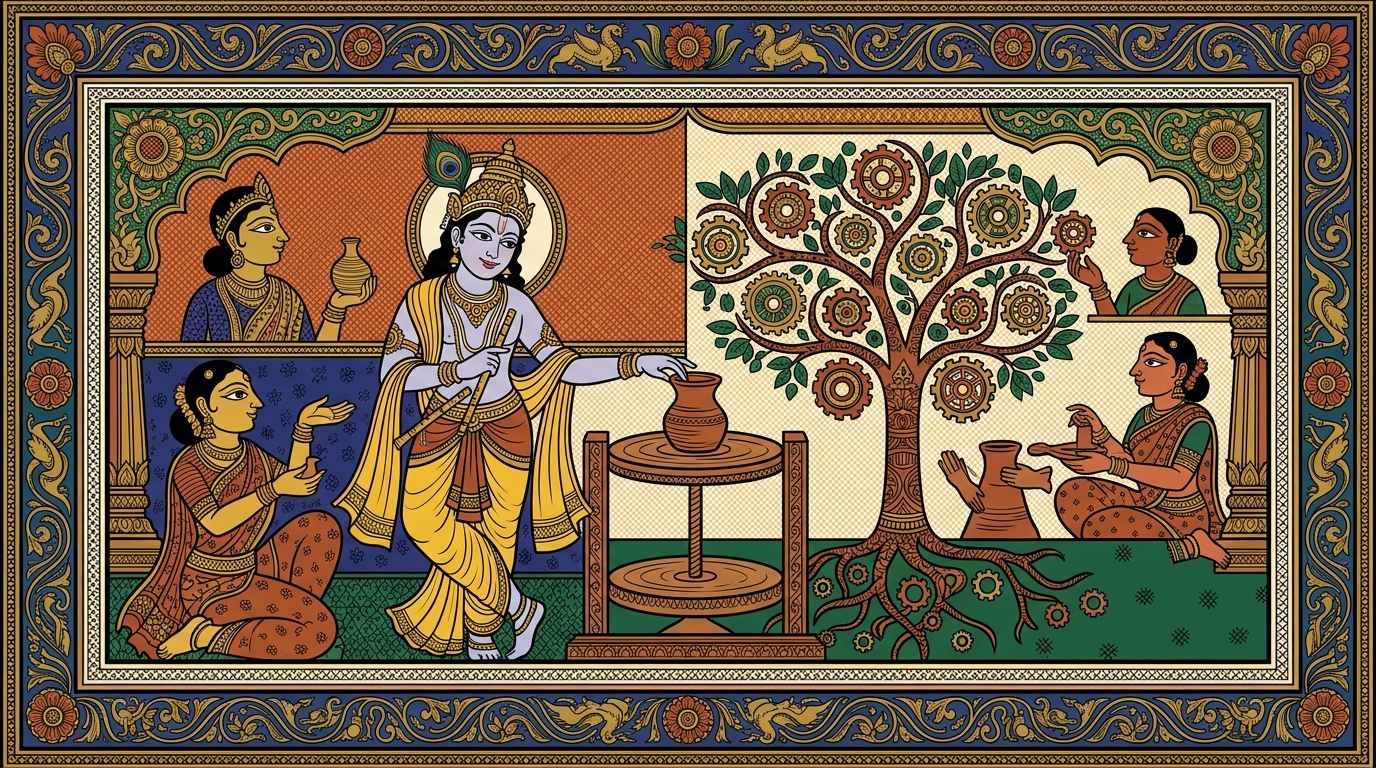
In a village by a slow brown river there lived an old potter named Kumbha,
famous for water pots so smooth and round that people said the moon must
have shaped them. A curious sage on his travels stopped to watch the old man
work, for the sage wished to understand how a single deed comes to be.
"Teach me, potter," said the sage, sitting in the doorway. "When you make a
pot, how many things are truly at work?"
Kumbha laughed and kept his wheel spinning. "More than you'd think for such
a humble cup," he said. "Watch, and I will count them for you."
"First," he said, "before my hands touch the clay, there is the knowing:
the craft my father taught me, how wet the clay must be, how fast to spin.
That is the knowledge." He tapped his head.
"Second, there is what I mean to make — this pot, round and deep, here in my
mind before it is in the world. That is the thing to be known, the goal."
"Third," he said, "there is me, old Kumbha, the one who knows the craft and
holds the goal. The knower. Without a knower, the knowing and the goal just
float, doing nothing."
The wheel hummed. A shape began to rise from the grey lump.
"Now the deed itself begins," Kumbha went on. "Fourth, my tools — the spinning
wheel, my wet fingers, the little wooden rib. The instruments. Fifth, the
work as it happens: the clay climbing, the walls thinning, the rim curling
over. The deed. And sixth," he lifted the finished pot and held it to the
light, "the doer, the hands that did it. Me again, but now acting, not just
knowing."
The sage counted on his fingers and smiled. "Three before, three during.
Knowledge, goal, knower, then tool, work, doer. Six quiet pieces in one
little pot."
"Aye," said Kumbha, setting the pot to dry. "And it is the same with every
deed under the sun, from making a pot to fighting a battle to speaking a
kind word. See the pieces, and you understand the whole. Then you act with
open eyes instead of stumbling about in the dark."