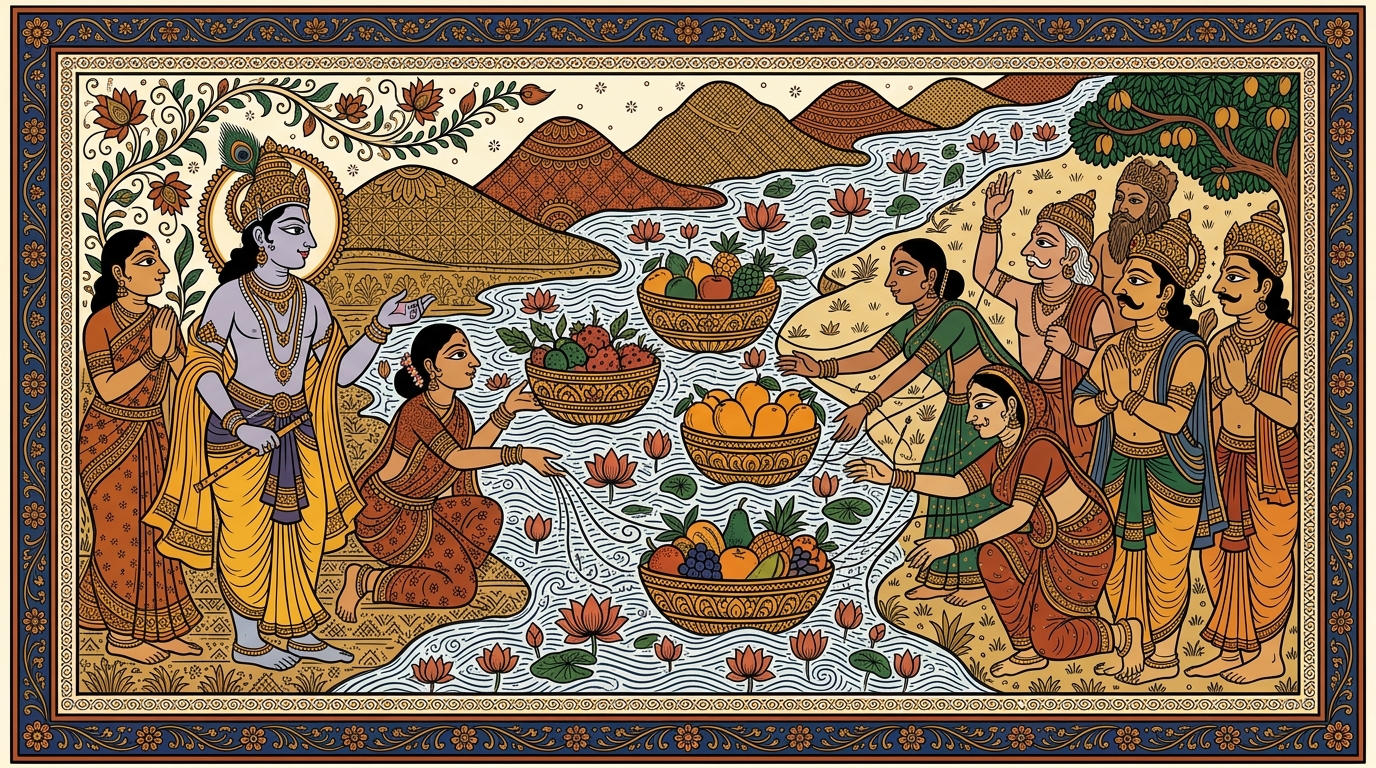
There was once a ferryman named Bandhu who carried people across a
wide, slow river. With every crossing, he was given something — a
coin, a basket of mangoes, sometimes only hard words from a tired
traveler. And Bandhu kept everything. Behind his little hut, he had
three great baskets.
Into the first basket he threw all his unwanted fruits: the insults,
the cheats who hadn't paid, the day a passenger spat at him. He
remembered every one, and they sat in the basket rotting and sour.
Into the second basket he piled all his wanted fruits: the praise, the
fat coins, the sweet mangoes. He counted them over and over, hungry for
more.
Into the third went the mixed days, half-good, half-bad, and these
confused him most of all.
Year by year, the baskets grew so heavy that Bandhu could barely
stand. He stooped under them even in his sleep, dreaming of debts owed
and praise deserved. The baskets had become part of him; he could not
set them down. The villagers said even after he died, his ghost still
crouched by the river, dragging three invisible baskets.
One day a wandering sage came to cross. He watched Bandhu groan beneath
his unseen load.
"Friend," said the sage, "why do you carry the past on your back?"
"These are my fruits," said Bandhu. "The bad I am owed, the good I have
earned, the muddled ones I cannot sort. They are mine."
"And they are crushing you," said the sage gently. "Listen. Row the
boat because the river needs crossing. Take what comes — sweet, sour,
or mixed — and then, each evening, tip all three baskets back into the
river. Keep none of it. Do the work; let the fruit float away."
That evening, trembling, Bandhu carried his three baskets to the
water's edge and tipped them in. The sour fruit, the sweet, the mixed —
all of it drifted off downstream and vanished. He stood up straight
for the first time in years.
The next morning he rowed lighter than the boat itself. Sweet days
came and went; sour days too; he no longer hoarded any of them. And
the old village tale changed: they said that when Bandhu finally
passed on, no ghost lingered at the river at all. There was nothing
left to drag.