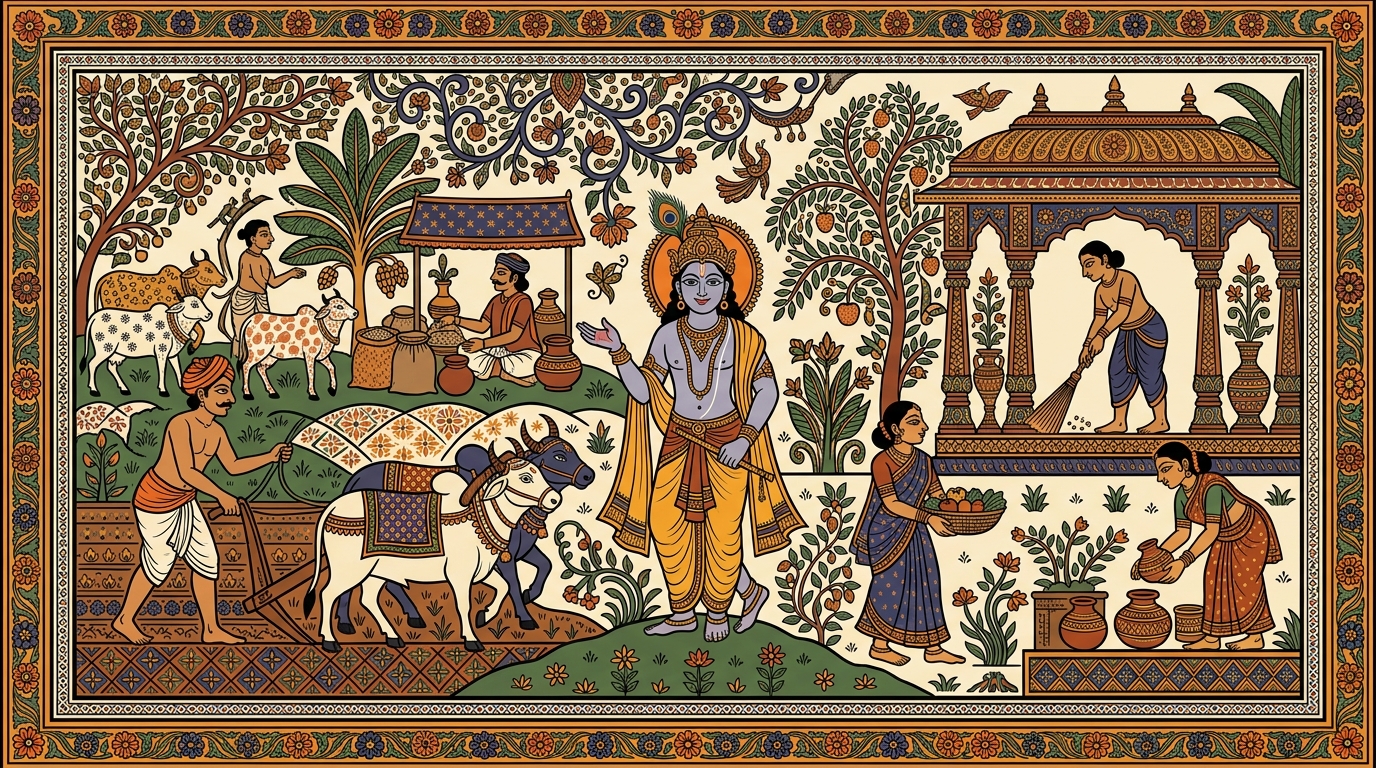
Hari Uncle's rice fields lay just outside Puri, green and shining after the
rains. Aarav had come to help for the morning, his feet sinking happily
into the cool mud.
"Why do you love this so much?" Aarav asked, watching Hari Uncle bend to
press a seedling into the wet earth. "It's hard work. Your back must ache."
Hari Uncle laughed. "My back does ache. But look." He swept his hand across
the field. "Every grain of rice in your lunch began as a seed someone
pressed into the mud, just like this. When I farm, I am feeding the whole
village — children I will never meet, eating bread I will never see. There
is no work I would rather do. It is the work my hands were made for."
Later, walking home, they stopped at Mohan's little shop near the temple
road. Mohan was weighing rice for an old woman, and Aarav noticed how
carefully he tipped a few extra grains onto the scale before tying the bag.
"You gave her more than she paid for," Aarav whispered when she had gone.
Mohan smiled. "Only a little. She walks far to get here. An honest shop
keeps good weights and a kind heart. Both, always. People trust me with
their money and their hunger. That trust is the most valuable thing on my
shelves."
Aarav thought about this all the way home. "Dadu," he said that evening,
"Hari Uncle grows the rice. Mohan sells it fairly. The man who carried it
on his cart, the woman who cooked it: everyone did a different job, and I
just... ate it."
Dadu nodded slowly, stirring his tea. "And one day you will do your own
job, and someone will eat the rice or read the words or sail the boat that
you made possible. There is no such thing as small work, Aarav. There is
only honest work and dishonest work. The farmer in the mud and the
shopkeeper at his scale and the helper who sweeps the temple steps — each
one is doing exactly the work their own nature gave them, and each one holds
up the whole village."
"So farming isn't better than selling, and selling isn't better than
helping?" Aarav asked.
"Not one bit better, and not one bit less," said Dadu. "A village where
everyone thinks their own job is too small for them is a village that
starves. Do your own work well, with honest hands, and you are doing
something holy, no matter what the work is called."