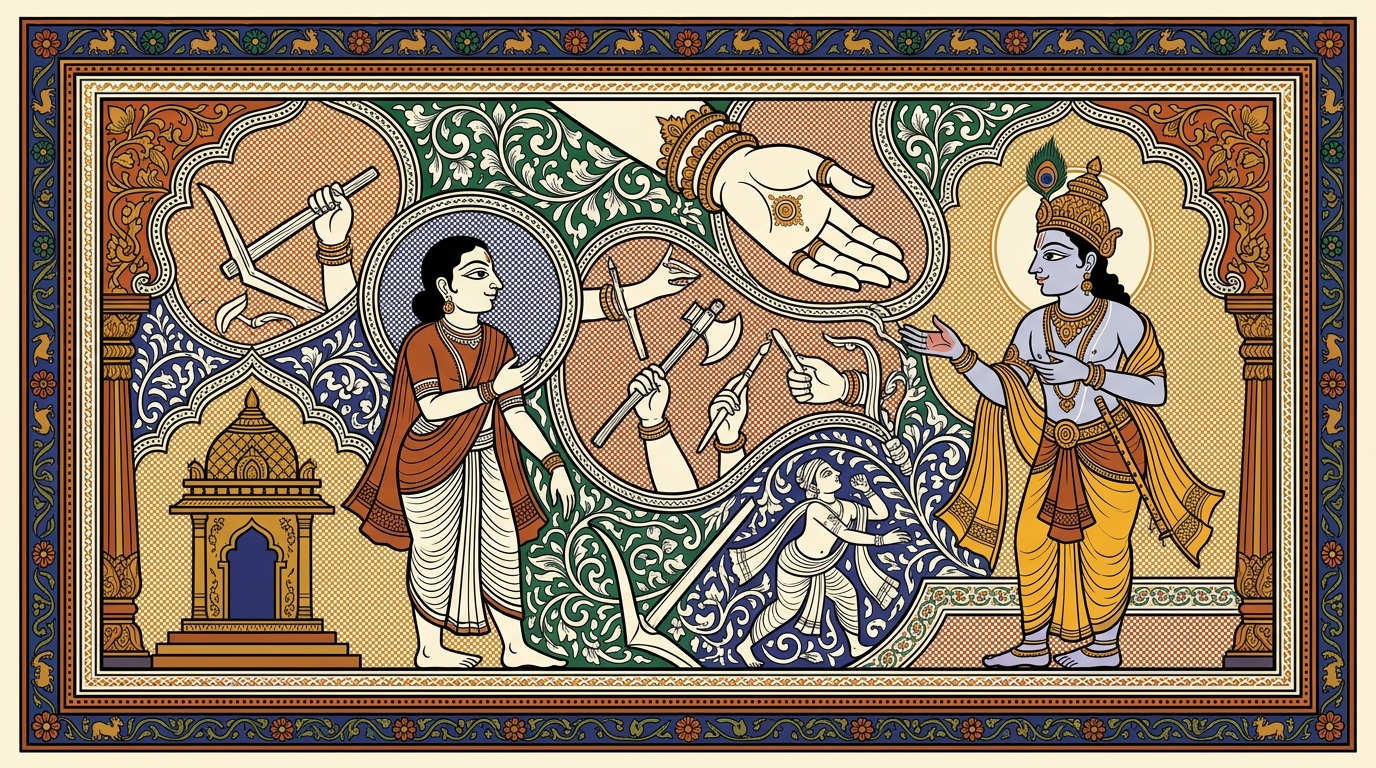
Long ago, before the great war, a young Arjuna stood in the forest clearing
where his teacher Drona trained the princes. He had just sent an arrow
flying clean through the eye of a wooden bird, and the other students
clapped and called his name.
Arjuna's chest swelled. "I did that," he thought. "My hand. My skill.
Mine alone."
Drona saw the look on his face and called him aside beneath a banyan tree.
"A fine shot," the teacher said. "Tell me, Arjuna, who made it?"
"I did, master," Arjuna answered at once.
Drona smiled and shook his head slowly. "Let us count," he said. He held up
one finger. "The first helper was the ground you stood on — firm and level.
Try shooting while sinking in mud, and see how proud you stay." A second
finger. "The second was you, the doer, with your steady hands and quiet
breath." A third finger. "The third was the bow and the arrow and the
bowstring — the tools, which others toiled to make." A fourth finger. "The
fourth was your effort, the thousand mornings you practised until your
fingers bled and healed and bled again."
Arjuna nodded, listening now instead of boasting.
Drona raised his thumb last of all. "And the fifth," he said gently, "is the
one we cannot name or hold: the will of the divine, the breeze that did not
blow, the bird that turned its head a heartbeat early. Five helpers, Arjuna.
Whatever you do, with your hands or your voice or your thoughts, whether it
flies true or falls short — all five are there."
The wind stirred the banyan leaves. Arjuna looked at his own hand, then at
the wide quiet forest around it.
"Then I cannot say the shot was mine alone," he said softly.
"No," said Drona. "And that is not a smaller truth, but a kinder one. The
proud man carries the whole world on one shoulder and breaks. The wise man
sees the five helpers and walks lightly. He aims with all his care — and
then he lets the arrow go."