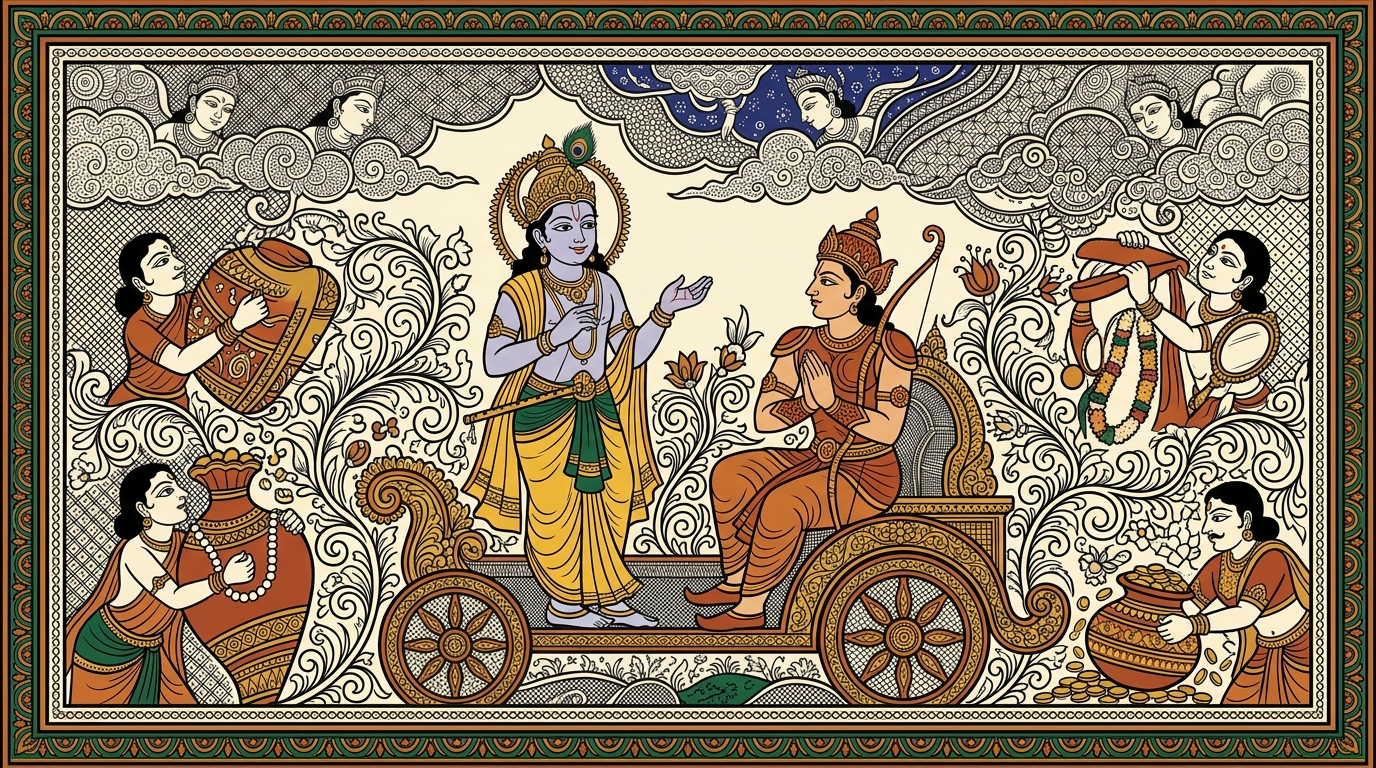
Before he became Arjuna's teacher, the master archer Drona once trained a
young charioteer named Sudeva, who had the strongest hands in the kingdom.
Sudeva could hold a team of four wild horses through a storm. Nobody doubted
his firmness.
But there was a thing about Sudeva. He never raced for the joy of it, nor
served for the love of his king. He held the reins so fiercely only because
of what each victory brought him — the prize purse, the praise of the crowd,
the gleaming gold cup raised over his head.
One day Drona set two races. In the first, a great festival, gold and glory
waited at the finish. Sudeva drove like a thunderbolt, gripping the reins
until his knuckles whitened, and he won. The crowd roared his name. He stood
taller than the temple.
In the second race there was no prize — only an old, sick villager who needed
to be carried swiftly to a healer in the next town. Drona asked Sudeva to
drive.
Sudeva's grip went slack. "There is nothing in it for me," he muttered. "No
cup. No crowd." Halfway there he slowed, then stopped to rest his horses,
then wandered off the road entirely, and the villager nearly did not make it.
Drona watched, and his face was grave. He called Sudeva to him afterward.
"Your hands are mighty," the teacher said. "But your firmness has a string
tied to it, and the other end of that string is held by a prize. Pull the
prize away, and your grip falls open. That is a restless firmness, my boy. It
looks like strength, but it is really hunger wearing strength's armour."
"Is wanting to win so wrong?" Sudeva asked.
"Wanting is not the whole of it," said Drona. "The question is whether you can
hold steady when there is nothing to win — when the only reward is that the
right thing was done. A true firmness keeps its grip in both races. Learn to
drive the second race as hard as the first, and then your hands will be worth
their strength."