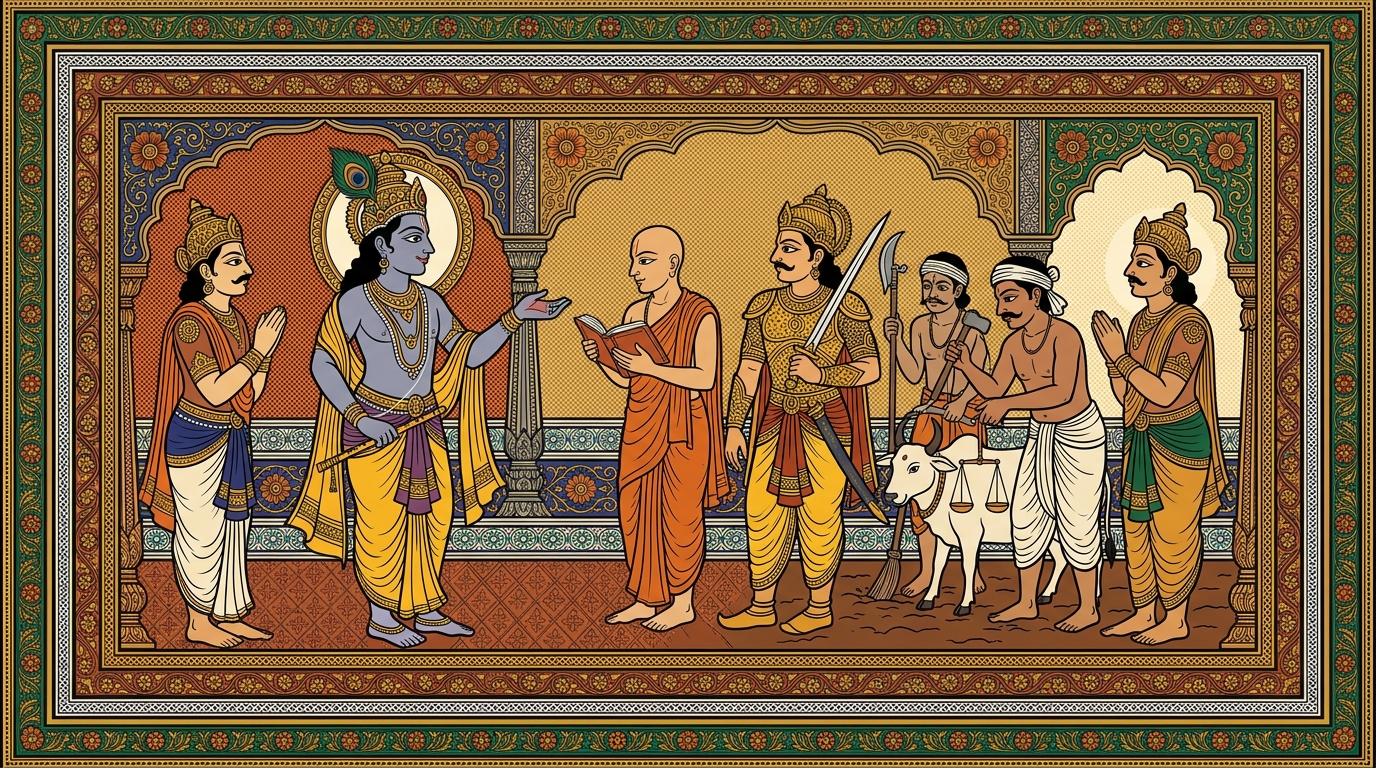
In a forest hermitage long ago lived the sage Gautama, who had four sons,
and from their earliest days each boy was clearly made of a different thread.
The eldest, Devadatta, loved nothing so much as quiet and questions. He would
sit for hours by the fire, asking his father what the stars were and why
truth mattered, memorising the old chants until they flowed from him like
river-water. His nature was calm and seeking.
The second, Virasena, could not sit still. He climbed the tallest trees,
faced down a leopard that strayed near the cattle, and stood between the
younger children and every danger. His nature was bold and protecting.
The third, Vasu, had a head for things and trades. He knew which fields gave
the best grain, kept the hermitage's cows fat and healthy, and could barter
cleverly with travelling merchants without ever cheating them. His nature was
practical and providing.
The fourth, Sukha, was the gentlest of all. He found his joy in helping —
fetching water, tending the sick, doing willingly the steady tasks that kept
the whole hermitage running. His nature was warm and serving.
One evening a visiting teacher watched the four boys and said to Gautama, "It
is strange — four sons of one father, raised in one place, and yet each is so
different."
Gautama smiled and stirred the fire. "Not strange at all," he said. "Each
child was born with his own mix of the three qualities of nature, and so each
leans toward his own kind of work. One seeks knowledge, one guards, one
provides, one serves. I do not push them into the same mould. I help each
become fully what his own nature already wants to be."
The teacher nodded slowly. "So the work is divided not by birth-name alone,"
he said, "but by what arises within."
"Just so," said Gautama. "The seeker, the guardian, the provider, the
server: the world needs all four, and each finds his peace by doing the work
his own nature gives him." And he looked at his four sons with equal love, for
he knew no thread was finer than another.