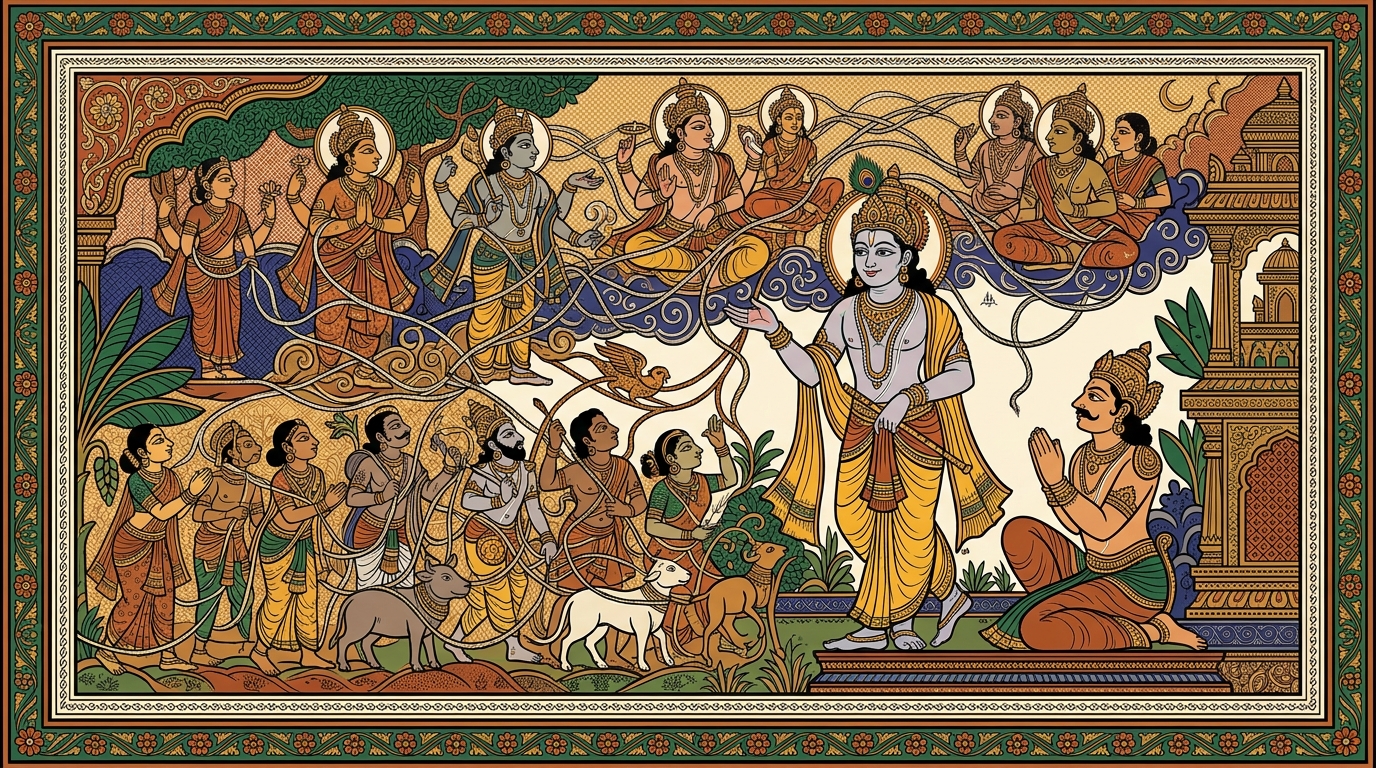
Long ago a young seeker named Suketu climbed into the mountains to find a
famous old weaver-sage who, it was said, understood the whole world as a
single great cloth.
He found her at her loom in a cave high above the clouds, working three
threads — one white and clear, one red and restless, one dark and heavy —
into everything she wove.
"Mother," Suketu said, bowing, "I have come to ask how I can become a perfect
being, free of all flaw, pure as the gods themselves."
The old weaver smiled and held up her cloth. "Look closely," she said.
"Every thread of this world is one of three: the white thread of clearness,
the red thread of restlessness, the dark thread of dullness. I weave nothing
without all three."
"Then weave me a cloth of the white thread only," said Suketu. "Pure light,
nothing else."
The weaver shook her head gently. "There is no such cloth, child. Not on the
whole earth. I have woven kings and farmers and beggars, oceans and ants. And not one of them is made of a single thread. Even up there —" she nodded
toward the sky "— the shining gods are woven of all three. No being anywhere,
on earth or in heaven, is wholly free of the three threads of nature."
Suketu's face fell. "Then no one can ever be perfect?"
"You misunderstand," said the weaver. "You cannot remove the threads. But
you can choose which thread to favour. Live so that the white thread runs
bright and the dark thread runs thin, and your cloth will be beautiful and
strong, though never made of one colour alone. That is the most any being can
do, gods included."
She set a small woven square in his hands, white-bright with only a faint
line of red and a thread of dark. "Be like this," she said. "Not pretending
the other threads are gone. Just letting the clear one lead."
Suketu went back down the mountain holding the little cloth, and for the rest
of his life, whenever he caught himself wishing to be flawless, he looked at
it and remembered: not flawless — clear.