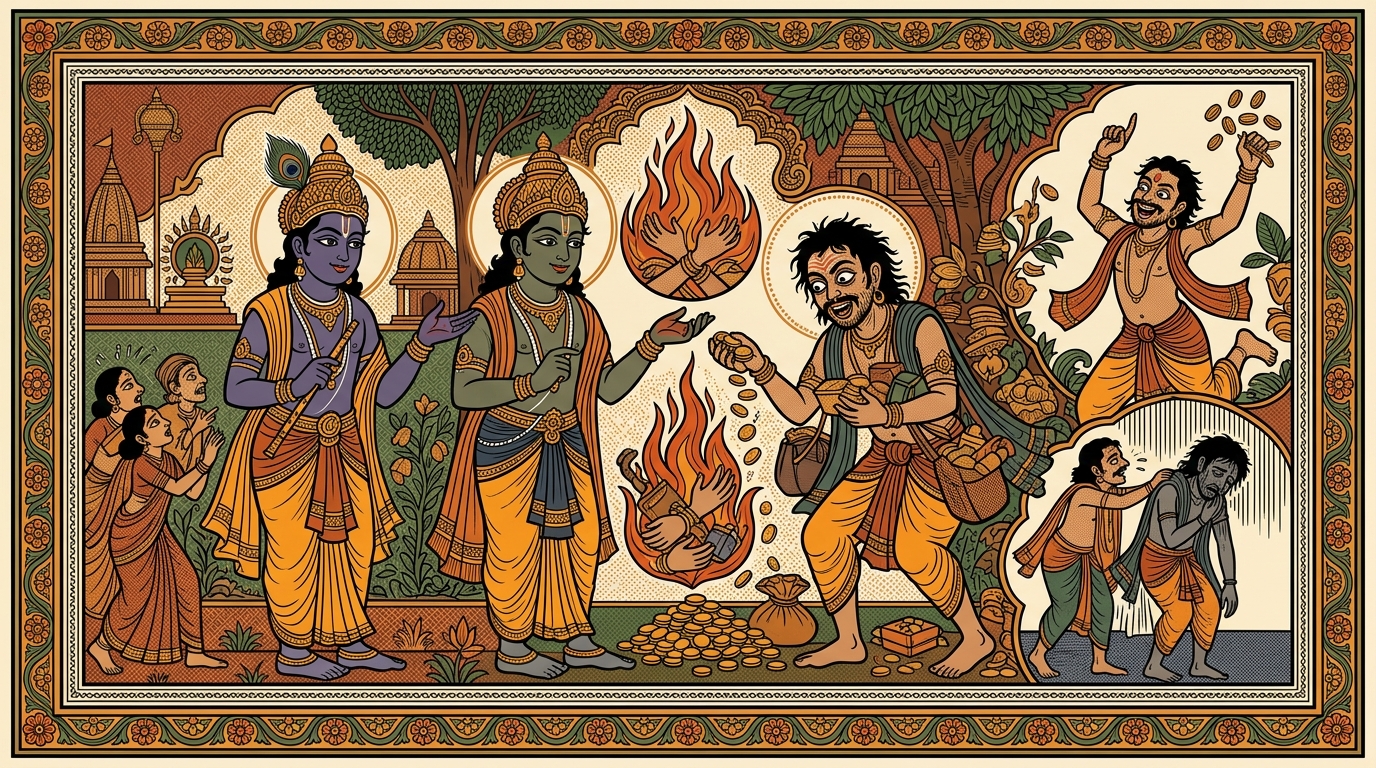
Among the many princes of the old kingdoms there was one named Subala,
famous not for his battles but for his hunger. He hungered for winning —
for prizes, for praise, for piles of gold — and the hunger never let him
rest.
When Subala set his heart on a thing, nothing else existed. He would
enter a chariot race and think of nothing but the laurel at the end. If a
rival's wheel ran close to his, Subala would crowd him toward the ditch,
careless of who got hurt, so long as he, Subala, crossed first. "The
prize is mine," he would mutter through clenched teeth. "Mine, mine."
And when he won — oh, how he soared! He would leap and roar and feast for
days, drunk on his own glory, certain he was the greatest man alive. The
whole palace had to celebrate or feel his temper.
But the wheel of fortune turns. One season Subala lost a great wager. In
a single afternoon his joy curdled into black despair. He would not eat.
He would not speak. He tore at his clothes and wept and swore the gods
had cheated him, and his gloom hung over the palace like smoke. Where his
joy had been wild, his grief was bottomless, and both came from the very
same place: his desperate clinging to results.
An old minister who had served three kings watched the prince swing from
feast to fury and back again, year after year.
"Look at him," the minister said quietly to a young attendant. "He is
never simply himself. When he wins, he is too high to touch the ground.
When he loses, he is too low to lift his head. He grasps at every prize
as if his life depended on it, and so every prize and every loss owns
him in turn. He is the busiest man in the kingdom, and the least free."
"What does he lack, master?" asked the attendant.
"Stillness," said the old man. "He has never once done a thing for the
sake of doing it well. Only for the winning. And the winning, like the
tide, always goes back out, and takes his peace with it every time."