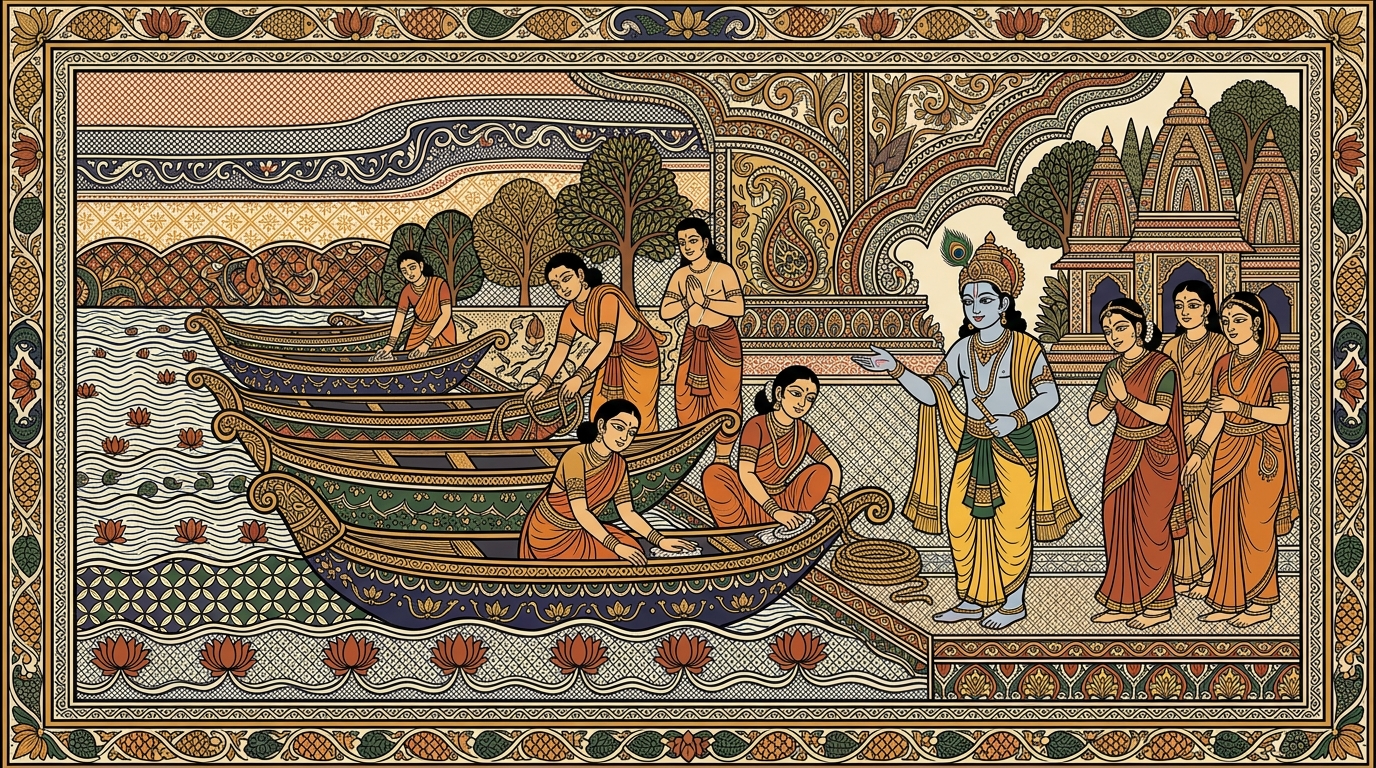
A storm had passed in the night, and morning at the Puri harbour looked
like the sea had thrown a tantrum. Seaweed lay tangled across the sand.
The wooden boats were caked with mud and grit, their decks slick with
salt and slime. Most of the fishermen were still asleep, exhausted from
holding their nets through the wind.
Aarav came down early to look at the waves. He had no boat of his own.
Nobody had asked him to do anything. He could have skipped stones and
gone home for breakfast, and no one would have known the difference.
But the boats were a mess.
So he found a stiff coconut-husk brush behind Dadu's shed, filled a
bucket from the freshwater pump, and started scrubbing the nearest hull.
It was hard, boring work. The grit got under his nails. His knees ached
on the wet sand. There was no prize at the end, no one watching, no
coins waiting.
Halfway through the third boat, his friend Manoj wandered over, eating a
guava.
"Whose boat is that?" Manoj asked.
"I don't know. Madan-chacha's, I think."
"Is he paying you?"
"No."
Manoj frowned. "Then why are you doing it? It's not even your boat. And
this one's so ugly — why not just do the nice new one over there? People
would notice that."
Aarav kept scrubbing. He thought about it for a moment, then shrugged.
"The boats need cleaning. I'm here. That's all." He didn't pick the
pretty boat or skip the ugly one. He just cleaned whichever one was in
front of him, the way you wash your own hands without wondering whether
they deserve it.
Manoj watched for a while. Then, without a word, he set down his guava,
grabbed a second brush, and knelt at the next boat.
By the time the fishermen woke and stumbled down to the shore, the whole
line of boats sat gleaming in the early light, ready for the sea. Madan-
chacha looked around in astonishment and asked who had done it.
Aarav had already gone home. He never did find out that the village
talked about it for a week. He hadn't done it to be talked about. He had
done it because it needed doing, and he was there, and that was reason
enough.