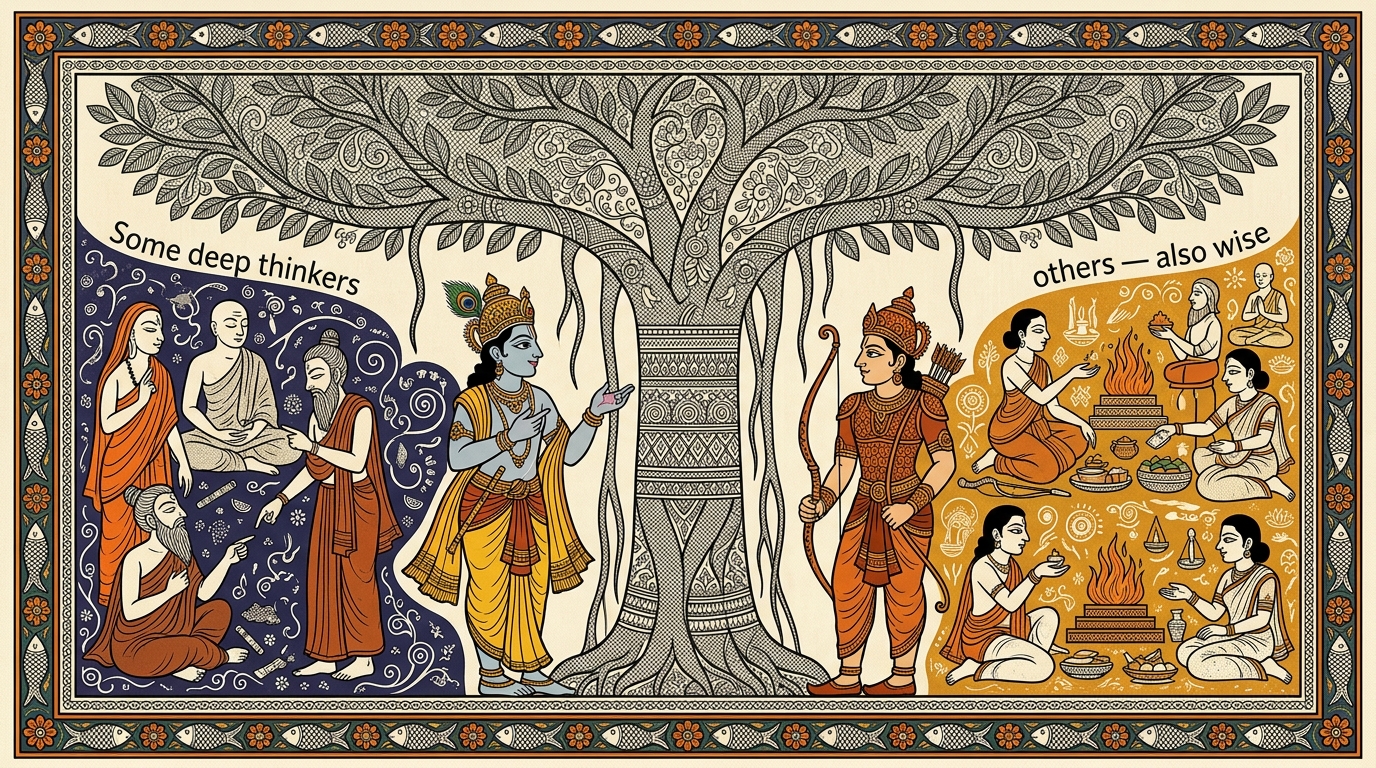
Long ago, beneath an enormous banyan tree whose roots hung down like a
forest of ropes, a group of sages gathered to settle a question. They came
from far hermitages, their beards white, their eyes bright, and they could
not agree.
"Action is the trouble," said the first sage, tapping the earth with his
staff. "Every deed leaves a mark. Light a fire and you make smoke. Walk
the road and you crush the ants beneath your feet. Even the kindest act has
a hidden cost somewhere. Since no action is ever perfectly clean, the
safest path is to give up all action, the way one would refuse a fruit
that has a worm inside."
Several sages nodded gravely. But a second sage rose, and he shook his
head.
"If we give up all action," he said, "do we also give up feeding the
hungry? Do we stop the sacred fire that the whole village gathers around?
Do we cease our prayers, our gifts to the poor, our quiet discipline at
dawn? Surely not! These actions, sacrifice, giving, and self-discipline,
are the very ones that make a person purer, not dirtier. To abandon them
would be like throwing away the broom because the floor keeps getting
dusty."
Now other sages nodded too, and the grove filled with voices, some on one
side, some on the other, until the parrots in the banyan flew off in
alarm.
Far away, on a quiet battlefield, Krishna told Arjuna of this very
disagreement. "You see," he said, "even the wise stand on two sides of
this question. One group says: action is flawed, let it all go. Another
says: never let go of the good and holy actions. I tell you both, Arjuna,
so that you know the question is real, and not a small one. Hear them
both, and then I will tell you what I myself have decided is true."
Arjuna listened, and for once he was glad he was not the only one who had
ever been confused. Even great sages, he saw, could stand under the same
tree and reach for different fruit.