Aarav did not want to learn to swim.
The sea at Puri was too big, the waves too loud, and the first morning Dadu
walked him into the shallows, the cold water grabbed his legs and the salt
stung his eyes and a wave knocked him flat onto the sand. He came up
spluttering and furious.
"This is horrible," he announced. "I hate it. Swimming is poison."
Dadu, standing waist-deep with the calm of a man who had spent fifty years
on the water, only nodded. "Yes," he agreed cheerfully. "At the start, it is.
Almost everything worth knowing tastes like poison at the start."
Aarav glared at him. "Then why would anyone do it?"
"Because of how it ends," said Dadu. "Come. One more time."
So Aarav came back, and the next day, and the day after that. Each morning
began with the same cold, the same swallowed mouthful of seawater, the same
burning eyes. He thrashed. He sank. He grew tired and cross. But Dadu was
patient, and Aarav was stubborn, and slowly his arms learned the rhythm and
his breath learned to wait.
Then came the morning it changed.
He pushed off from Dadu's hands, expecting to sink — and he did not sink. The
water held him up. He lay on his back with the sky enormous and blue above
him, the waves rocking him like a cradle, and a feeling spread through his
whole body that was quieter and bigger than any sweet had ever given him. He
was floating. The thing that had felt like poison had turned, somewhere along
the way, into something like nectar.
"Dadu!" he shouted, laughing, water in his ears. "I'm doing it! It feels —
it feels wonderful!"
Dadu waded over, grinning. "Now you know the best kind of happiness," he
said. "It is bitter at the door and sweet in the room. It is born not from a
quick taste, but from a mind that grew quiet and steady through practice.
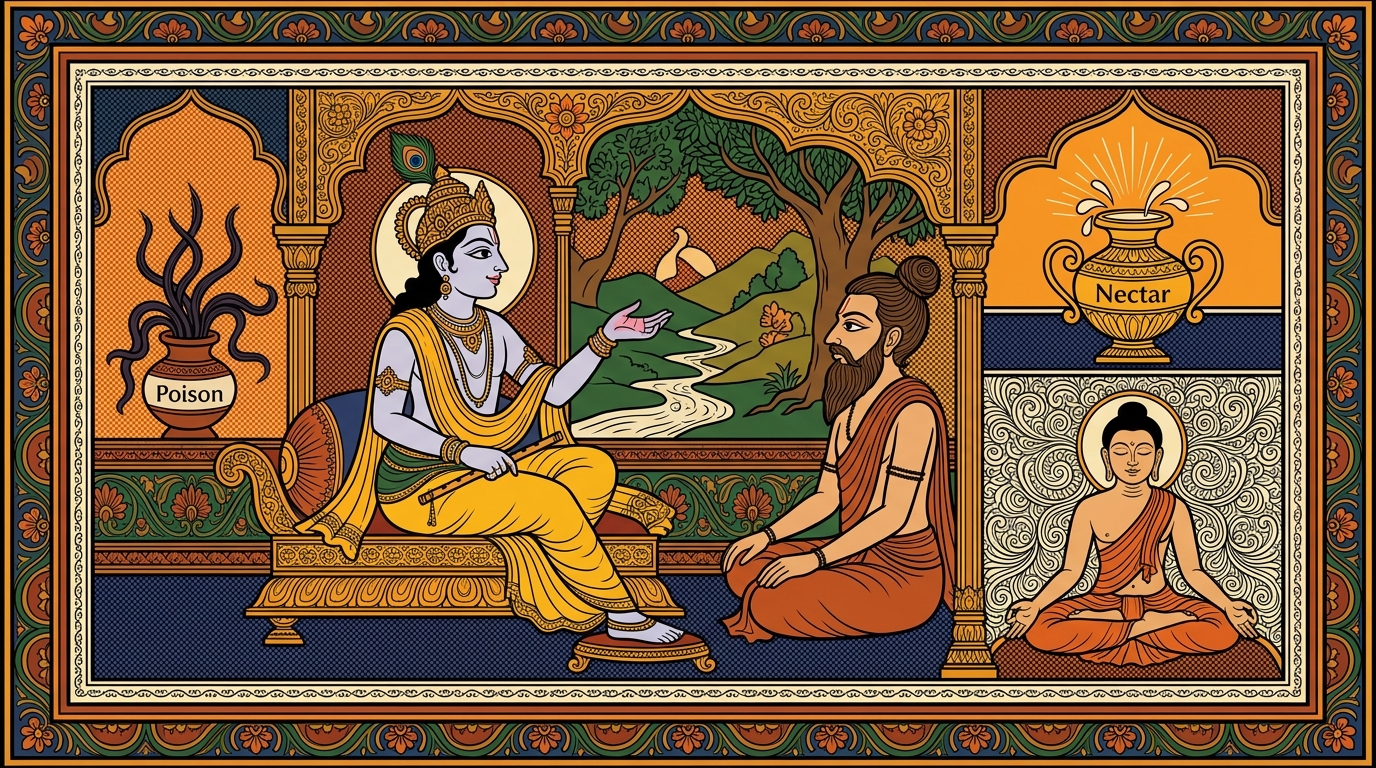
Krishna called such joy the highest of the three — the one that begins like
poison and ends like nectar."
Aarav floated, and the sea held him, and he understood.