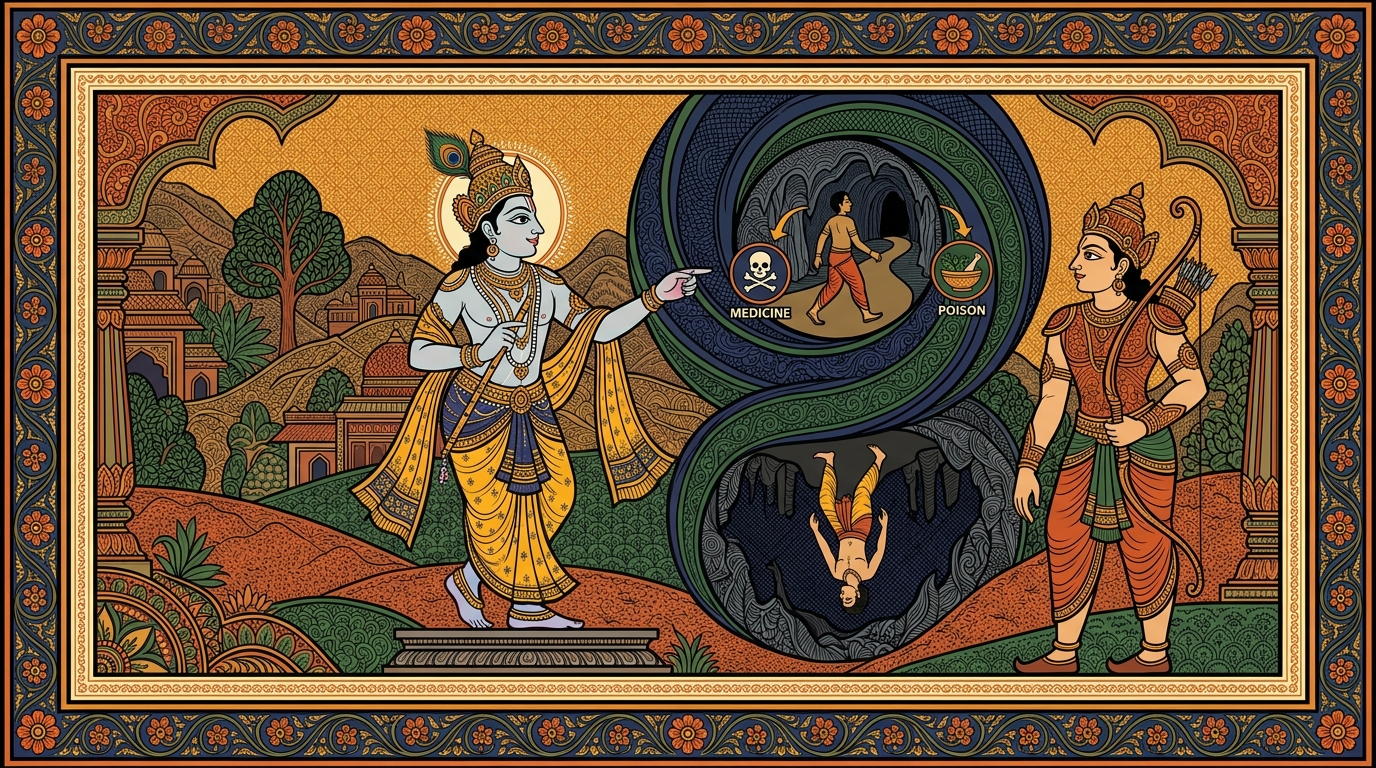
There was once a demon named Vatapi who lived with his brother in a deep,
sunless cave. The cave was famous for a strange and frightening thing:
travellers who wandered too far inside came out changed. They would walk
backwards thinking they walked forward. They would call the cold fire and
the fire cold. The deepest dark, they swore, was the brightest light.
A young traveller named Sumati heard of the cave and laughed. "A mind is a
mind," he said. "Nothing can flip what I plainly see." And he went in to
prove it.
For a while he kept his bearings. But the cave was patient. The darkness
crept into him slowly, like cold water filling a boat through a tiny crack.
Soon he passed a clear, sweet spring and thought, "Poisoned — I must not
drink." He passed a snake coiled to strike and thought, "A rope, harmless,"
and reached out his hand.
Worst of all, he no longer knew anything was wrong. He felt sure. He felt
clever. Every backward step felt like progress.
Outside the cave sat an old sage named Agastya, who had come to help any
soul wise enough to call out. He heard Sumati stumbling somewhere within,
cheerfully announcing all the wrong things as right.
"Sumati!" the sage called. "Stop walking. Just stand still and listen to my
voice."
The traveller froze. Some small true part of him, not yet swallowed by the
dark, heard the call.
"When your own mind tells you that down is up and harm is help," Agastya
called gently, "do not trust your certainty. The most lost person is the one
who is sure he is found. Follow my voice out, one slow step at a time, and
do the opposite of whatever your turned-around mind insists."
Step by careful step, doubting himself now, Sumati came out into the
daylight. He blinked, and the world stood upright again: the spring sweet,
the snake dangerous, the sun warm and high.
"I was so sure," he whispered, trembling.
"That is the dark mind's deepest trap," said Agastya. "Not that it cannot
see, but that it feels most certain exactly when it is most wrong. The way
out is to listen — to a teacher, to the wise, to that small honest voice
that never quite goes out."