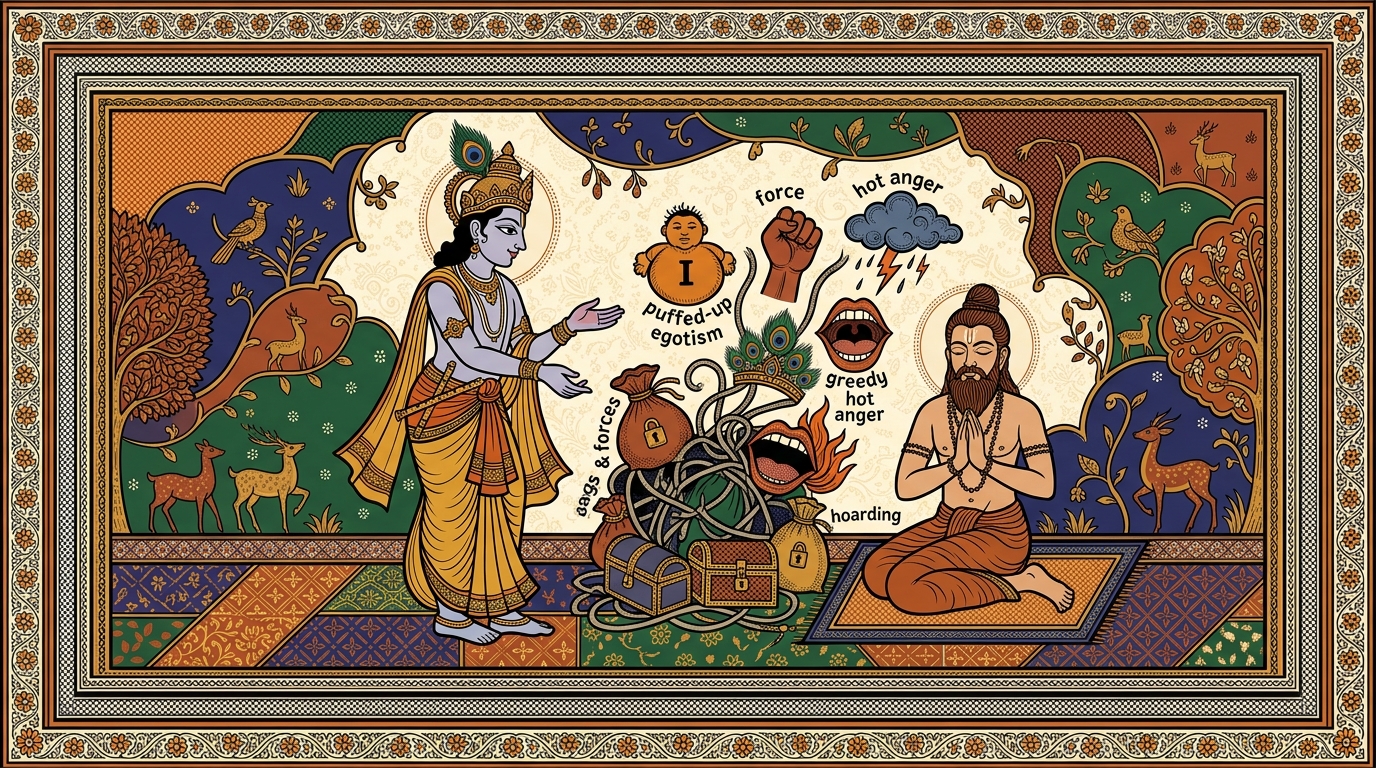
There was once a wandering sage named Pippalada who came down from the
mountains to cross the great plains and reach the holy river. On his back he
carried an enormous bundle, lumpy and bulging, tied with many knots. It was so
heavy that he stooped under it and could barely walk.
At the first village, a child asked, "Holy one, what is in your big bundle?"
Pippalada wiped his brow. "Ah," he sighed, "let me show you, for I have carried
it so long I had almost forgotten." He untied the first knot and pulled out a
great brass mirror. "This is my Ego — I stop at every pond to admire myself."
He set it down by the road. "Take it, if anyone wants it. I am tired of it."
He untied the next knot. Out came a heavy iron club. "This is Force — I used to
shove and shout to get my way." He laid it down. Then a peacock-feather crown:
"Arrogance — I loved to be praised." Down it went. Then a sticky pot of honey
that he could never stop licking: "Craving — always wanting more." Down. Then a
hissing coal he kept in a clay jar: "Anger — it burned my own hands most of
all." He buried it in the sand. Then a tangle of ropes and locks and keys:
"Grabbing and hoarding — clutching at things and calling them mine." He let the
whole tangle fall.
With each thing he set down, Pippalada stood up a little straighter. By the time
the bundle was empty, he stood tall and easy, breathing the open air, smiling
like a man twenty years younger.
The child stared. "Now your bag is empty. Aren't you sad?"
"Sad?" laughed Pippalada. "Child, I am free. A heart that says 'mine' about
nothing has room for everything. A heart with no anger, no greed, no proud
'I' is so quiet that the great Spirit can move through it like wind through an
open door." He bowed to the child and walked on toward the river — light,
peaceful, and at last ready for what waited at the end of the road.