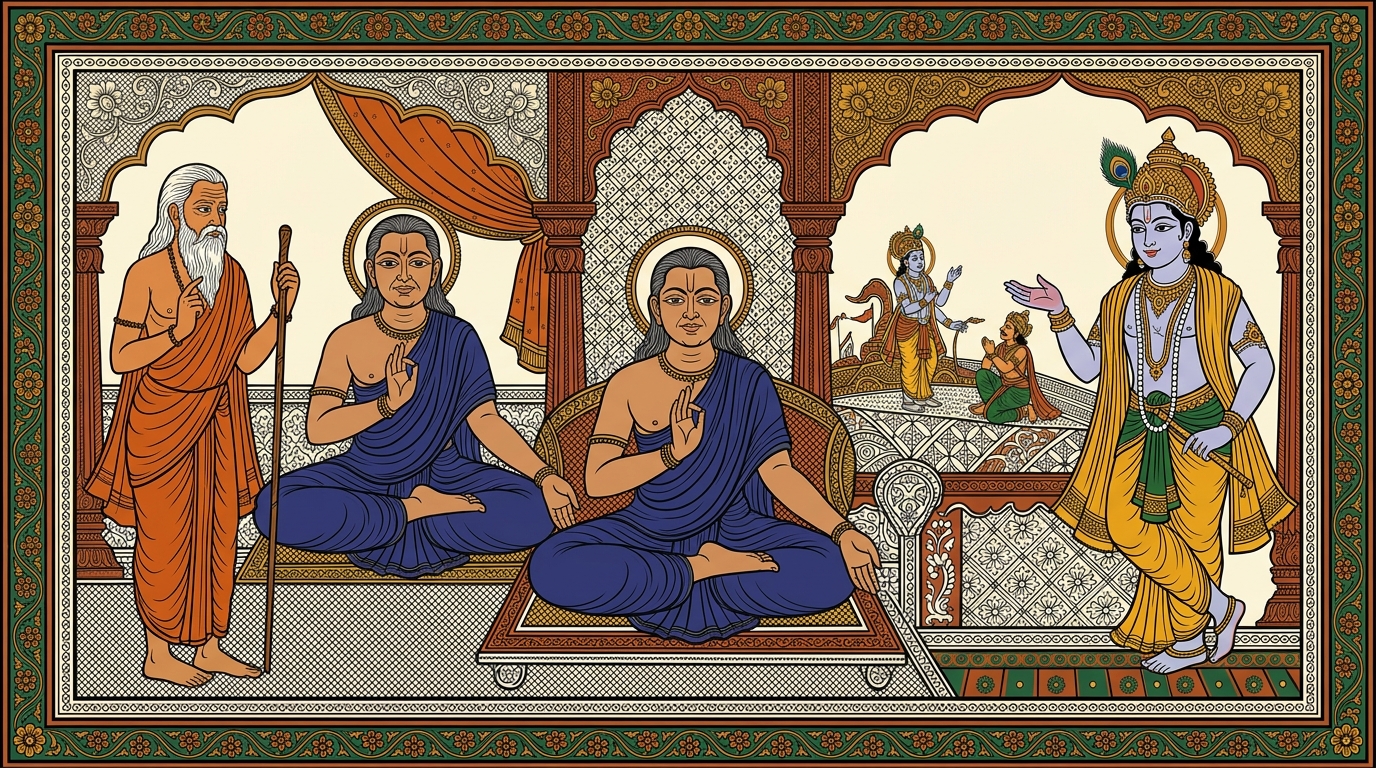
Before the war began, the great sage Vyasa had come to the blind king
Dhritarashtra. Vyasa was no ordinary sage — he was the one who had
arranged the ancient Vedas, the grandfather of the whole quarrelling
family, a man whose eyes seemed to look straight through time.
"A terrible war is coming," Vyasa told the king gently. "If you wish, I
can give you eyes to see it."
But Dhritarashtra shook his head. "I have never seen anything in my whole
life," he said. "I do not want my first sight to be the sight of my sons
dying. Do not give these eyes to me."
So Vyasa turned instead to Sanjaya, the king's loyal companion. Resting a
hand upon him, the sage said, "Then let Sanjaya see. From wherever he
sits, he will behold the entire field — every warrior, every weapon,
every word spoken. Whatever happens, near or far, in light or in
darkness, nothing will be hidden from him. This is my gift."
And so it was. While the great host clashed and roared in the distance,
Sanjaya sat quietly by the king and watched it all unfold in his mind's
eye, true and clear.
That gift was why Sanjaya could now say what he said. He had not been
told the story later by a tired soldier. He had not pieced it together
from rumours drifting back from the field. He had been there, in spirit,
standing as if upon the chariot itself.
"Think of it, O King," Sanjaya marvelled. "By Vyasa's kindness, I heard
the supreme secret with my own ears. Not from a messenger. Not from a
poet singing of it years afterward. I heard the highest yoga spoken
aloud by Krishna, the Lord of yoga Himself, in His very own voice, as
the words left His lips."
Sanjaya pressed his hands together. A teacher's grace had given him eyes
to see and ears to hear. And what those ears had caught was the rarest
thing in all the worlds: the truth, spoken plainly, by the one who knew
it best.