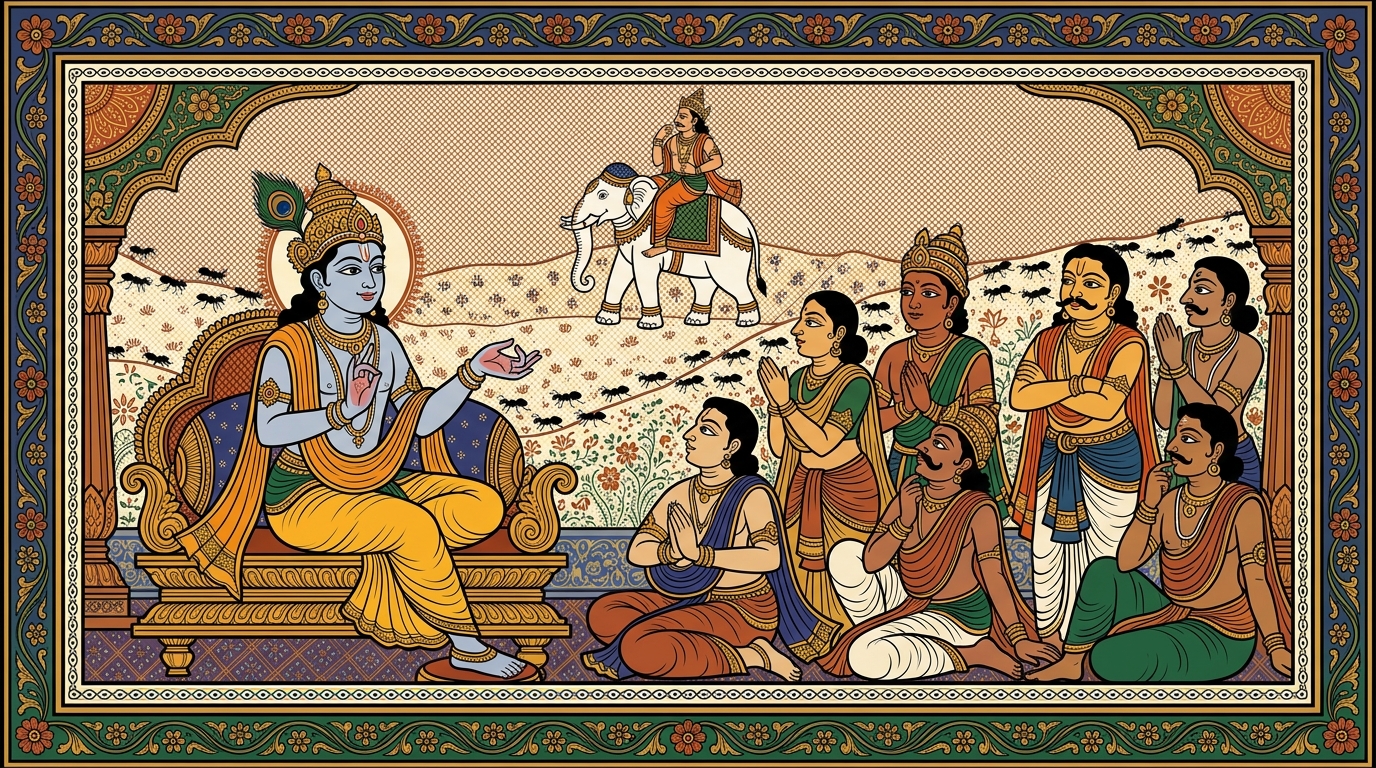
In the old tale, King Indra, ruler of the gods, grew very proud. He had
built himself a palace of gold and jewels, and he believed there had never
been, and never would be, anyone as great and as separate and as special as
himself. He saw the worlds spread below him as a great crowd of small,
scattered beings, and high above them all, alone and shining, stood Indra.
To cure his pride, Lord Vishnu came to him disguised as a curious boy. As
they spoke, a long line of ants came marching across the marble floor of the
palace.
The boy began to laugh.
"Why do you laugh?" demanded Indra.
"At the ants," said the boy gently. "For each of those ants, O King, was once
an Indra, just like you. Each sat on a golden throne and thought, 'I am the
one, separate and grand, above all the rest.' Each saw the world as a crowd
of little strangers and himself alone at the top. And one by one, age after
age, they fell and were born again — as ants in the long, long line you see
marching now."
Indra went cold. He looked at the ants, then at his golden hands, then at the
endless ants again.
"I thought I was so separate," he whispered. "I saw only the differences:
me up here, everyone else down there, all of us cut apart. I never once saw
what joins us."
"That seeing," said the boy, his form beginning to shimmer into the great
blue shape of Vishnu, "is restless seeing. It counts and ranks and divides,
'this one and that one and that one,' and never rests, because separateness
is a lonely place. It is true that the ants are many. But you missed the one
light shining in every ant, and in you. That light has no high or low."
The proud king bowed his head, his golden palace suddenly small around him.
And from that day Indra looked at the marching line of creatures and, instead
of feeling above them, felt quietly among them — a little less grand, a great
deal less lonely.