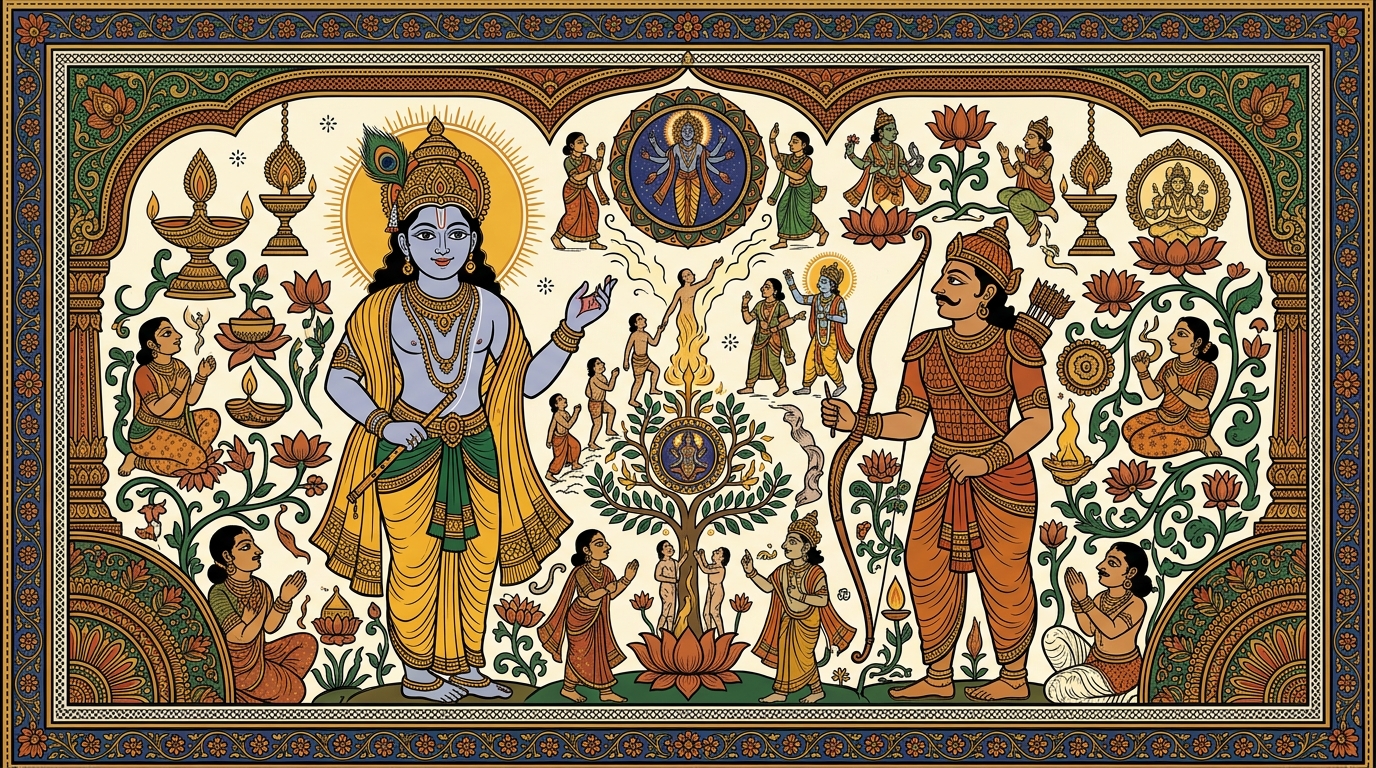
The Yoga of the Eternal Spirit
अक्षरब्रह्मयोग
Arjuna asks big questions about life, death, and what happens after we leave this world. Krishna explains that whatever we think about at the very end of our life is where our heart truly goes. So if we practice remembering goodness and love every day, we carry that light with us always.
✶ Art Style: Pattachitra from Odisha Learn more
Pattachitra means "cloth painting" in Odia, and this art has been practised in Odisha for over a thousand years. Artists called chitrakars prepare their own canvases by layering cloth with a paste of chalk and tamarind seed gum, creating a smooth surface. Then they paint mythological stories using bold black outlines and vibrant natural colors. The most striking feature is the intricate border — three or four nested frames of flowers and geometric patterns surround every scene, like looking through decorated windows into the world of the gods.
Signature Elements
- • Bold black outlines with fine internal detailing
- • Multi-layered ornamental borders (3-4 nested frames)
- • Horror vacui — every space filled with patterns
- • Narrative panel compositions
Did you know?
Pattachitra artists traditionally make their own colors from natural materials — white from conch shells, red from a local stone called hingula, yellow from the urine of cows that eat mango leaves, and black from burnt coconut shells!
किं तद्ब्रह्म किमध्यात्मं किं कर्म पुरुषोत्तम। अधिभूतं च किं प्रोक्तमधिदैवं किमुच्यते॥
ArjunaArjuna is full of big questions and cannot hold them back. He asks Krishna: "What is Brahman, the great endless Spirit? What is the Self that lives inside me? What exactly is action? What is the world of changing things, and what is the world of the shining gods?" He wants to understand the truth behind everything he can see.
अधियज्ञः कथं कोऽत्र देहेऽस्मिन्मधुसूदन। प्रयाणकाले च कथं ज्ञेयोऽसि नियतात्मभिः॥
ArjunaArjuna keeps asking. "Who is the Lord of sacrifice, the one hidden behind every offering, and how does He live inside this body of mine?" Then he asks the deepest question of all: "When the time comes to leave this world, how do people with calm, steady minds keep You in their thoughts?" His heart is already reaching past the battle, toward what truly lasts.
अक्षरं ब्रह्म परमं स्वभावोऽध्यात्ममुच्यते। भूतभावोद्भवकरो विसर्गः कर्मसंज्ञितः॥
KrishnaKrishna begins to answer, one question at a time. "The Imperishable — the thing that never breaks or fades — is the supreme Brahman. Your own deepest nature, the part of you that never changes, is the Self. And action, called karma, is the great sending-forth that brings all living beings into the world." With clear, simple words, Krishna starts untying Arjuna's tangle.
अधिभूतं क्षरो भावः पुरुषश्चाधिदैवतम्। अधियज्ञोऽहमेवात्र देहे देहभृतां वर॥
KrishnaKrishna keeps answering. "The world of changing beings is everything that passes away. The shining cosmic Person is the world of the gods. And the Lord of sacrifice, the one who lives behind every offering, is Me, right here, inside this very body, O best of embodied ones." Krishna is telling Arjuna: the great One you are searching for is not far away. He is as close as your own heart.
अन्तकाले च मामेव स्मरन्मुक्त्वा कलेवरम्। यः प्रयाति स मद्भावं याति नास्त्यत्र संशयः॥
KrishnaNow Krishna answers Arjuna's hardest question — about the last moment of life. "Whoever, at the very end, lets go of the body while remembering Me, becomes one with My very being. Of this there is no doubt." Krishna speaks gently. Dying is not going away to some far place, he says; it is more like a drop slipping back into the sea it never really left. A heart that remembers love has nothing to fear.
यं यं वापि स्मरन्भावं त्यजत्यन्ते कलेवरम्। तं तमेवैति कौन्तेय सदा तद्भावभावितः॥
KrishnaKrishna shares a great secret. "Whatever a person thinks of at the very last moment, letting go of the body, that very thing is what they become, O son of Kunti. For the mind goes where it has dwelt all along." In other words: the last thought is not random. It is the one your whole life has been quietly practising. So fill your days with what you love most.
तस्मात्सर्वेषु कालेषु मामनुस्मर युध्य च। मय्यर्पितमनोबुद्धिर्मामेवैष्यस्यसंशयम्॥
KrishnaKrishna gives Arjuna a simple instruction with two halves at once: "So, at every moment, keep remembering Me, and also do your work, fight your battle. If your mind and your thinking both rest on Me while your hands stay busy, you will surely reach Me. There is no doubt about it." You do not have to choose between living your life and remembering God. You can do both together.
अभ्यासयोगयुक्तेन चेतसा नान्यगामिना। परमं पुरुषं दिव्यं याति पार्थानुचिन्तयन्॥
KrishnaKrishna explains how the remembering becomes strong: "With a mind trained by steady practice, a mind that no longer keeps wandering off to other things, and by thinking on Him again and again, a person reaches the supreme, shining divine Person." A mind is like a young horse. Left alone it runs everywhere. But trained patiently, day after day, it learns to run straight to one place.
कविं पुराणमनुशासितारमणोरणीयांसमनुस्मरेद्यः। सर्वस्य धातारमचिन्त्यरूपमादित्यवर्णं तमसः परस्तात्॥
KrishnaKrishna describes who to remember: the One who is the wise Seer, more ancient than anything, the gentle ruler of all; smaller than the smallest atom yet the supporter of the whole universe; whose true form no mind can fully picture; who shines like the sun and is beyond all darkness. He is both tinier than tiny and vaster than vast, and brighter than every shadow.
प्रयाणकाले मनसाचलेन भक्त्या युक्तो योगबलेन चैव। भ्रुवोर्मध्ये प्राणमावेश्य सम्यक्स तं परं पुरुषमुपैति दिव्यम्॥
KrishnaKrishna describes a person leaving the body well. At the moment of departure, with a mind that does not waver, full of love, and with the strength gathered from long practice, he settles his life-breath steadily at the point between the eyebrows, and so he reaches that supreme, shining divine Person. Death, for such a person, is not a falling but a calm walking home.
यदक्षरं वेदविदो वदन्ति विशन्ति यद्यतयो वीतरागाः। यदिच्छन्तो ब्रह्मचर्यं चरन्ति तत्ते पदं संग्रहेण प्रवक्ष्ये॥
KrishnaKrishna names the goal in three ways at once: "That which the knowers of the Veda call the Imperishable; that which seekers free from all craving enter into; that for the sake of which people live a life of discipline: that goal I will now tell you about, briefly." It is the changeless, deathless reality that the wisest people give their whole lives to reach.
सर्वद्वाराणि संयम्य मनो हृदि निरुध्य च। मूर्ध्न्याधायात्मनः प्राणमास्थितो योगधारणाम्॥
KrishnaKrishna teaches the simple steps for growing still: close the gates of the senses (let the eyes, ears and the rest grow quiet), gather the wandering mind and hold it gently in the heart, draw the life-breath up to the head, and rest there, settled in steady concentration. It is the way of drawing your attention inward and becoming calm and collected.
ॐ इत्येकाक्षरं ब्रह्म व्याहरन्मामनुस्मरन्। यः प्रयाति त्यजन्देहं स याति परमां गतिम्॥
KrishnaKrishna teaches the simplest of all practices. If, as you leave your body, you say the one sacred syllable "Om," the sound that holds the whole Eternal, and you keep Me in your heart, then you travel to the very highest place there is. One little sound, said with love, can carry you all the way home.
अनन्यचेताः सततं यो मां स्मरति नित्यशः। तस्याहं सुलभः पार्थ नित्ययुक्तस्य योगिनः॥
KrishnaKrishna gives Arjuna a gentle promise. For the one who remembers Me all the time, with a mind that does not wander off to other things, I am easy to reach. When someone keeps Me always in their heart, I am never far away: love makes the distance small.
मामुपेत्य पुनर्जन्म दुःखालयमशाश्वतम्। नाप्नुवन्ति महात्मानः संसिद्धिं परमां गताः॥
KrishnaKrishna explains the great fulfilment. The wise souls who reach Me have reached the highest perfection. For to reach Me is to wake up to being the changeless Self they always were. Nothing is left outside them to be pulled back, so they are not born again into this fleeting world, so often a house of sorrow. They have come home to their own true being, which does not change or end.
आब्रह्मभुवनाल्लोकाः पुनरावर्तिनोऽर्जुन। मामुपेत्य तु कौन्तेय पुनर्जन्म न विद्यते॥
KrishnaKrishna reveals something huge. Every world, even the shining realm of Brahmā the creator high above, comes back again — they all rise and fade and rise again, over and over. But the one who reaches Me, says Krishna, is not born again. My home is the one place that does not turn in that endless wheel.
सहस्रयुगपर्यन्तमहर्यद्ब्रह्मणो विदुः। रात्रिं युगसहस्रान्तां तेऽहोरात्रविदो जनाः॥
KrishnaKrishna stretches Arjuna's imagination wide. A single day of Brahmā the creator lasts a thousand ages, and his night lasts a thousand ages too. The people who truly understand this know how vast time is. Our days feel long to us, but to God they are smaller than the blink of an eye.
अव्यक्ताद्व्यक्तयः सर्वाः प्रभवन्त्यहरागमे। रात्र्यागमे प्रलीयन्ते तत्रैवाव्यक्तसंज्ञके॥
KrishnaKrishna paints the great rhythm of the worlds. When Brahmā's long day dawns, all beings stream out of the hidden Unmanifest into the visible world. When his long night falls, they melt back into that same hidden source. The whole universe breathes out and breathes in, just like this, again and again.
भूतग्रामः स एवायं भूत्वा भूत्वा प्रलीयते। रात्र्यागमेऽवशः पार्थ प्रभवत्यहरागमे॥
KrishnaThis same crowd of living beings is born, then melts away, then is born again, over and over. When the great cosmic night arrives, they all dissolve back into the unseen, helplessly, not by their own wish. And when the cosmic day dawns again, they come streaming back into being. Nobody chooses it; it simply turns, like a giant wheel, endlessly.
परस्तस्मात्तु भावोऽन्योऽव्यक्तोऽव्यक्तात्सनातनः। यः स सर्वेषु भूतेषु नश्यत्सु न विनश्यति॥
KrishnaBut beyond that unseen world, the one that beings melt into at the cosmic night, there is yet another Unseen, even higher, and it is eternal. It has always been and always will be. When every single being perishes, this one does not perish. It stands, changeless, while all else comes and goes.
अव्यक्तोऽक्षर इत्युक्तस्तमाहुः परमां गतिम्। यं प्राप्य न निवर्तन्ते तद्धाम परमं मम॥
KrishnaThat eternal Unseen is called the Imperishable, the one thing that never wears away. The wise say it is the highest goal of all. To "reach" it is not to journey to a distant home but to discover you were never apart from it — the way a wave discovers it was always the sea. Once that is known, there is nothing separate left to return to the wheel of birth and death. And Krishna says: that Imperishable is My own highest being.
पुरुषः स परः पार्थ भक्त्या लभ्यस्त्वनन्यया। यस्यान्तःस्थानि भूतानि येन सर्वमिदं ततम्॥
KrishnaThat supreme Person — in whom every single being lives and dwells, and who is spread through this entire universe like thread through cloth — can be reached in one way: by undivided love. Not love that wanders from this to that, but love that points only toward Him, whole and steady, like an arrow that never wavers.
यत्र काले त्वनावृत्तिमावृत्तिं चैव योगिनः। प्रयाता यान्ति तं कालं वक्ष्यामि भरतर्षभ॥
KrishnaNow, Arjuna, I will tell you about the times of departure. When yogis leave their bodies at one kind of time, they go and do not return. When they leave at another, they go and come back again. Listen, best of the Bharatas, and I will explain these two times: the road of no-return and the road that circles home.
अग्निर्ज्योतिरहः शुक्लः षण्मासा उत्तरायणम्। तत्र प्रयाता गच्छन्ति ब्रह्म ब्रह्मविदो जनाः॥
KrishnaKrishna names the markers of the bright road home: fire, light, the day, the bright half of the month, and the six months when the sun travels its northern course. Those who leave their bodies along this shining path, if they truly know Brahman, go to Brahman and do not come back. It is the road of light leading to the Light.
धूमो रात्रिस्तथा कृष्णः षण्मासा दक्षिणायनम्। तत्र चान्द्रमसं ज्योतिर्योगी प्राप्य निवर्तते॥
KrishnaKrishna names the markers of the dimmer road: smoke, the night, the dark half of the month, and the six months of the sun's southern course. A good yogi who leaves by this path reaches the gentle light of the moon, enjoys a long, happy rest there, and then comes back to be born once more. It is a beautiful road, but it loops around and returns.
शुक्लकृष्णे गती ह्येते जगतः शाश्वते मते। एकया यात्यनावृत्तिमन्ययावर्तते पुनः॥
KrishnaKrishna says these two roads, the bright and the dark, are the world's two everlasting paths. They have always existed and always will. By the bright road a soul goes home and never returns; by the dark road a soul goes to rest and then comes back again. Two roads, two destinations, woven into the world forever.
नैते सृती पार्थ जानन्योगी मुह्यति कश्चन। तस्मात्सर्वेषु कालेषु योगयुक्तो भवार्जुन॥
KrishnaKrishna tells Arjuna: a yogi who really understands these two roads is never confused or afraid, no matter what. Knowing where each path leads, his heart stays calm. So, Arjuna, at all times, in every moment, stay joined to your practice. Be steady. Be ready. That is how you keep peace inside you, today and always.
वेदेषु यज्ञेषु तपःसु चैव दानेषु यत्पुण्यफलं प्रदिष्टम्। अत्येति तत्सर्वमिदं विदित्वा योगी परं स्थानमुपैति चाद्यम्॥
KrishnaKrishna closes the chapter with a promise. There are many good rewards in the world: for studying the holy books, for worship, for hard and honest effort, for giving generously. But the yogi who truly understands all that Krishna has taught here goes beyond every one of those rewards, and reaches the supreme, first, original Home — the source from which everything began.