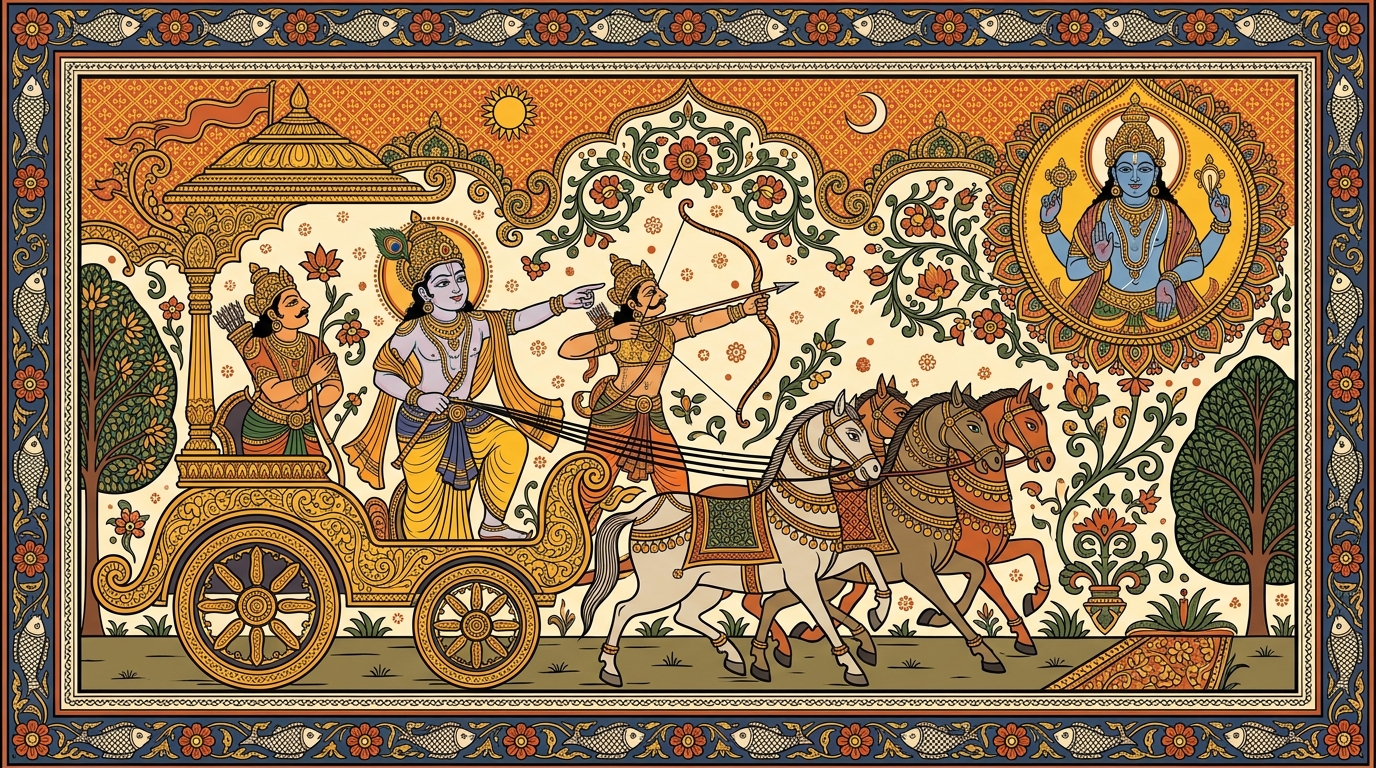
Long ago, in a hermitage at the foot of the snow-mountains, there lived
a young man named Suketu who wanted, more than anything, to keep his
mind on God. But his mind would not stay.
He would sit to meditate, and within three breaths he was thinking about
breakfast. He would picture the shining One in his heart, and suddenly
he was remembering a quarrel from two summers ago. His mind was like a
sparrow in a room with many windows — it flew to one, then another, then
another, never settling.
He went to the old teacher of the hermitage, a rishi with eyes like
still water. "My mind will not obey me," Suketu complained. "It runs
everywhere. How will I ever reach the Divine if I cannot hold one
thought for even a minute?"
The teacher took him to where the young men practised archery. A boy was
shooting at a wooden target far across the field. His first arrow flew
wide into the trees. His second landed in the grass. His tenth grazed
the target's edge. But he kept shooting, every dawn, every dusk.
"Come back in a year," said the teacher.
Suketu came back in a year. The same boy was shooting. Now every arrow
flew straight to the centre, one after another, as if the target pulled
them in. The boy was not even frowning with effort. His arms simply knew
the way.
"His arrows once wandered like your mind," said the teacher. "What
changed? Not magic. Only this — abhyasa. Practice. Again and again and
again, the same loosing of the same arrow, until the wandering wore away
and only the straight path was left. Your mind is no different. Sit
again tomorrow. And the day after. And a thousand days after that. Each
time it flies to a window, bring it gently back. One day you will find
it no longer flies away at all. It will go straight to the Shining One,
the way that boy's arrow goes straight to the heart of the target."
Suketu bowed. He went back to his seat under the deodar tree. His mind
flew to a window. He brought it back. It flew again. He brought it back.
And somewhere far ahead, a year, a decade away, an arrow was already
learning to fly straight.