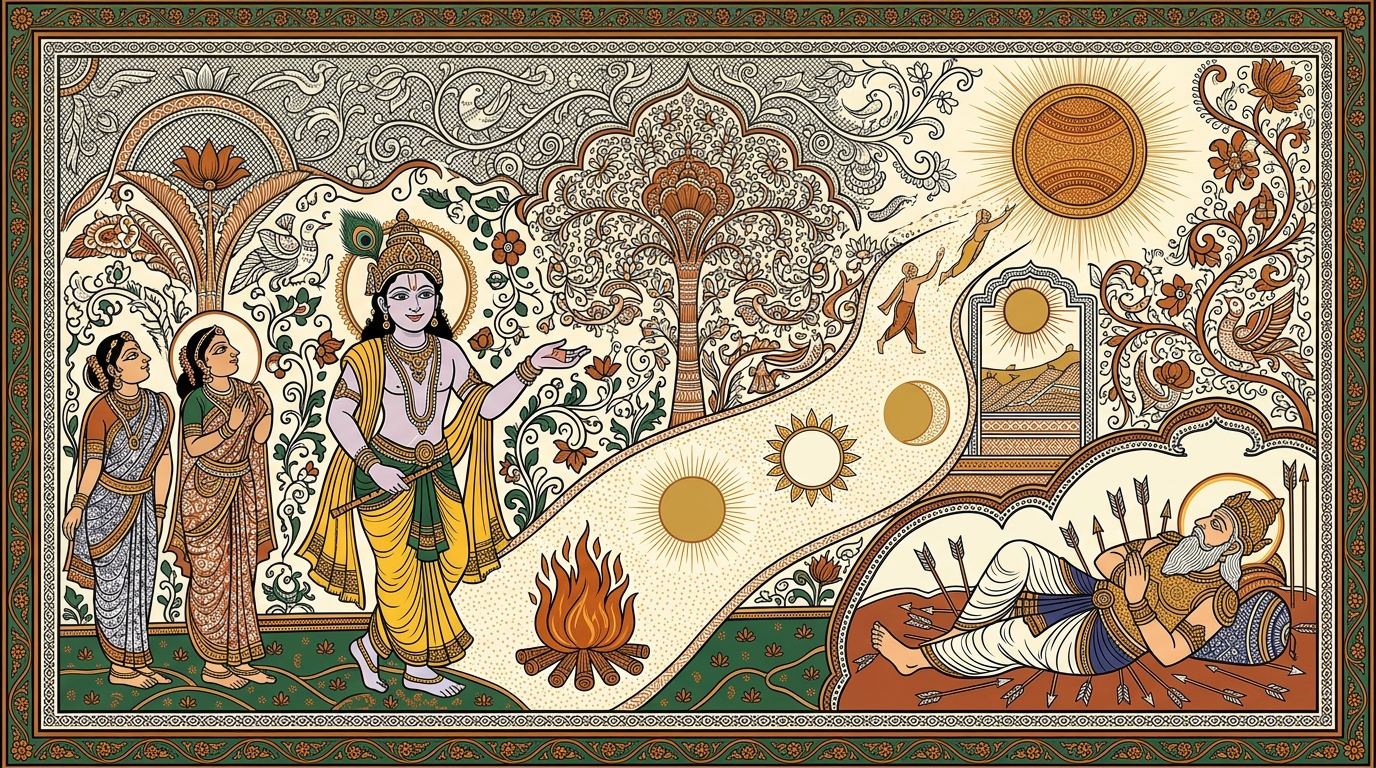
The great war was over. The field of Kurukshetra was quiet now,
and on a bed unlike any other in the world lay Bhishma — the eldest,
the grandfather of both armies, pierced through with so many arrows
that he rested upon their shafts as if upon a thousand needles. The
points held him a hand's width above the earth.
He was not dead. He could not die — not yet. Long ago, as a young
prince, Bhishma had been granted a rare gift: he alone would choose
the hour of his own death. And he had chosen.
"I will not go now," he told the kings and warriors who gathered
around his strange bed. "The sun still travels its southern road.
The days grow short and the dark gathers early. I will wait."
They brought him water — Arjuna shot an arrow into the ground beside
his head, and a clear cold spring rose up to meet the old man's lips.
They brought him soft words and tears. But Bhishma only looked at the
sky, watching, counting the days.
"Why do you wait, grandfather?" young Yudhishthira asked, his eyes wet.
Bhishma smiled through his pain. "There is a road for the departing,"
he said, his voice slow but steady. "A bright road — marked by fire
and light, by the open day, by the brightening half of the moon, and
above all by the six months when the sun climbs northward. Those who
leave by that road, with God held in the heart, go to the Boundless and
do not return to be born again. I have lived long. I will leave by the
light, not the dark."
And so the grandfather waited. Fifty-eight days he lay upon the arrows,
teaching everything he knew — duty, kindness, the secret of a quiet
mind — to all who would listen. Each dawn he checked the sun's slow
march across the heavens.
At last the morning came. The sun turned and began its northern course;
the bright fortnight opened like a flower; the day was clear and full of
light. Bhishma felt it the way you feel spring arrive. He gathered his
breath, fixed his thought upon the Lord, and let his arrows release him.
He had waited a lifetime, then a little longer — to go home by the road
of light.