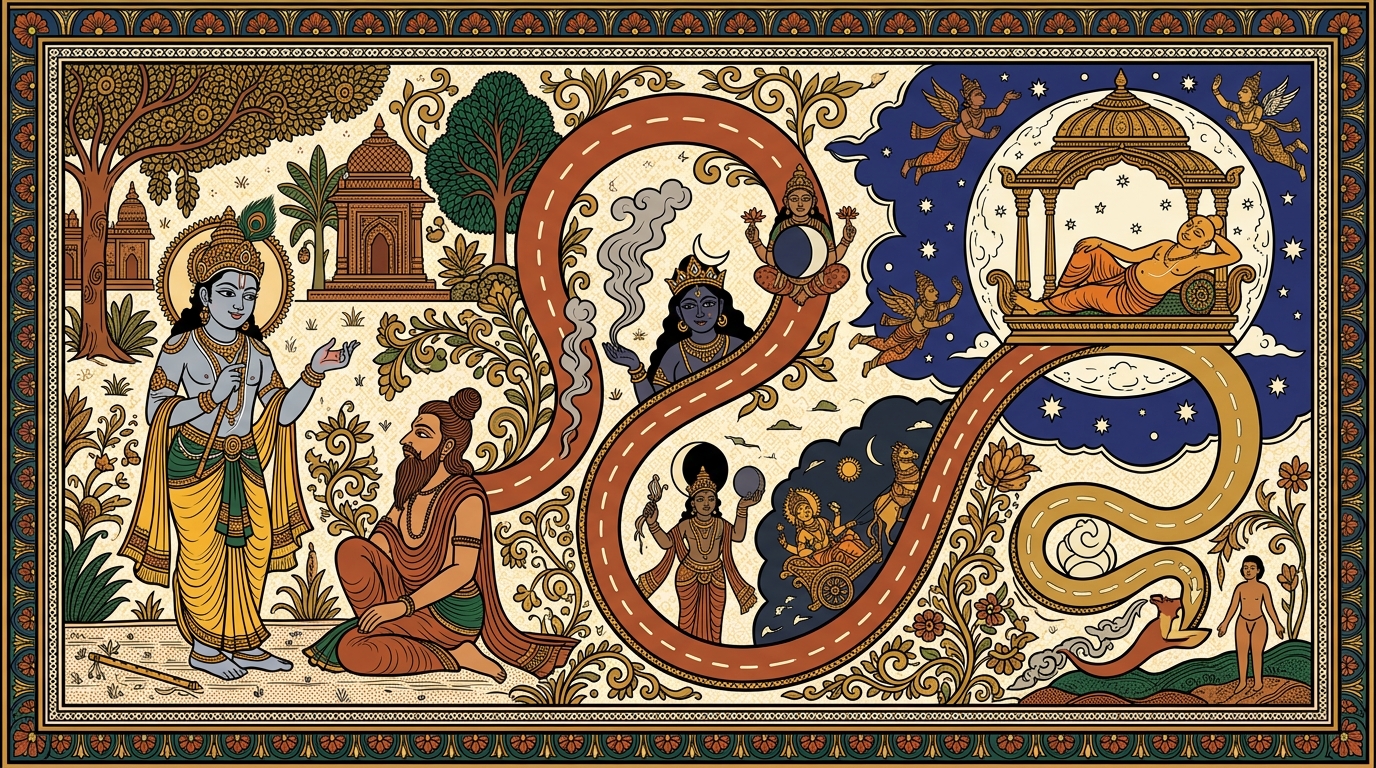
In the old forest schools, when the lamps were lit and the night
pressed soft against the windows, a teacher once sat surrounded by his
students and spoke of what happens after we leave our bodies.
"There is not one road for the departing," he said, "but two."
A boy near the front leaned in. "You told us yesterday of the bright
road — fire, day, the brightening moon, the sun going north. The road
that goes home and never returns."
"I did," the teacher said. "Tonight I will tell you of the other road.
It is not a bad road. Do not fear it. But it is different."
He pointed to the cooking fire at the edge of the courtyard, where the
flames had died and only grey smoke now curled upward into the dark.
"Many good and kind people travel the second road," he said. "Those who
do their duties faithfully, who give to others, who perform their rites
and live well — but who have not yet fully known the Boundless. Their
road is marked by smoke instead of flame, by night instead of day, by
the darkening half of the moon, and by the six months the sun spends
journeying south."
The students were very quiet. Somewhere an owl called.
"Where does that road lead?" the boy asked.
"Upward, to the cool silver light of the moon," the teacher answered,
and his voice grew warm. "There the good souls rest. They are happy.
They are repaid for every kindness they ever did, every gift they ever
gave, every prayer they ever offered. It is a long and gentle holiday
among the ancestors, a place of rest and reward."
"Then they stay forever?"
The teacher shook his head slowly. "No. When their good deeds have all
been enjoyed, like a traveller whose food runs out, they turn around.
Down the silver light they come again — into rain, into earth, into a
new life, born once more upon the world to learn and grow some more."
He looked kindly at his students. "So there are two roads. By one, you
go home and stay. By the other, you rest a while and return. Knowing
this, choose how you live — for how you live decides which road your
feet will find."