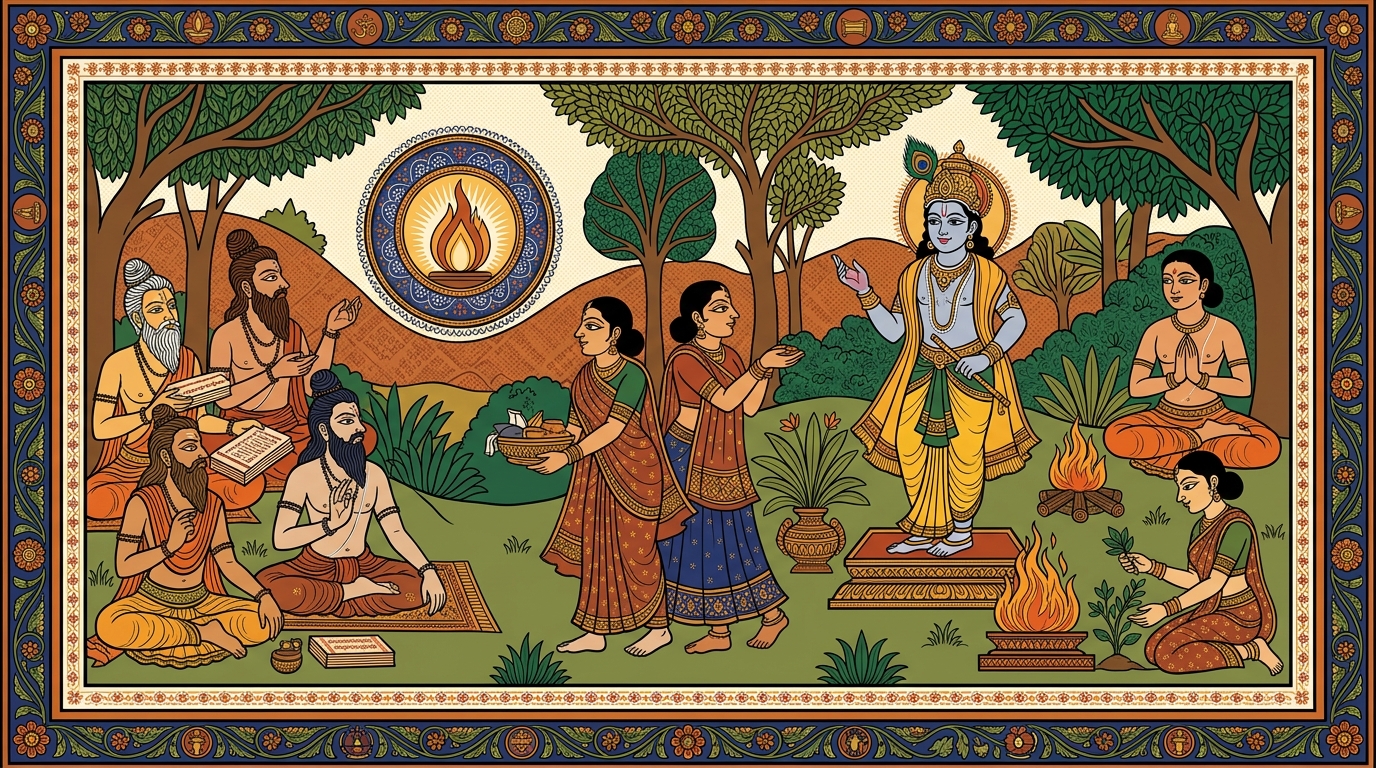
At the edge of a great forest, where the road ran out and only deer-paths
continued, a merchant named Kshema once stopped his cart to rest. As he
sat, a small group of people came walking out of the trees.
They wore plain cloth, the colour of bark. They carried nothing — no
bundles, no coins, no sandals even. Their faces were calm in a way Kshema
had never seen on any face in the marketplace. They were not rushing. They
did not look hungry for anything.
"Where are you going?" Kshema called. "And where are your things?"
The eldest among them, a woman with white hair and clear eyes, smiled.
"We are going toward the Imperishable," she said. "And we left our things
behind because they were heavy, and the road we walk is best walked light."
"The Imperishable?" Kshema repeated.
"There is one thing that never breaks, never fades, never dies," the woman
said. "Everything you carry in your cart will one day wear out — the cloth,
the coins, even your own body. But behind all the things that change, there
is something that does not. The teachers who know the Vedas speak of it.
They call it the Akshara — the Changeless. Seekers who have let go of every
craving enter into it like a river entering the sea. And people like us — we
live simply, we train our minds, we keep our lives clean and quiet — all of
it for one reason: so that one day we may reach that Changeless thing and
never have to leave it."
Kshema looked at his cart, heaped with silks and spices and bags of silver.
For a moment it all seemed very heavy. "Doesn't it frighten you," he asked,
"to own nothing?"
The woman laughed, a light, free sound. "We do not own nothing," she said.
"We are walking toward the one thing worth owning — the thing that can never
be lost, because it never perishes. Everything else you can lose. This, you
cannot."
And they walked on into the trees, light-footed, unhurried, leaving Kshema
sitting beside his heavy, glittering, perishable cart — wondering, for the
first time in his life, what it would feel like to walk that light.