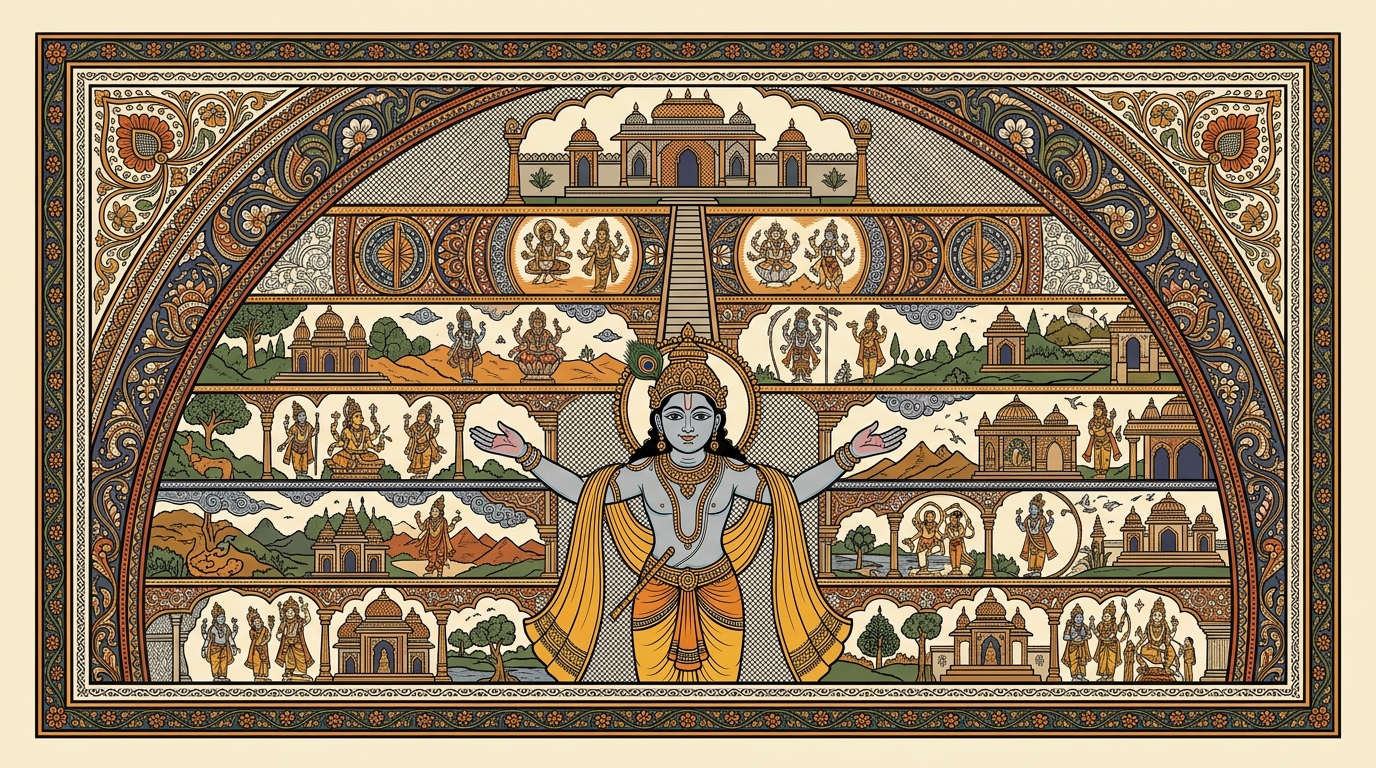
There is an old, old story of the sage Markandeya, who was granted
a strange and dizzying vision of how vast time truly is.
In the vision, Markandeya floated above all the worlds and watched
them turn like a great slow wheel. Far below were the worlds of
living creatures — humans, animals, the busy earth. Above them rose
the gleaming realms of the gods, where beings lived for ages in
light and music. And higher still, almost beyond seeing, shone the
realm of Brahmā himself, the creator, the highest heaven of all,
bright as ten thousand dawns.
Markandeya gasped. "Surely that highest realm lasts forever," he
said. "Surely the creator's own home never ends."
But as he watched, even that shining realm began, ever so slowly,
to dim. After an unimaginable stretch of time — a time so long that
mountains were born and worn to sand and born again — even
Brahmā's day came to its close. The bright realm folded inward and
grew dark. And Markandeya understood: not even the highest heaven
is forever. It too rises, and shines, and fades, and is born once
more, turning and turning on the great wheel.
"Then is there nothing," Markandeya whispered, "that steps off the
wheel? Nothing that does not return?"
And in the vast quiet, he felt an answer, not in words but in his
very bones. There was one place. The supreme abode of the Lord,
Krishna's own being, stood utterly still at the center of all the
turning, like the hub of a wheel that does not spin even while the
rim races round. Whoever reached that center did not have to ride
the wheel again.
When the vision lifted, Markandeya sat for a long while in silence.
He had seen the highest heavens come and go like sparks. And he had
glimpsed the one home that does not come and go at all. From that
day, the sage pointed his heart only there — toward the still
center, the one place beyond return.