The Yoga of the Three Qualities
गुणत्रयविभागयोग
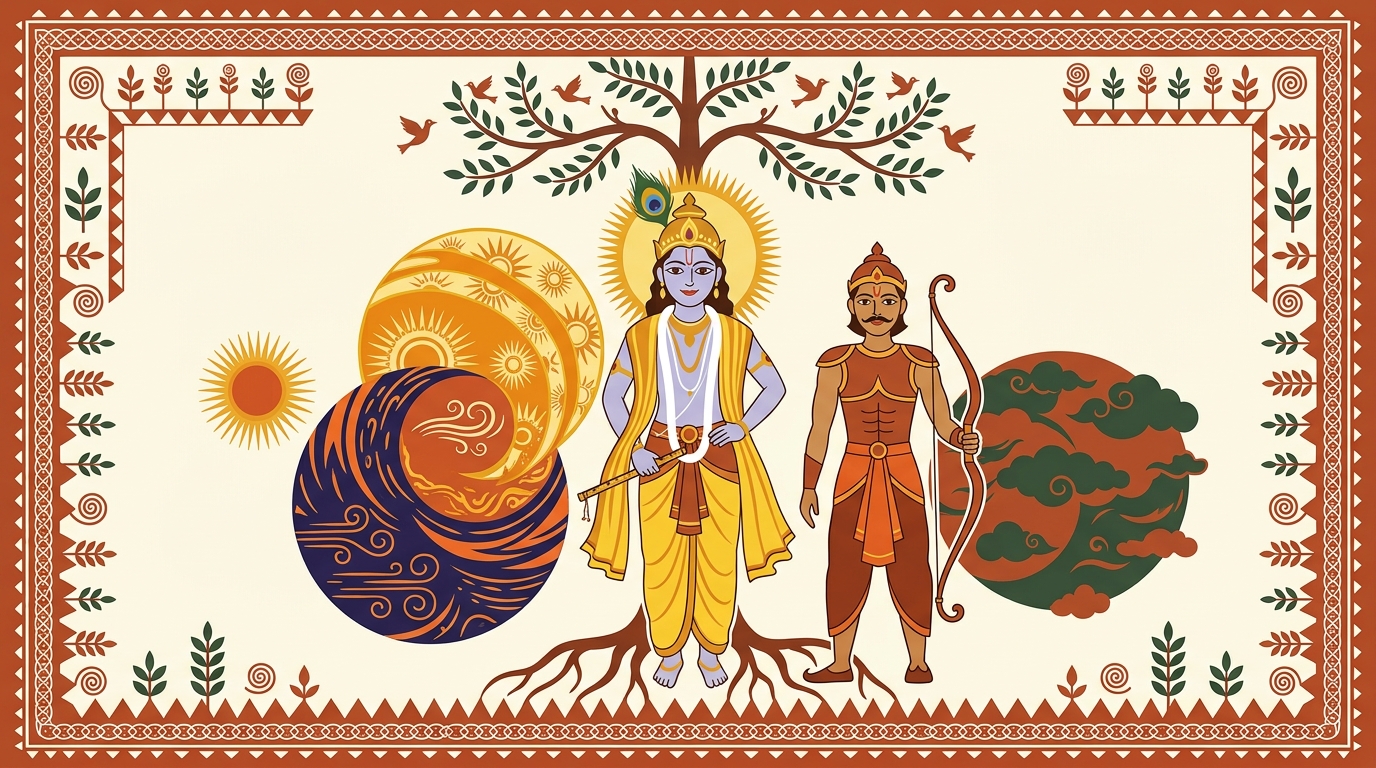
Krishna explains that everything in nature is made of three qualities, like three colors mixing together. Sattva is calm and bright like sunshine. Rajas is restless and energetic like a storm. Tamas is heavy and sleepy like a dark cloud. The goal is to rise above all three and become truly free.
✶ Art Style: Warli from Maharashtra Learn more
Warli is one of the oldest art forms in India, practised by the Warli tribe of Maharashtra for over 2,500 years. Using just white rice paste on a red or brown mud wall, Warli artists create an entire world from simple shapes — circles, triangles, and lines. A circle becomes the sun or the moon, triangles become mountains or dancing people, and lines connect everything into scenes of daily life, harvests, festivals, and stories from nature.
Signature Elements
- • White figures on dark earth-toned backgrounds
- • Simple geometric shapes (circles, triangles, lines)
- • Stick-figure humans in dynamic poses
- • Scenes of daily life and nature
Did you know?
In Warli tradition, paintings are always done by women. They paint the walls of their homes before weddings and harvest festivals, and the central figure is always Palaghata — the mother goddess of fertility — drawn as a large triangle.
परं भूयः प्रवक्ष्यामि ज्ञानानां ज्ञानमुत्तमम्। यज्ज्ञात्वा मुनयः सर्वे परां सिद्धिमितो गताः॥
KrishnaKrishna leans close to Arjuna and says he will share the very best knowledge of all once more, the highest of everything that can be known. This is the knowledge that the wise sages learned long ago, and by knowing it they crossed past every trouble and reached the greatest perfection a person can reach. It is a secret worth listening to with your whole heart.
इदं ज्ञानमुपाश्रित्य मम साधर्म्यमागताः। सर्गेऽपि नोपजायन्ते प्रलये न व्यथन्ति च॥
KrishnaKrishna explains what happens to those who really hold this knowledge close. They come to share his own nature: they become calm and free and steady like him. So when whole new worlds are made, they are not pulled back to be born again into fear and forgetting; and when worlds dissolve and melt away at the end of time, they do not tremble or worry. They rest, safe and unshaken, in what never ends.
मम योनिर्महद्ब्रह्म तस्मिन्गर्भं दधाम्यहम्। संभवः सर्वभूतानां ततो भवति भारत॥
KrishnaKrishna paints a picture of how everything in the world is born. Great Nature, vast and full of every possibility, is like a mother's womb that belongs to him. Into that womb Krishna places the seed, the tiny spark of life. And from that joining of the womb and the seed, every single being is born: every child, every bird, every tree and star. All of it comes from him, dear Arjuna.
सर्वयोनिषु कौन्तेय मूर्तयः संभवन्ति याः। तासां ब्रह्म महद्योनिरहं बीजप्रदः पिता॥
KrishnaKrishna widens the picture even more. In every kind of womb — in human mothers, in birds' eggs, in seeds in the soil, in fish in the sea — whatever bodies and shapes come to life, they all begin the same way. Great Nature is the mother who holds and grows them, and Krishna is the father who gives the spark of life. Every living thing, everywhere, has the same vast mother and the same loving father.
सत्त्वं रजस्तम इति गुणाः प्रकृतिसंभवाः। निबध्नन्ति महाबाहो देहे देहिनमव्ययम्॥
KrishnaKrishna names the three qualities, called gunas, that all of Nature is woven from, like three threads twisted together: sattva, which is calm and bright; rajas, which is restless and busy; and tamas, which is heavy and sleepy. These three are born from Nature, and they wrap themselves around the true Self who lives inside your body. That Self never changes and never dies, yet the three threads tie it down, the way ropes can hold even a strong, free creature.
तत्र सत्त्वं निर्मलत्वात्प्रकाशकमनामयम्। सुखसङ्गेन बध्नाति ज्ञानसङ्गेन चानघ॥
KrishnaOf the three threads, Krishna says, sattva is the clean and shining one. It has no stain, so it lets us see clearly, and it makes us feel light and well. But even sattva, to Arjuna's surprise, can tie the Self down. It binds in a gentle way: by making us cling to feeling happy, and by making us cling to knowing things. Even a lovely thread is still a thread, and a soft rope can hold you just as surely as a rough one.
रजो रागात्मकं विद्धि तृष्णासङ्गसमुद्भवम्। तन्निबध्नाति कौन्तेय कर्मसङ्गेन देहिनम्॥
KrishnaKrishna names the second quality: rajas. It is the colour of longing: full of passion, always thirsting for more, always reaching out to grab and hold. Rajas is born from craving and attachment, and it ties the soul down by making it cling to action: do this, get that, run here, win there. The work feels exciting, but the wanting never quite ends, and so the rope of busyness keeps the heart bound.
तमस्त्वज्ञानजं विद्धि मोहनं सर्वदेहिनाम्। प्रमादालस्यनिद्राभिस्तन्निबध्नाति भारत॥
KrishnaNow Krishna names the third quality: tamas. It is born of not-knowing, a heavy, foggy darkness that confuses every living being. Tamas does not pull you toward things like rajas does; instead it makes you not bother at all. It ties the soul down with three soft, sticky ropes: not paying attention, being too lazy to act, and sleeping when it is time to be awake. The mind grows dim, and the bright, clear Self is hidden behind a grey cloud.
सत्त्वं सुखे सञ्जयति रजः कर्मणि भारत। ज्ञानमावृत्य तु तमः प्रमादे सञ्जयत्युत॥
KrishnaKrishna shows how each of the three qualities holds the soul in a different way. Sattva fastens you to happiness — you love feeling calm and bright, and you do not want to let that good feeling go. Rajas fastens you to action — you love doing and getting busy and cannot sit still. And tamas, having pulled a veil over your clear knowing, fastens you to carelessness — you forget, you drift, you stop paying attention. Three different ropes, but each one ties.
रजस्तमश्चाभिभूय सत्त्वं भवति भारत। रजः सत्त्वं तमश्चैव तमः सत्त्वं रजस्तथा॥
KrishnaKrishna shows that the three qualities are not fixed: they take turns, like changing weather inside us. Sometimes sattva rises up and rises over rajas and tamas, and we feel calm and clear. At another moment rajas pushes past sattva and tamas, and we feel restless and busy. And at still another moment tamas covers both sattva and rajas, and we feel heavy and dull. Round and round they go, first one and then another taking the lead, all through a single day.
सर्वद्वारेषु देहेऽस्मिन्प्रकाश उपजायते। ज्ञानं यदा तदा विद्याद्विवृद्धं सत्त्वमित्युत॥
KrishnaHow do you know when sattva, the bright, calm quality, has grown strong inside you? Krishna gives the sign: a clear light of understanding shines out from every gate of the body. The "gates" are your senses — your eyes, ears, nose, tongue, skin, and thinking mind. When all of them feel clear and awake, when things make sense and you understand easily, like a room flooded with morning sunlight — then know that sattva has become strong in you.
लोभः प्रवृत्तिरारम्भः कर्मणामशमः स्पृहा। रजस्येतानि जायन्ते विवृद्धे भरतर्षभ॥
KrishnaJust as a clear light is the sign of sattva, Krishna lists the signs of rajas grown strong. When the restless quality fills you, five things spring up: greed, the wish to grab more and more; busyness, throwing yourself into activity; starting lots of new projects all at once; never feeling calm or at rest; and a constant longing, reaching out for what you do not yet have. When you notice these crowding in, you can know that rajas has become strong inside you.
अप्रकाशोऽप्रवृत्तिश्च प्रमादो मोह एव च। तमस्येतानि जायन्ते विवृद्धे कुरुनन्दन॥
KrishnaKrishna names the signs of the heavy, dark quality called tamas. When tamas grows strong inside a person, four things appear together: a dimness, as if no light is shining; a stuckness, where nothing gets started; carelessness, forgetting the things that matter; and a muddled confusion that clouds the mind. "When you feel dull, lazy, forgetful, and foggy all at once," he tells Arjuna, "know that tamas has grown big inside you."
यदा सत्त्वे प्रवृद्धे तु प्रलयं याति देहभृत्। तदोत्तमविदां लोकानमलान्प्रतिपद्यते॥
KrishnaKrishna explains what happens at the very end of a life. If a person leaves the body at a time when sattva, the calm, bright, clear quality, is shining strongly inside them, then they go to the spotless, shining worlds of the wisest beings, those who know the highest truth. A clear and peaceful heart at the end leads to clear and peaceful places.
रजसि प्रलयं गत्वा कर्मसङ्गिषु जायते। तथा प्रलीनस्तमसि मूढयोनिषु जायते॥
KrishnaKrishna continues describing how the quality strong at death shapes what comes next. If a person dies while rajas, the restless, craving, busy quality, is on top, they are reborn among people attached to endless doing and getting. And if a person dies while tamas, the heavy, dark, confused quality, is on top, they are reborn among dull, deluded beings. The mood you leave by tends to be the mood you arrive into.
कर्मणः सुकृतस्याहुः सात्त्विकं निर्मलं फलम्। रजसस्तु फलं दुःखमज्ञानं तमसः फलम्॥
KrishnaKrishna shows what each kind of action leaves behind, like the fruit a tree bears. The wise say that good action done in a calm, clear spirit bears spotless, sweet fruit, and leaves you and the world clean and bright. Action driven by restless craving bears the fruit of pain, and leaves you sore and unsettled. And action done in heavy, dark dullness bears the fruit of ignorance, and leaves you more confused than before.
सत्त्वात्सञ्जायते ज्ञानं रजसो लोभ एव च। प्रमादमोहौ तमसो भवतोऽज्ञानमेव च॥
KrishnaKrishna gives a simple map of where each quality leads inside the mind. From sattva, the calm and bright quality, clear knowledge grows: you understand things. From rajas, the restless quality, greed grows: you keep wanting and grabbing. And from tamas, the heavy quality, two dark things grow together: carelessness and confusion, plus a deeper not-knowing. The weather of your mind decides what fruit it grows.
ऊर्ध्वं गच्छन्ति सत्त्वस्था मध्ये तिष्ठन्ति राजसाः। जघन्यगुणवृत्तिस्था अधो गच्छन्ति तामसाः॥
KrishnaKrishna gives the picture as a ladder. Those who live settled in sattva, the calm, bright quality, rise upward toward higher and lighter places. Those full of rajas, restless craving and busyness, stay in the middle, going round and round in ordinary human life. And those sunk in tamas, heaviness, fog, and laziness, drift downward to duller, darker places. Which way you travel depends on which quality you let rule your days.
नान्यं गुणेभ्यः कर्तारं यदा द्रष्टानुपश्यति। गुणेभ्यश्च परं वेत्ति मद्भावं सोऽधिगच्छति॥
KrishnaKrishna shares a secret about who is really doing all the doing. Everything that happens in the world — running, building, thinking, growing — is the work of the three gunas, the three weathers of nature, not of the quiet Self who watches. When the wise one truly sees this, that the gunas are the only doers, and also knows the Self that rests beyond all three, then that person reaches Krishna's own being.
गुणानेतानतीत्य त्रीन्देही देहसमुद्भवान्। जन्ममृत्युजरादुःखैर्विमुक्तोऽमृतमश्नुते॥
KrishnaKrishna tells what happens when the Self rises above the three gunas that spring up out of the body: sattva, rajas, and tamas. The one who climbs beyond all three is set free from being born and dying, from growing old, and from pain. Going past the weather of the body, that one reaches the deathless, a life that never ends.
कैर्लिङ्गैस्त्रीन्गुणानेतानतीतो भवति प्रभो। किमाचारः कथं चैतांस्त्रीन्गुणानतिवर्तते॥
ArjunaNow Arjuna has three questions, the kind a curious friend would ask. He says: "Krishna, the one who has climbed above the three gunas — how would I recognise such a person? By what little signs would I know them? How do they live and behave each day? And how did they cross over the three weathers in the first place?" He wants the marks, the manners, and the method.
प्रकाशं च प्रवृत्तिं च मोहमेव च पाण्डव। न द्वेष्टि सम्प्रवृत्तानि न निवृत्तानि काङ्क्षति॥
KrishnaKrishna begins to answer Arjuna by describing the free person's heart. When the bright calm of clear knowing comes, or the busy buzz of activity, or the heavy fog of dullness — when any of these three weathers arrives, the free one does not push it away with dislike. And when each one passes and leaves, the free one does not chase after it or beg it to stay. The moods come; the moods go; and that person stays peaceful right through.
उदासीनवदासीनो गुणैर्यो न विचाल्यते। गुणा वर्तन्त इत्येव योऽवतिष्ठति नेङ्गते॥
KrishnaKrishna goes on with the marks of the free one. Such a person sits like a calm onlooker, the way you might watch a busy street from a quiet window. The gunas, the three weathers of the mind, cannot shake or upset them. Knowing simply that "it is the gunas that are turning, not me," the free one stands firm and does not budge, steady as a mountain while the weather rolls past.
समदुःखसुखः स्वस्थः समलोष्टाश्मकाञ्चनः। तुल्यप्रियाप्रियो धीरस्तुल्यनिन्दात्मसंस्तुतिः॥
KrishnaKrishna describes the person who has risen above the three qualities. Whether something hurts or feels lovely, he stays even and steady inside himself. A lump of mud, a plain stone, and a piece of gold all look the same to him; none can pull at his heart. The pleasant and the unpleasant weigh the same on his scales. And when people scold him or sing his praises, both feel exactly alike to him. He is calm and unshaken, holding still while the world keeps changing.
मानापमानयोस्तुल्यस्तुल्यो मित्रारिपक्षयोः। सर्वारम्भपरित्यागी गुणातीतः स उच्यते॥
KrishnaKrishna finishes the picture of the person who has risen above the three qualities. Whether the world honours him or scolds him, both feel the same to him. He treats his friends and the people who oppose him with the very same even kindness, taking no side in his heart. And he has put down all the restless "I want this, I must grab that" projects that keep most people busy and worried. A person like this, Krishna says, is the one we call gunatita, one who has crossed past all three qualities and become truly free.
मां च योऽव्यभिचारेण भक्तियोगेन सेवते। स गुणान्समतीत्यैतान्ब्रह्मभूयाय कल्पते॥
KrishnaKrishna gives the secret of how anyone — not only forest sages — can cross beyond the three qualities. Whoever loves and serves him with a steady, never-wandering heart, holding on to him through every up and down, slips past all three qualities almost without noticing. Love that does not stray carries you across. And once a person has crossed, Krishna says, he becomes ready to be one with Brahman, the vast and shining truth at the heart of everything, and the deepest truth of his own self. This is less like reaching a far shore than like waking up to find you were always the sea.
ब्रह्मणो हि प्रतिष्ठाहममृतस्याव्ययस्य च। शाश्वतस्य च धर्मस्य सुखस्यैकान्तिकस्य च॥
KrishnaKrishna ends the chapter with the deepest secret of all. "I am the ground that Brahman itself rests upon," he says, the firm place beneath the vast and boundless truth. "I am the deathless that never dies, the unchanging that never wears away, the eternal that lasts forever. I am the dharma that holds all things up, and I am the one perfect happiness, the joy that is whole and unbroken, that has no opposite and never runs out." Under every changing mood, beneath every up and down of life, this is what is always there. And this is no stranger holding you up from outside. It is the still depth of your own self, what you most truly are.