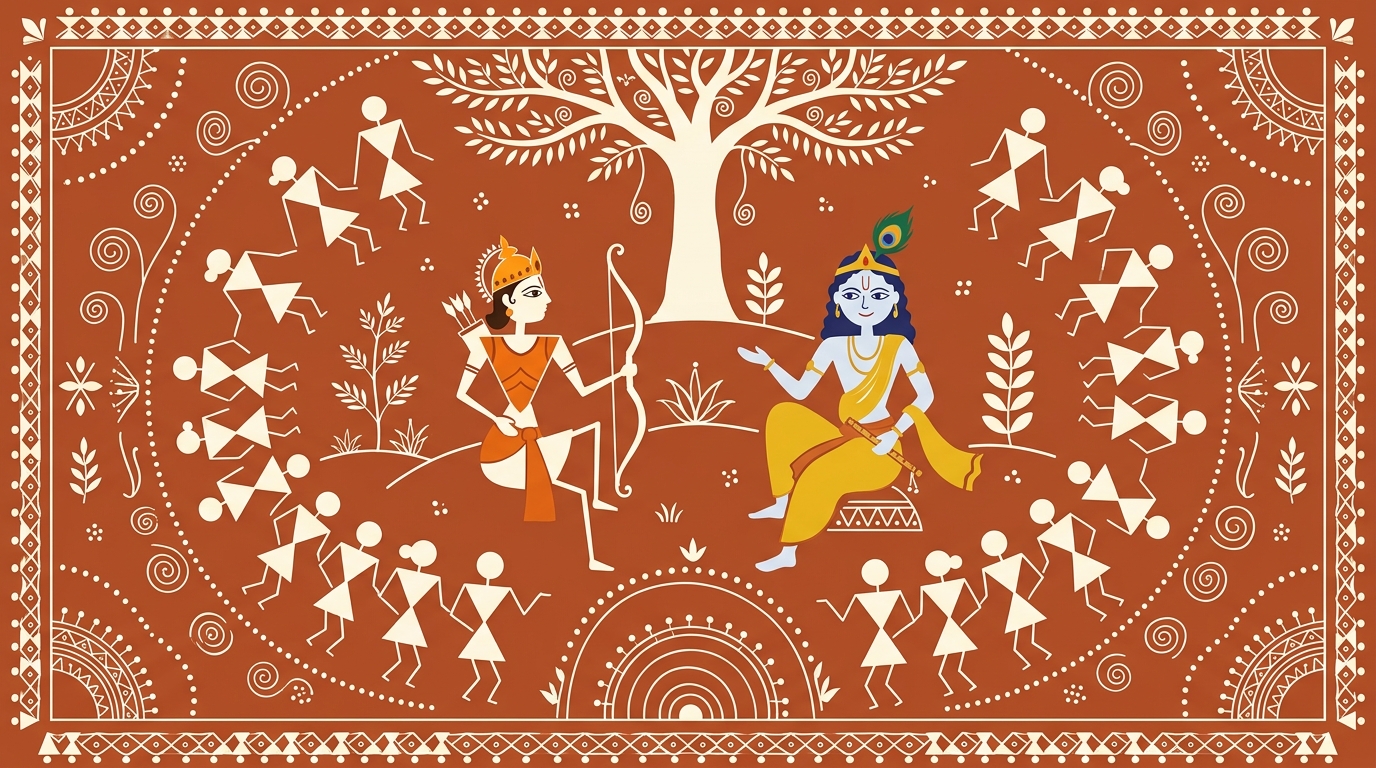
Between the two great armies the chariot stood still, and the two friends
inside it spoke quietly together, as if there were all the time in the
world.
Krishna had just finished telling Arjuna something wonderful: that a person
could climb right above the three weathers of the mind — the bright calm of
sattva, the restless fire of rajas, the heavy dark of tamas — and reach a
life that never ends. Arjuna listened with his whole heart. But he was an
archer, a man who liked clear marks to aim at, and a soft puzzle had begun
to turn in his mind.
He shifted on the chariot floor and looked at his friend. "Krishna," he
said slowly, "that sounds beautiful. But how would I ever *know* such a
person if I met one? They would look like anyone else, wouldn't they — two
arms, two eyes, walking down the road. What are the signs? By what little
marks could I tell that someone has gone beyond the three gunas?"
Krishna smiled but did not interrupt. He could see more questions coming,
the way you see more arrows in a quiver.
"And another thing," Arjuna went on, leaning forward. "How does such a
person *live*? When the day is ordinary — eating, walking, speaking to
people, doing their work — how do they behave? Are they strange and far
away, or close and ordinary?"
He paused, and then asked the deepest question of all, the one underneath
the other two. "And tell me this, my friend. *How* did they do it? How does
anyone actually cross over these three weathers that push and pull at all
of us? Not what it feels like at the end — but the way across. Show me the
path, and I will walk it."
Then Arjuna fell silent and waited, his eyes bright, the whole battlefield
forgotten, listening for his friend's answer.