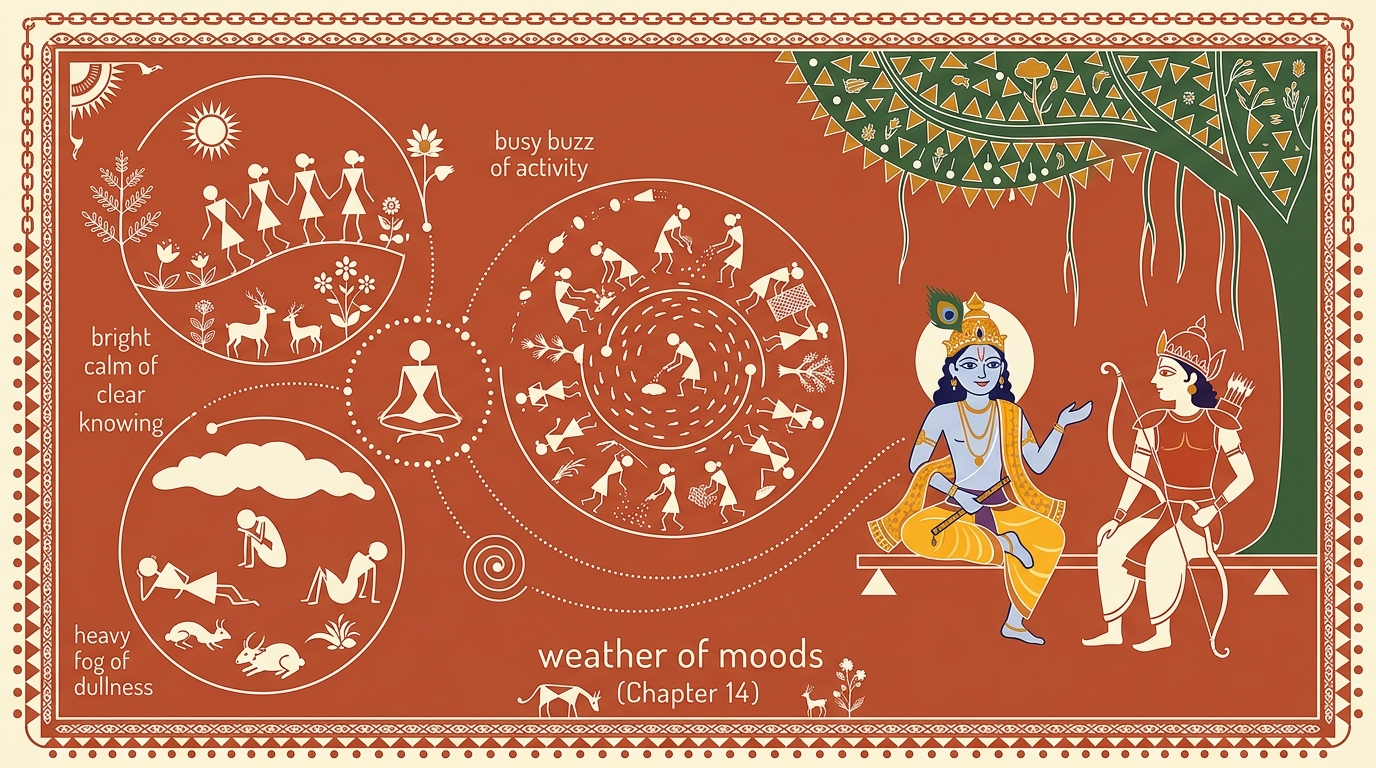
All week Jeeva had been at war with his own moods.
On the bright mornings, when his mind felt clear and everything made sense
and his lessons came easily, he loved it so much that he clung to it. "Stay
like this!" he begged the good feeling. But by afternoon it had slipped
away, and then he felt cheated and cross.
On the busy days, when he was buzzing with energy and ran everywhere and
couldn't sit still, he didn't know whether he liked it or hated it — so he
fought it, trying to force himself calm, and only got more tangled.
And on the heavy, foggy afternoons, when his head felt thick as a wet
blanket and he couldn't think and didn't want to do anything, he was
furious at himself. "Go away!" he told the dullness, shoving at it. It only
sat on him harder.
Aaji found him on the third day, frowning at the sky as if it had insulted
him. "What is the matter, little storm-cloud?" she asked.
"My moods won't behave!" Jeeva burst out. "The good ones leave when I want
them to stay. The bad ones stay when I want them to leave. I can't make
them do what I want!"
Aaji sat beside him and pointed up. "Look at the sky," she said. "This
morning, bright. At noon, windy and rushing. Now, see — a heavy grey cloud
coming over. Does the sky chase the bright morning and beg it to come back?
Does the sky shove at the grey cloud and shout *go away*?"
Jeeva almost laughed. "No. The sky just… lets them."
"The sky just lets them," Aaji nodded. "Bright comes, bright goes. Busy
comes, busy goes. Heavy comes, heavy goes. And the wide sky behind it never
moves at all. Your moods are weather, child. The clear ones, the busy ones,
the foggy ones — they are the three gunas blowing through. You don't have
to grab them or fight them. Just be the sky. Let them come. Let them go."
That afternoon a foggy, dull mood crept over Jeeva again. But this time he
didn't shove at it. He just noticed it, the way you notice a cloud, and
waited. And after a while — he hardly saw it happen — it drifted off on its
own, and he was still there, quiet and whole, like the sky.