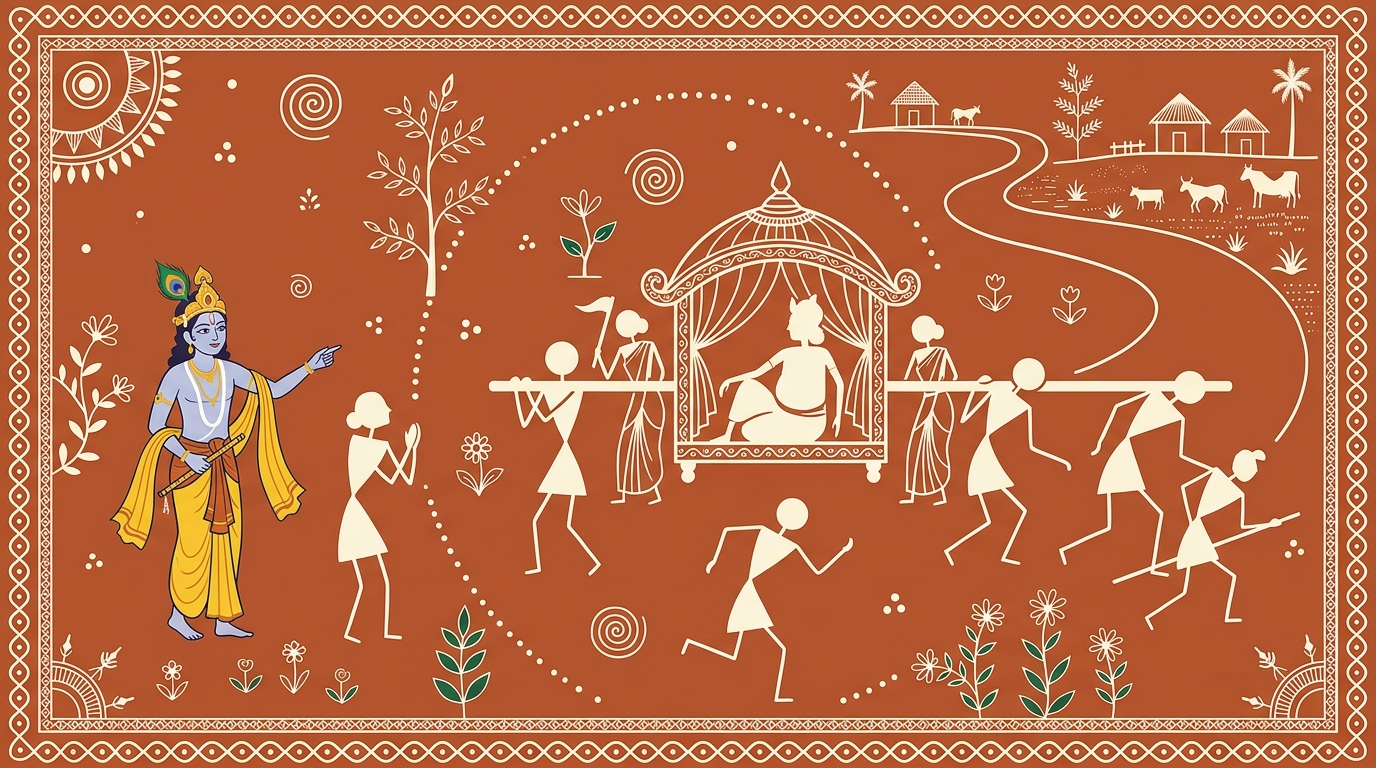
There was once a sage named Bharata who, in an earlier life, had grown so
attached to a little deer that he forgot God at the end and had to be born
again. So in his next life he was very careful. He pretended to be a
simpleton — slow, silent, doing nothing that would tangle his heart — and
people called him Jadabharata, "Bharata the dull," and laughed at him.
One day a king's servants were looking for someone strong to help carry the
royal palanquin, the covered seat that bearers lift on poles. They saw
Jadabharata, big and quiet, and ordered him to take a pole.
Jadabharata lifted his corner and walked. But he was so gentle that he kept
stepping carefully around every ant on the path, so the palanquin jolted
and swayed. The king, bouncing inside, grew angry and leaned out.
"You there! Walk straight! Are you weak? Are you ill? Why do you jolt my
seat?" He scolded the silent man with sharp, stinging words.
Now, anyone else would have flinched, or shrunk, or burned with shame. But
Jadabharata only looked back at the king with calm, unbothered eyes — like
a person sitting quietly at a window, watching the street.
Then he spoke, and his voice was so peaceful the king fell silent. "Whose
weakness, O King? The body grows tired, the legs grow heavy — that is the
weather of nature, the gunas turning and taking their turns. They tire, not
I. The scolding falls on this body and these ears, and they hear it. But I
— the quiet one who watches — I am not shaken. The gunas are turning. I
only stand and let them."
The king stared. The angry words he had been holding fell away from him
like dropped stones. He climbed down from his palanquin and bowed before
the silent man, understanding at last that here was someone the three
weathers could never move, steady as a mountain while all the storms of
the world rolled by.