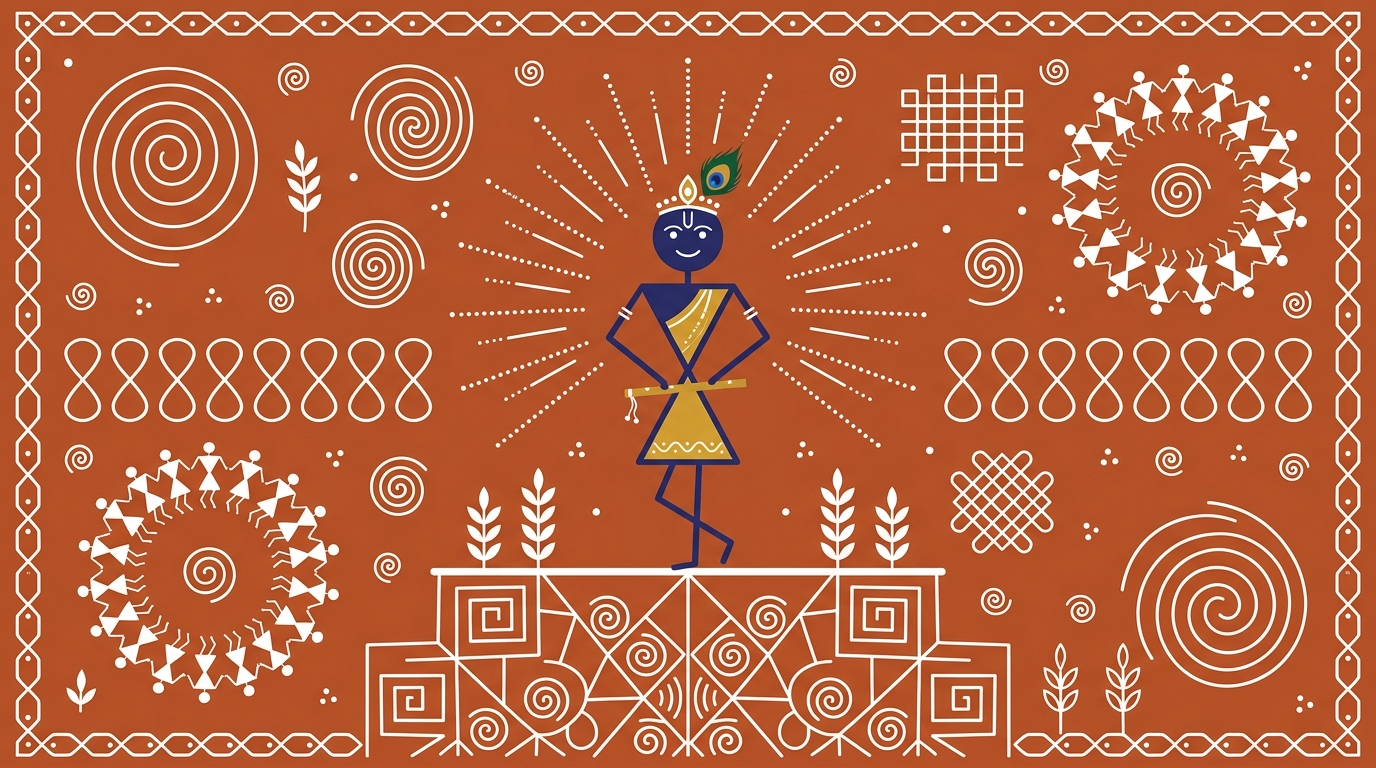
It had been a strange day for Jeeva. In the bright morning he had felt
wonderful, clear and curious, helping Aaji mix paste and asking a hundred
questions. By the busy midday he had felt itchy and cross, racing about,
wanting things he could not have. And in the heavy, sleepy afternoon he had
felt dull and grumpy, not wanting to do anything at all.
Now it was evening. He sat with Aaji on the cool mud floor of her hut, where
a single oil lamp burned. On the wall above them spread her great Warli
mural — hundreds of tiny white figures dancing, farming, marrying, dying, all
in one endless spiral.
"Aaji," Jeeva said, "I don't understand myself. This morning I was so happy.
Then I was cross. Then I was sleepy and grumpy. Which one is really me?"
Aaji watched the lamp flame lean and straighten in the breeze from the door.
"Look at the flame," she said. "See how it bends one way, then the other,
then stands tall? Bright, low, flickering — all in a minute. Your moods are
like that, little one. Happy, restless, sleepy — they come and go all day
long, like weather, like the bending of the flame."
"Then there's no real me," Jeeva said sadly. "Just moods coming and going."
"Ah," said Aaji, and she pressed her warm palm flat against his chest. "Be
very still and feel underneath the moods. Underneath the happy. Underneath
the cross. Underneath the sleepy. There is something that was *there all
day* — quiet, watching, never bending, never flickering. The one who *noticed*
the morning and the midday and the afternoon. That one did not change at all.
That stillness under everything — that is the most real you. And it is not
only inside you. It is the same stillness under the whole spinning world."
She lifted her hand toward the great spiral of dancers on the wall. "All these
little figures — born, dancing, dying, born again, round and round. They
change. But the wall they are painted on does not move. It just holds them,
quietly, forever."
Jeeva looked at the steady wall behind the swirling figures, and at the calm
flame standing straight now in the still air.
"Krishna says," Aaji whispered, "that beneath every changing thing there is
one happiness that does not change, that never dies, never wears out, never
runs dry. It holds up everything, the way the wall holds up the painting. It
was under your happy morning and your grumpy afternoon, the same the whole
time. That unchanging happiness, holding up the whole world — *that* is God.
And, my little one, you have never once been outside it."
Jeeva closed his eyes. Beneath the tired end of a strange long day, very
quietly, he felt it, something that had been peaceful all along, holding him,
the way the still wall holds the dancing figures. And he smiled.