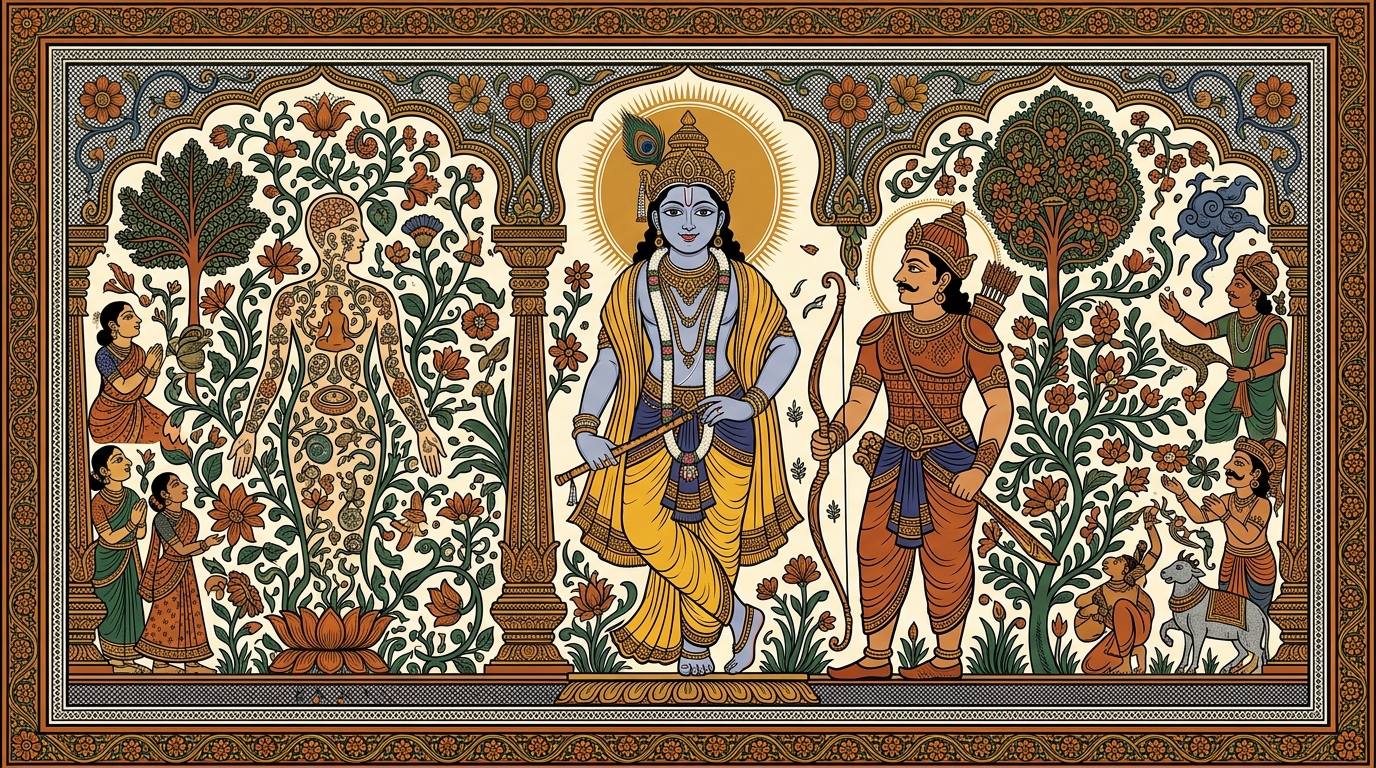
The Yoga of the Field and the Knower
क्षेत्रक्षेत्रज्ञविभागयोग
Krishna uses a beautiful example — think of your body as a garden (the field) and your soul as the gardener (the knower of the field). The gardener watches over the garden but is different from it. When you understand that you are the wise gardener and not just the garden, you see life in a whole new way.
✶ Art Style: Pattachitra from Odisha Learn more
Pattachitra means "cloth painting" in Odia, and this art has been practised in Odisha for over a thousand years. Artists called chitrakars prepare their own canvases by layering cloth with a paste of chalk and tamarind seed gum, creating a smooth surface. Then they paint mythological stories using bold black outlines and vibrant natural colors. The most striking feature is the intricate border — three or four nested frames of flowers and geometric patterns surround every scene, like looking through decorated windows into the world of the gods.
Signature Elements
- • Bold black outlines with fine internal detailing
- • Multi-layered ornamental borders (3-4 nested frames)
- • Horror vacui — every space filled with patterns
- • Narrative panel compositions
Did you know?
Pattachitra artists traditionally make their own colors from natural materials — white from conch shells, red from a local stone called hingula, yellow from the urine of cows that eat mango leaves, and black from burnt coconut shells!
प्रकृतिं पुरुषं चैव क्षेत्रं क्षेत्रज्ञमेव च। एतद्वेदितुमिच्छामि ज्ञानं ज्ञेयं च केशव॥
ArjunaArjuna asks Krishna six things he longs to understand: What is prakriti, the changing world of nature? What is purusha, the spirit that watches it? What is the field, and who is the knower of the field? And what is real knowledge, and what is the thing worth knowing? "I wish to understand all of this, Krishna," he says.
इदं शरीरं कौन्तेय क्षेत्रमित्यभिधीयते। एतद्यो वेत्ति तं प्राहुः क्षेत्रज्ञ इति तद्विदः॥
KrishnaKrishna begins to answer. "This body, Arjuna, is called the field. And the one who knows this body — the one who is aware of it from the inside — the wise call him the knower of the field." So your body is like a field, and the real you is the farmer who knows that field.
क्षेत्रज्ञं चापि मां विद्धि सर्वक्षेत्रेषु भारत। क्षेत्रक्षेत्रज्ञयोर्ज्ञानं यत्तज्ज्ञानं मतं मम॥
KrishnaKrishna says something startling: "Know that I Myself am the knower seated in every single field, Arjuna — the same one awareness looking out of every creature." And he adds: to understand the difference between the field and the knower of the field — that, in my view, is real knowledge.
तत्क्षेत्रं यच्च यादृक्च यद्विकारि यतश्च यत्। स च यो यत्प्रभावश्च तत्समासेन मे शृणु॥
KrishnaKrishna promises Arjuna a clear, short map. "Listen, and I will tell you briefly what the field is, what it is like, how it changes, and where it comes from, and also who the knower is and what his power is." He is about to explain the whole great mystery in a few simple strokes.
ऋषिभिर्बहुधा गीतं छन्दोभिर्विविधैः पृथक्। ब्रह्मसूत्रपदैश्चैव हेतुमद्भिर्विनिश्चितैः॥
KrishnaKrishna says this same truth about the field and the knower has been sung by the sages in many different ways: in all kinds of sacred hymns, and in the carefully reasoned verses about Brahman. Many voices, many songs, across many ages — but all of them pointing to the one same truth.
महाभूतान्यहंकारो बुद्धिरव्यक्तमेव च। इन्द्रियाणि दशैकं च पञ्च चेन्द्रियगोचराः॥
KrishnaNow Krishna lists what the field is made of, like pieces of a great puzzle: the five great elements (earth, water, fire, air, and space); the ego, the feeling of "I"; the intellect that decides; the unmanifest source from which it all unfolds; the ten senses and the one mind; and the five things the senses reach for — sound, touch, sight, taste, and smell. All of these together build the field.
इच्छा द्वेषः सुखं दुःखं संघातश्चेतना धृतिः। एतत्क्षेत्रं समासेन सविकारमुदाहृतम्॥
KrishnaKrishna finishes his short map of the field by naming its changes: desire and dislike, pleasure and pain, the body that is a gathering of parts, the awareness that fills it, and the firmness that holds it steady. "This," he says, "is the field, briefly told, along with all the ways it changes." All these come and go — and the knower simply watches them pass.
अमानित्वमदम्भित्वमहिंसा क्षान्तिरार्जवम्। आचार्योपासनं शौचं स्थैर्यमात्मविनिग्रहः॥
KrishnaKrishna begins to describe what real knowledge looks like. It shows in how you live, not in facts you memorise. To be humble, to never show off, to hurt no one, to be patient, to be honest and straight, to serve your teacher, to keep yourself clean and pure, to stay steady, and to hold your own mind in check — all of this, Krishna says, IS knowledge. A wise person is known by these qualities, not by clever words.
इन्द्रियार्थेषु वैराग्यमनहङ्कार एव च। जन्ममृत्युजराव्याधिदुःखदोषानुदर्शनम्॥
KrishnaKrishna continues his list of what real knowledge is. A wise person is not ruled by cravings for tasty things, pretty things, or exciting things. They can enjoy life without being grabbed by it. They do not make everything about "me, me, me." And they look honestly at hard truths: that bodies are born, grow old, fall sick, and one day die. Seeing this clearly is not gloomy. It helps you stop clinging to what cannot last and reach for what does.
असक्तिरनभिष्वङ्गः पुत्रदारगृहादिषु। नित्यं च समचित्तत्वमिष्टानिष्टोपपत्तिषु॥
KrishnaMore signs of a wise person, Krishna says: they love their family and home without clinging to them so tightly that they cannot breathe. And whether the day brings what they hoped for or what they dreaded, their heart stays steady and even. They do not bounce sky-high when things go their way, or crash to the ground when they don't. This calm, even heart in good times and bad — this is true knowledge.
मयि चानन्ययोगेन भक्तिरव्यभिचारिणी। विविक्तदेशसेवित्वमरतिर्जनसंसदि॥
KrishnaKrishna says, "Another mark of true knowledge is a steady, loving devotion to Me that never wanders off to chase other things." The wise person likes quiet, clean, peaceful places where the mind can settle, and does not get swept up in the noise and showing-off of big crowds. The wise person loves quiet places, not because they dislike people, but because the calm is where you can listen to what is deepest and truest.
अध्यात्मज्ञाननित्यत्वं तत्त्वज्ञानार्थदर्शनम्। एतज्ज्ञानमिति प्रोक्तमज्ञानं यदतोऽन्यथा॥
KrishnaKrishna finishes his great list. To stay always rooted in knowing the Self — the real "you" inside — and to keep your eyes fixed on the goal of truth: THIS, he says, is what knowledge means. All these qualities together are real knowledge. And whatever is different from this — forgetting the Self, losing sight of the truth — that is ignorance. Real knowledge shows in whether you keep looking toward what matters most, not in how much you know.
ज्ञेयं यत्तत्प्रवक्ष्यामि यज्ज्ञात्वामृतमश्नुते। अनादिमत्परं ब्रह्म न सत्तन्नासदुच्यते॥
KrishnaNow Krishna turns to the greatest mystery of all — the "knowable," the truth that, once you truly know it, sets you free from death forever. It is Brahman, the supreme reality: beginningless, with no start and no end. And it is so far beyond ordinary things that we cannot even call it simply "a thing that exists" or "a thing that doesn't exist." It is not like anything else. It is the deepest truth, and Krishna is about to try to describe what cannot quite be described.
सर्वतःपाणिपादं तत्सर्वतोऽक्षिशिरोमुखम्। सर्वतःश्रुतिमल्लोके सर्वमावृत्य तिष्ठति॥
KrishnaKrishna paints a vast picture of Brahman. It has hands and feet everywhere, eyes and heads and faces everywhere, ears everywhere — because it is the seeing in every eye, the hearing in every ear, the awareness behind every working hand across the whole world. The eyes and hands belong to nature; the one Self lends them only the light by which they see and know. It wraps around everything that exists and holds it all, the way the sky surrounds everything beneath it.
सर्वेन्द्रियगुणाभासं सर्वेन्द्रियविवर्जितम्। असक्तं सर्वभृच्चैव निर्गुणं गुणभोक्तृ च॥
KrishnaThe knowable shines out through every sense — it is the seeing in your eyes and the hearing in your ears — yet it has no senses of its own. It clings to nothing, yet it holds up everything. It stands beyond all the qualities of nature, and still it is the one that experiences them all. It is the source behind your senses while never being trapped inside them.
बहिरन्तश्च भूतानामचरं चरमेव च। सूक्ष्मत्वात्तदविज्ञेयं दूरस्थं चान्तिके च तत्॥
KrishnaThis knowable lives outside all beings and inside them too. It is perfectly still, and yet it is the very thing that moves in everything that moves. It is so fine and subtle that your mind cannot quite catch hold of it the way you catch a ball. It seems far, far away — and at the very same moment it is closer to you than anything else.
अविभक्तं च भूतेषु विभक्तमिव च स्थितम्। भूतभर्तृ च तज्ज्ञेयं ग्रसिष्णु प्रभविष्णु च॥
KrishnaThis knowable is not split into pieces, yet among all the many beings it looks as if it were divided up — a little in you, a little in me, a little in every creature. Really it is one whole thing. It is the one that feeds and sustains everything that lives, the one that draws all things back into itself at the end, and the one that brings them all forth at the beginning.
ज्योतिषामपि तज्ज्योतिस्तमसः परमुच्यते। ज्ञानं ज्ञेयं ज्ञानगम्यं हृदि सर्वस्य विष्ठितम्॥
KrishnaThis knowable is the light of all lights — brighter than the sun, the moon, and every fire, for it is the light that makes even them able to shine. It is far beyond all darkness; no shadow can reach it. It is knowledge itself, it is the thing worth knowing, and it is reached by true knowing. And it is seated quietly in the heart of every single being.
इति क्षेत्रं तथा ज्ञानं ज्ञेयं चोक्तं समासतः। मद्भक्त एतद्विज्ञाय मद्भावायोपपद्यते॥
KrishnaSo now, in short, Krishna has told what the field is, what true knowledge is, and what the knowable is. The one who loves Krishna and really understands all this — the field, the knowing, and the One worth knowing — becomes ready for Krishna's own way of being. Understanding this is like finishing a map: once you see the whole picture, you are ready for the journey home.
प्रकृतिं पुरुषं चैव विद्ध्यनादी उभावपि। विकारांश्च गुणांश्चैव विद्धि प्रकृतिसम्भवान्॥
KrishnaKrishna names two great things that have always existed, with no beginning at all: prakriti, which is nature — all the changing stuff that things are made of — and purusha, which is the Self, the quiet one who watches. And know this too: every change you see, and the three "gunas" (the strands or moods of nature), all come out of prakriti, not out of the watching Self.
कार्यकारणकर्तृत्वे हेतुः प्रकृतिरुच्यते। पुरुषः सुखदुःखानां भोक्तृत्वे हेतुरुच्यते॥
KrishnaPrakriti — nature — is the cause behind all the doing: it makes the body and the busy hands and feet and senses that get things done. But purusha — the Self — is the one behind the feeling: it is the cause of experiencing the happiness and the hurt. Nature does the work; the Self is the one who feels pleasure and pain through it.
पुरुषः प्रकृतिस्थो हि भुङ्क्ते प्रकृतिजान्गुणान्। कारणं गुणसङ्गोऽस्य सदसद्योनिजन्मसु॥
KrishnaThe Self, when it forgets itself and settles into nature, starts tasting nature's flavours — its joys and sorrows, its ups and downs. And the more it clings to those flavours, wanting more and more of them, the more it gets pulled back into new lives, sometimes happy ones and sometimes hard ones. Krishna is saying that getting hooked on the changing show is what keeps us going around and around.
उपद्रष्टानुमन्ता च भर्ता भोक्ता महेश्वरः। परमात्मेति चाप्युक्तो देहेऽस्मिन्पुरुषः परः॥
KrishnaInside this very body, says Krishna, there lives a higher Self, and it has many names. It is the witness who watches everything, the one who quietly allows things to happen, the one who holds the whole body up, the one who tastes its joys, the great Lord, the supreme Self. It does not push or fuss. It simply is — present in you right now, watching from the very centre of you.
य एवं वेत्ति पुरुषं प्रकृतिं च गुणैः सह। सर्वथा वर्तमानोऽपि न स भूयोऽभिजायते॥
KrishnaWhoever truly understands the difference between the Self and nature — between the calm watcher and the changing show with all its qualities — is free. Krishna says it does not matter how such a person lives or what they are doing. Once you really know which part of you is the deathless Self, you are not pulled back into the cycle of being born again and again. Knowing sets you free.
ध्यानेनात्मनि पश्यन्ति केचिदात्मानमात्मना। अन्ये साङ्ख्येन योगेन कर्मयोगेन चापरे॥
KrishnaThere is more than one way to find the Self, Krishna explains. Some people discover it by sitting quietly in meditation and looking inward with a calm, steady mind. Others find it by thinking deeply and reasoning their way to the truth. And still others find it by doing their everyday work with a selfless, loving heart. Different paths, but they all lead to the same summit.
अन्ये त्वेवमजानन्तः श्रुत्वान्येभ्य उपासते। तेऽपि चातितरन्त्येव मृत्युं श्रुतिपरायणाः॥
KrishnaSome people cannot yet figure out the deep truth all by themselves, and that's perfectly all right. They hear it from wise teachers they trust, take it to heart, and live by it faithfully. Krishna says, "Even these people cross safely beyond death." Trusting good words and holding fast to them is its own gentle path home.
यावत्सञ्जायते किञ्चित्सत्त्वं स्थावरजङ्गमम्। क्षेत्रक्षेत्रज्ञसंयोगात्तद्विद्धि भरतर्षभ॥
KrishnaLook at anything alive, Krishna says — a tree standing still or a deer running, a tiny insect or a great person. Every single living thing is born from two things joining together: the field (the body and all of nature) and the knower (the conscious Self that fills it with life). Wherever you see life, you are seeing the field and its knower joined as one.
समं सर्वेषु भूतेषु तिष्ठन्तं परमेश्वरम्। विनश्यत्स्वविनश्यन्तं यः पश्यति स पश्यति॥
KrishnaThe one who really sees, says Krishna, is the one who sees the same supreme Self living equally inside every single being — the king and the beggar, the bird and the deer, the friend and the stranger. Bodies come and go, they grow old and pass away, but the Self shining inside them never dies. To see the undying One the same in everyone is to see things as they truly are.
समं पश्यन्हि सर्वत्र समवस्थितमीश्वरम्। न हिनस्त्यात्मनात्मानं ततो याति परां गतिम्॥
KrishnaWhen you see the same Lord living equally in everyone and everything, you stop hurting the Self by your own smaller self. Because to harm anyone else would be to harm the very same one living inside you. The person who truly sees this never wants to wound another, and so he walks straight to the highest goal of all.
प्रकृत्यैव च कर्माणि क्रियमाणानि सर्वशः। यः पश्यति तथात्मानमकर्तारं स पश्यति॥
KrishnaAll the work in the world is done by nature alone — by the body, the hands, the wind, the soil, the seasons. The Self inside simply watches; it does no work at all. The person who sees that nature is the doer, and that the Self is the still witness behind it, is the one who sees the truth.
यदा भूतपृथग्भावमेकस्थमनुपश्यति। तत एव च विस्तारं ब्रह्म सम्पद्यते तदा॥
KrishnaWhen you see that all the countless different beings really rest in one single Self, and that all their variety spreads out from that one source alone, then you reach Brahman, the boundless spirit. The many are like branches of one tree or waves on one sea — different on top, but joined underneath.
अनादित्वान्निर्गुणत्वात्परमात्मायमव्ययः। शरीरस्थोऽपि कौन्तेय न करोति न लिप्यते॥
KrishnaThis supreme Self has no beginning and no end, and it is free of all the changing qualities of nature. So even though it lives right inside your body, it never really does anything and nothing ever sticks to it. It is like sunlight that pours over mud and gold alike and is never dirtied by either.
यथा सर्वगतं सौक्ष्म्यादाकाशं नोपलिप्यते। सर्वत्रावस्थितो देहे तथात्मा नोपलिप्यते॥
KrishnaSpace goes everywhere, filling every room and pot and corner, yet it is so fine and pure that nothing can ever stain it. In just the same way, the Self is present all through the body, but it stays spotless and untouched. Smoke and dust may fill the air, but the space itself is never dirtied.
यथा प्रकाशयत्येकः कृत्स्नं लोकमिमं रविः। क्षेत्रं क्षेत्री तथा कृत्स्नं प्रकाशयति भारत॥
KrishnaJust as one single sun lights up this whole wide world all at once, so the one Knower — the Self — lights up the entire field of the body and mind. One light is enough for everything. Your eyes, your thoughts, your feelings, all of you is lit up by a single quiet awareness sitting within.
क्षेत्रक्षेत्रज्ञयोरेवमन्तरं ज्ञानचक्षुषा। भूतप्रकृतिमोक्षं च ये विदुर्यान्ति ते परम्॥
KrishnaThose who use the eye of knowledge to clearly tell apart the field — the changing body and nature — from the Knower who watches it all, and who see how living beings become free from nature, reach the very highest place. This is the whole of the chapter in one breath: know the field, know the Knower, tell them apart, and be free.