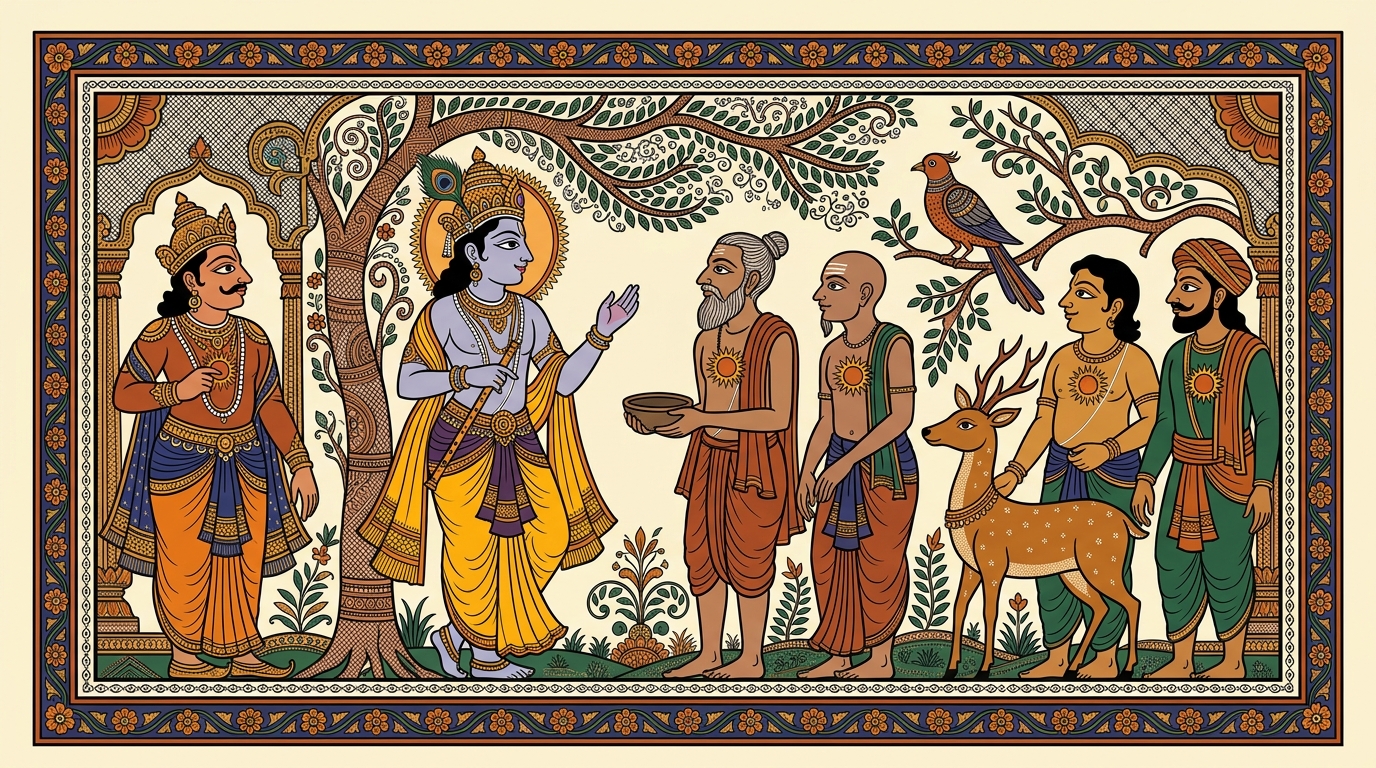
There was once a sage named Ribhu who lived in a hermitage at the edge of
a forest, and travellers told a strange story about him. No matter who
came down the road, Ribhu would stop, fold his hands, and bow — exactly
the same low, gentle bow to every single one.
A merchant in fine silks came by, jingling with gold, and Ribhu bowed. A
beggar with a cracked bowl and dusty feet came by, and Ribhu bowed just
as deeply. A proud king rode past on an elephant, and Ribhu bowed. A
little spotted deer stepped shyly from the trees to drink at the stream,
and Ribhu bowed to the deer as well.
One day a young student named Vidur came to study with him, and the bowing
troubled him.
"Master," Vidur said, "I understand bowing to the king — he is great. But
why do you bow to the ragged beggar the very same way? And why on earth do
you bow to a *deer*? It can't even understand you."
Ribhu smiled and led the boy to the stream. "Look into the water," he said.
"What do you see?"
"My face," said Vidur.
Ribhu scooped water into a clay cup, then a coconut shell, then a broad
leaf, and set the three side by side. The evening sky shone in each one.
"Tell me — how many skies are there?"
Vidur looked. "One sky. But it shows in all three."
"Yes," said Ribhu softly. "And the cup may be plain, the shell may be
cracked, the leaf may be torn — but the sky in each is the same whole sky,
perfect and unbroken. The cups will dry up and crack and crumble. The sky
they reflected never does."
He gestured back toward the road. "The merchant's silk, the beggar's rags,
the king's crown, the deer's soft coat — these are only the cups. They are
born, they grow old, they pass away. But the Self that shines inside each
one is the same supreme Self, whole and undying in every one of them. When
I bow, Vidur, I am not bowing to the silk or the rags. I am bowing to the
one sky shining in all of them."
Vidur was silent for a long time, watching the light tremble on the water.
Then, very slowly, he turned and bowed — to a sparrow hopping in the dust,
to the old gardener sweeping leaves, to Ribhu, and at last to his own
reflection in the stream.
For the first time, he was truly seeing.