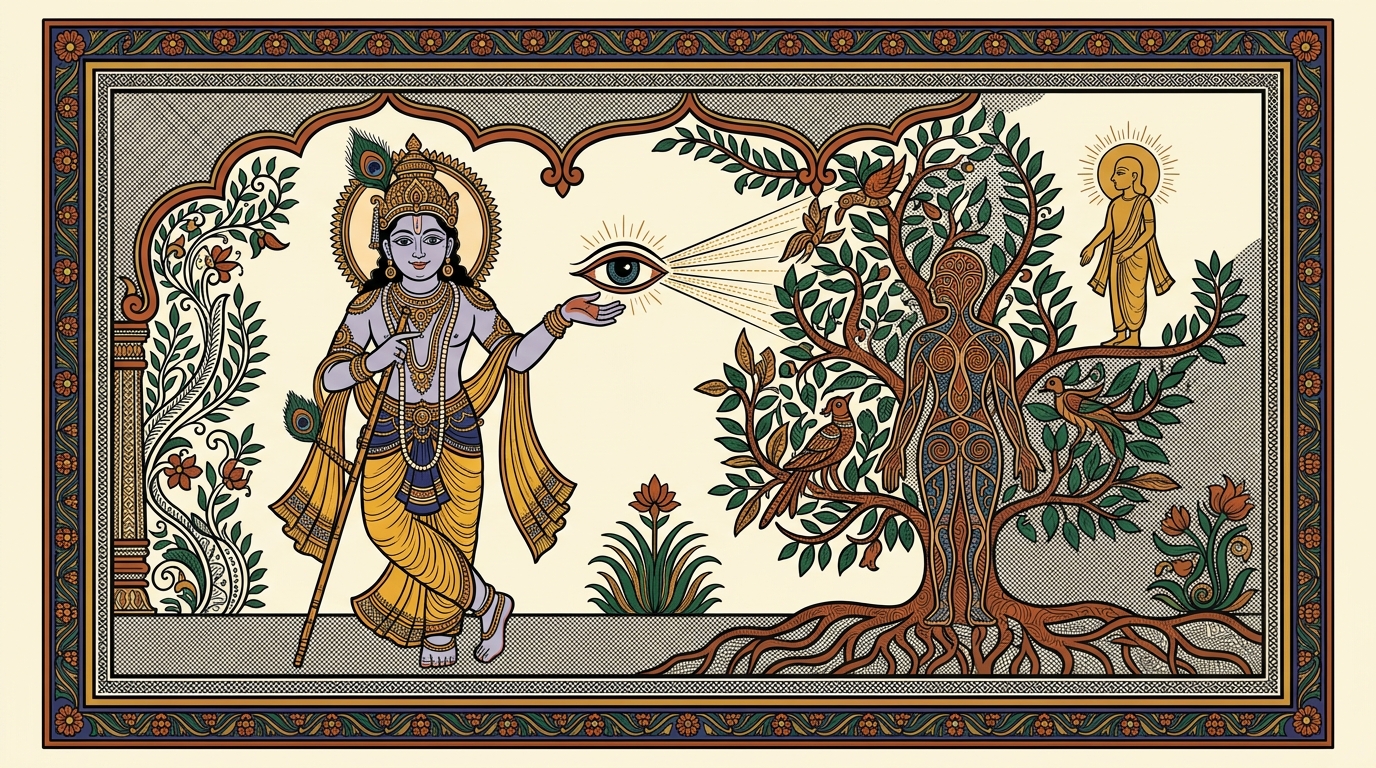
For thirty years the seeker Nirmala had carried a single question, and now,
on a clear morning by the bank of the river, the question was about to
answer itself.
She had begun as a girl in her teacher's forest school, learning the old
teaching: that there is a field and there is a Knower of the field. The
field is everything that changes — the body that grows and ages, the
feelings that come and go, the whole turning world of nature. The Knower is
the one who watches all of it without changing. For thirty years she had
repeated this. For thirty years she had only half believed it.
She had felt, like everyone, that she was her body. That she was her busy
thoughts. That when the body hurt, she hurt; when the thoughts raced, she
was the racing. The teaching had been a sentence in her memory, not a sight
in her eyes.
But this morning, sitting very still as the river slid past and a single
white crane lifted off the far bank, something shifted. It was as if a thin
veil she had never known was there suddenly drew aside.
She watched a thought rise in her mind — and saw, with sudden clearness,
that she was the one watching it, not the thought itself. She felt the cool
air on her skin — and saw that she was the one knowing the feeling, not the
skin. The body sat breathing on the riverbank; the feelings drifted through
like the river's ripples; the whole field of nature went on changing. And
she — the quiet Knower — simply watched, unchanging, free.
For the first time the difference was not a sentence. It was a seeing. The
field was over here, changing. The Knower was here, still. And between them
lay all the freedom in the world. Nature could do what nature did; she was
not bound to any of it. The beings of the world were not trapped in nature
after all — they only had to open this eye of knowledge to step free.
Nirmala rose. She did not feel that she had gained something new so much as
set down something heavy she had carried by mistake all her life. The river
shone. The crane was a white speck against the blue. And she walked into the
morning weightless, having told apart the field from the One who knows it —
and so, at last, reaching the Supreme.