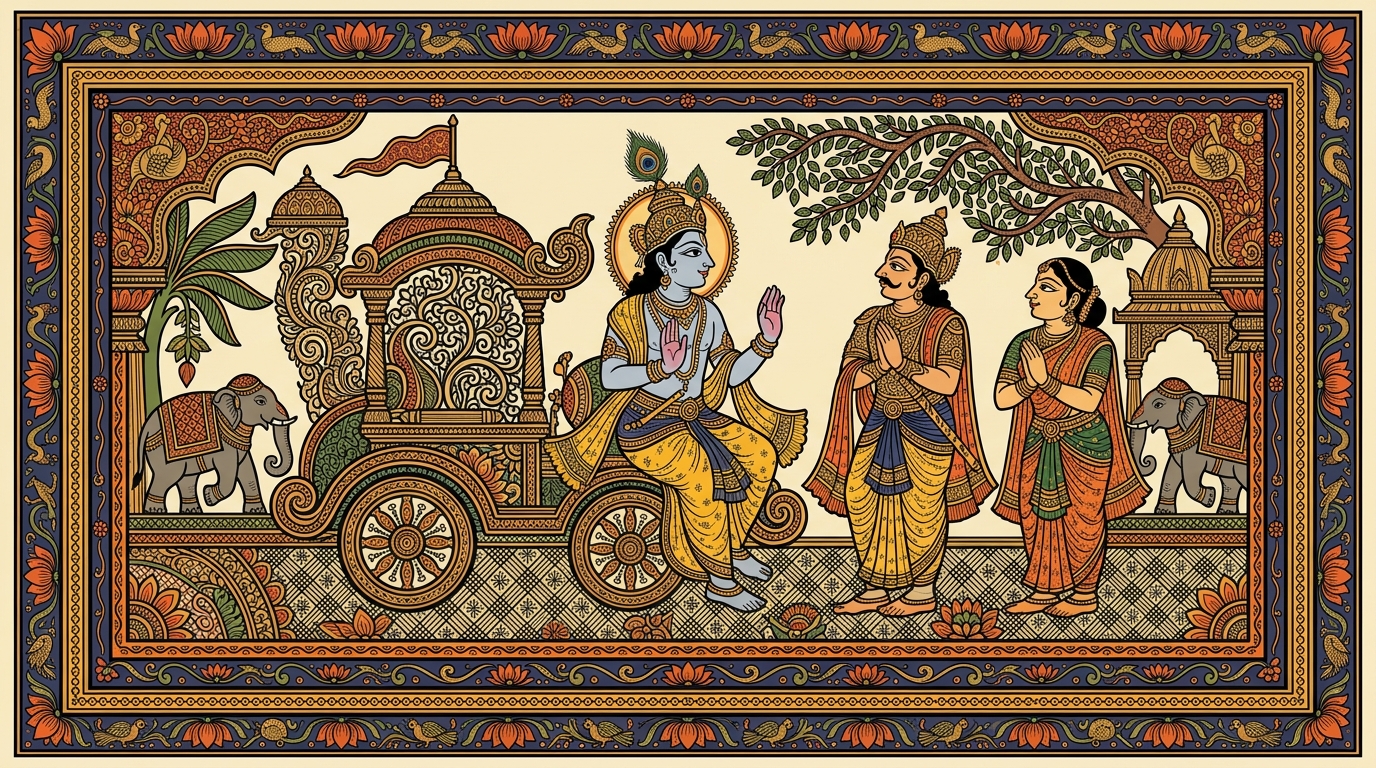
At the forest school of the sage Gautama, two students sat side by side
under the same wide banyan tree, learning from the same teacher.
Their names were Aruni and Vidura, and from the outside they looked alike —
same simple robes, same slates, same morning chores. But inside, they were
walking in two very different directions.
Aruni had one question burning quietly in his heart, and he never let it go:
"Who am I, really? What is this Self the teacher speaks of, the truth behind
everything?" Whatever he was doing — sweeping the courtyard, fetching water,
reciting a hymn — a part of him stayed turned toward that question, the way a
sunflower stays turned toward the sun. The chores changed, the seasons
changed, but the direction of his heart did not.
Vidura was clever — cleverer than Aruni, some said. He could memorise a hymn
after hearing it once. But his attention darted everywhere, like a sparrow
that never lands. One day he wanted to win a debate. The next, he wanted
praise. The next, he forgot the lesson entirely, daydreaming about a feast
in the village. The deep question — Who am I, really? — would float up in
his mind, and he would brush it away like a fly. There was always something
shinier to think about.
Years passed. Both students learned a great many verses.
One evening the old teacher called them and said, "Tell me what you have
found."
Aruni spoke softly. "Teacher, I do not know everything. But I have never let
go of the question of the Self. It is always before me, like a lamp I carry
through a dark house. Wherever I go, it lights my way."
Vidura spoke quickly and brilliantly, reciting hymn after hymn, fact after
fact. But when the teacher asked, "And the Self — have you kept it in
sight?" Vidura fell silent. Somewhere along the way, he had lost the thread.
The teacher laid a hand on each boy's head. "Aruni," he said, "you possess
knowledge — not because you know the most, but because you never looked
away from the truth. And Vidura, my clever one, you have gathered a thousand
facts and mislaid the one thing that mattered. That forgetting, my son, is
what we call ignorance. Turn back toward the lamp. It is not too late."