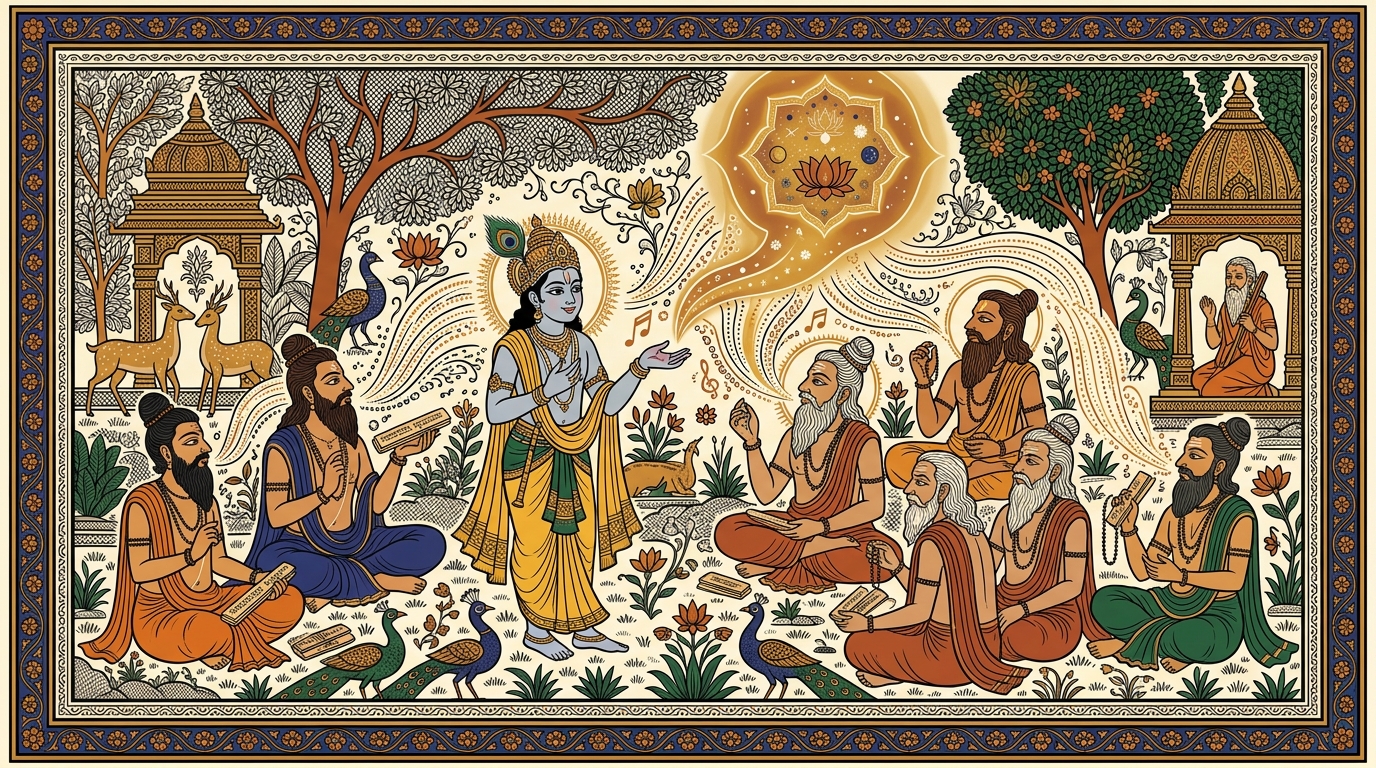
Once, long ago, the great rishis gathered. They came from every corner of
the land — from snowy mountain caves, from river islands, from forest
clearings and seaside hermitages — to sit together for one full moon and
speak of the highest truth.
A great fire was lit in the center of the clearing. The sages settled
around it as the stars came out, and one by one, they spoke of the Self,
the knower seated in every field.
The first sage was old and quiet. He closed his eyes and sang a slow,
deep chant, the kind used in the most ancient sacrifices. His Self was
*the breath of all breaths, the light behind the eye.*
The second was a poet. She sang her truth in flowing, beautiful verses,
full of images — the Self as a swan gliding on a still lake, as honey
hidden in a flower.
The third did not sing at all. He reasoned, step by careful step, the way
a builder lays stones. "If the body changes," he said, "there must be one
who notices the change, who does not change. Follow the argument: that one
is the Self." His words were short and sharp and certain.
A young listener, sitting at the edge of the firelight, grew confused.
"But they are all saying *different* things!" he whispered to the sage
beside him. "One sings, one makes poems, one argues. Which one is right?"
The old sage chuckled. "Look at the fire, child."
The boy looked. The flames leapt orange, gold, blue at the base, red at
the tips, throwing sparks up into the dark.
"So many colours," said the sage. "So many shapes, never the same for two
moments. Is it many fires?"
"No," said the boy. "It's one fire."
"Just so. Each rishi sings the one truth in his own voice — one in chant,
one in poetry, one in reasoned argument, written down in the threadlike
verses about Brahman. The voices differ. The songs differ. The truth does
not. They are all describing the very same Self that knows every field."
The boy looked around the circle of glowing faces, all turned toward the
same flame, all speaking of the same hidden light — and understood.
This is what Krishna reminded Arjuna: *the sages have sung this in many
ways, in many hymns and in well-reasoned verses.* The teaching he was
giving was not new and not his alone. It was the one old truth, carried
down in a thousand different songs.