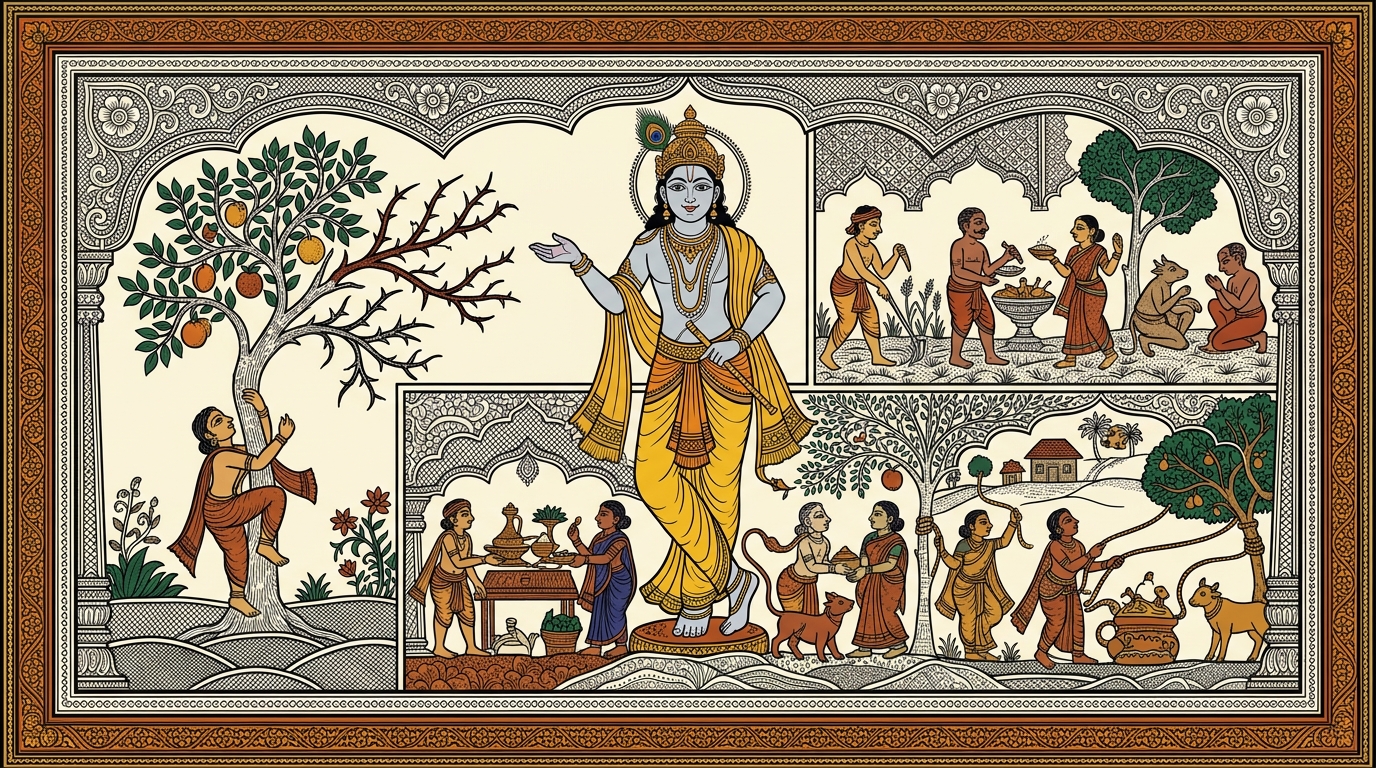
Long ago, a young traveller named Sumati set out from his village to
reach the great teacher who lived past the seven hills. His father had
walked the road once and warned him: "Keep your feet moving and your
eyes on the path. The road is long, but it ends at the teacher's door."
Sumati promised he would.
The first morning, the road wound through a mango grove so sweet-smelling
that he stopped to eat. The mangoes were warm from the sun and dripping
with juice. "Just one more," he said, again and again, until the
afternoon was gone.
The next day he came to a river where village children were splashing
and laughing. He waded in to cool his feet — and stayed till dusk,
soaked and giggling, the teacher's door forgotten.
Then came a festival town, drums booming, sweets piled high, lamps
swinging from every doorway. Sumati danced. He feasted. He cheered. When
the festival ended he wandered into another, and another, chasing the
next bright thing the way a moth chases the next lamp.
Months passed. Then years. Sumati's sandals wore through and he bought
new ones. His face grew lined. One festival left him richer; the next
left him robbed and hungry, sleeping in a cold doorway. Up and down he
went — a fine meal here, an empty belly there — like a leaf tossed on
a stream. And with every turn, he forgot a little more why he had ever
started walking.
One evening, footsore and grey-haired, he met a child sitting by the
roadside. "Where are you going, uncle?" the child asked.
Sumati opened his mouth — and could not remember. He had been so busy
tasting the road that he had forgotten he was a traveller at all. He had
forgotten the teacher. He had forgotten the door.
He sat down heavily in the dust. Slowly, like a bell ringing far off,
his father's words came back: "Keep your eyes on the path." He had
chased every sweet thing and every bitter thing along the way, and the
chasing itself had kept him wandering, life after life, never arriving.
That, the wise say, is exactly how the Self forgets itself. It settles
into nature, tastes her pleasures and pains, and clings — and the
clinging is the rope that ties it to the long, winding road of births.
The traveller is never trapped by the road itself. Only by loving the
road more than the door.