In a quiet ashram beside a wide river, the sage Kapila sat with his mother,
Devahuti. He had grown into a great teacher, and she had come, humbly, as
his student.
"My son," she said, "the world spins around me — birth and death, joy and
sorrow, things made and things broken. Help me see what is really going on."
Kapila scooped up a handful of river clay and set it on a flat stone between
them. "Watch, Mother." With his thumbs he shaped the clay quickly — first a
little pot, then he crushed it and made a tiny elephant, then crushed that
and rolled it into a ball, then flattened the ball into a leaf.
"How many things did I just make?" he asked.
"Four," she said. "A pot, an elephant, a ball, a leaf."
"And how many lumps of clay?"
Devahuti smiled. "One. Always the same clay. Only the shapes changed."
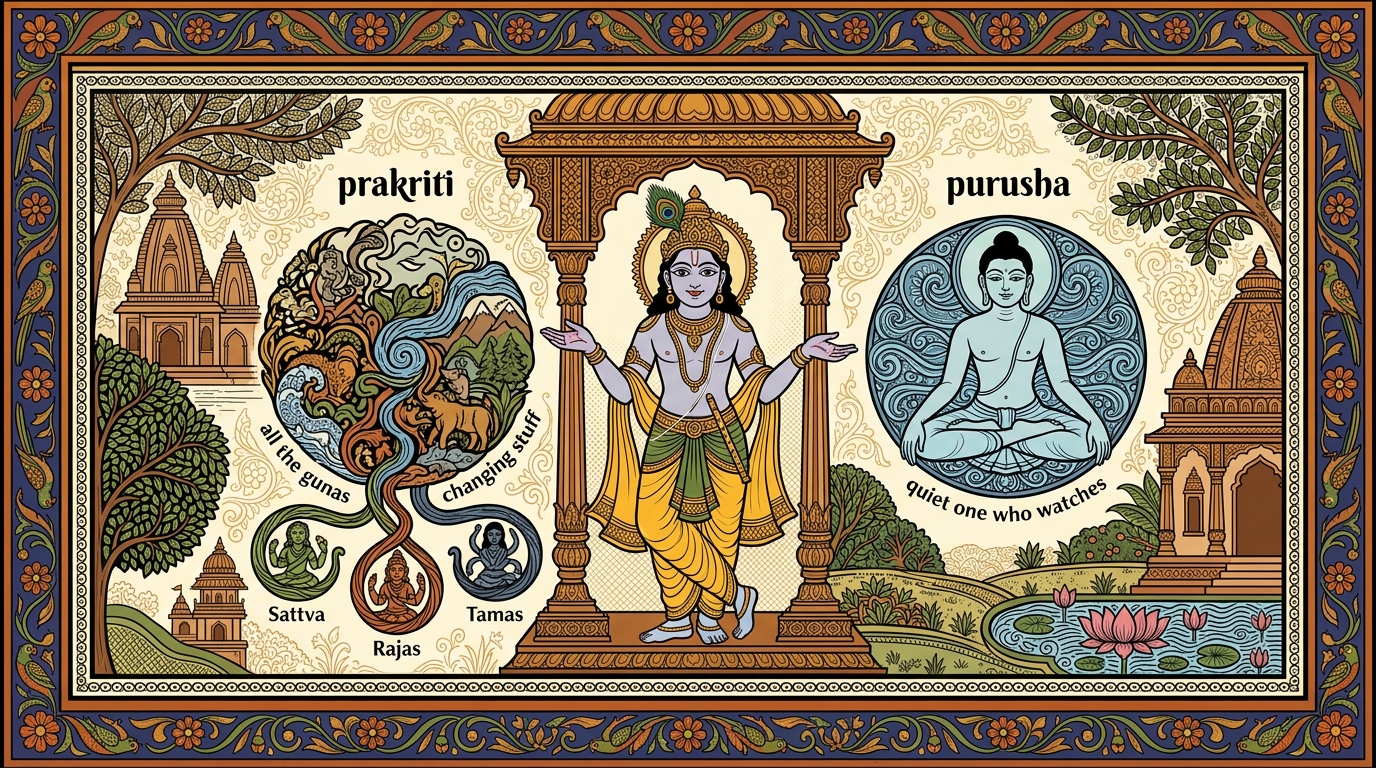
"This is prakriti," said Kapila. "Nature. The one clay that everything is
shaped from — bodies, mountains, seas, thoughts, feelings. It is forever
being made into new shapes and crushed and made again. The pot, the elephant,
the ball — those are the changes, the modifications. And the way the clay can
be heavy or light or sticky — those are the gunas, nature's three moods.
Changes and gunas, all born from this one clay. It has no beginning. It was
always here."
"And the other thing you spoke of?" she asked.
Kapila set down the clay and went still. "Now look at us. Who watched the
clay change from pot to elephant to leaf? You did. I did. The shapes came and
went, but the watcher stayed the same the whole time. That watcher is
purusha — the Self, the conscious one. It does not get shaped or crushed. It
only knows. And it too has no beginning."
Devahuti looked at the little flattened leaf of clay, then at her own hands,
then at her son's calm eyes. "So all my life," she said slowly, "the clay of
me has been changing — baby, girl, mother, old woman — but the watcher inside
has been the same all along."
"Yes, Mother," said Kapila. "Two things, both beginningless. The clay that
changes. The one who watches it change. Knowing them apart is the start of
freedom."
The river slid past them, carrying its endless clay to the sea, while the two
of them sat unchanged on the bank, watching.