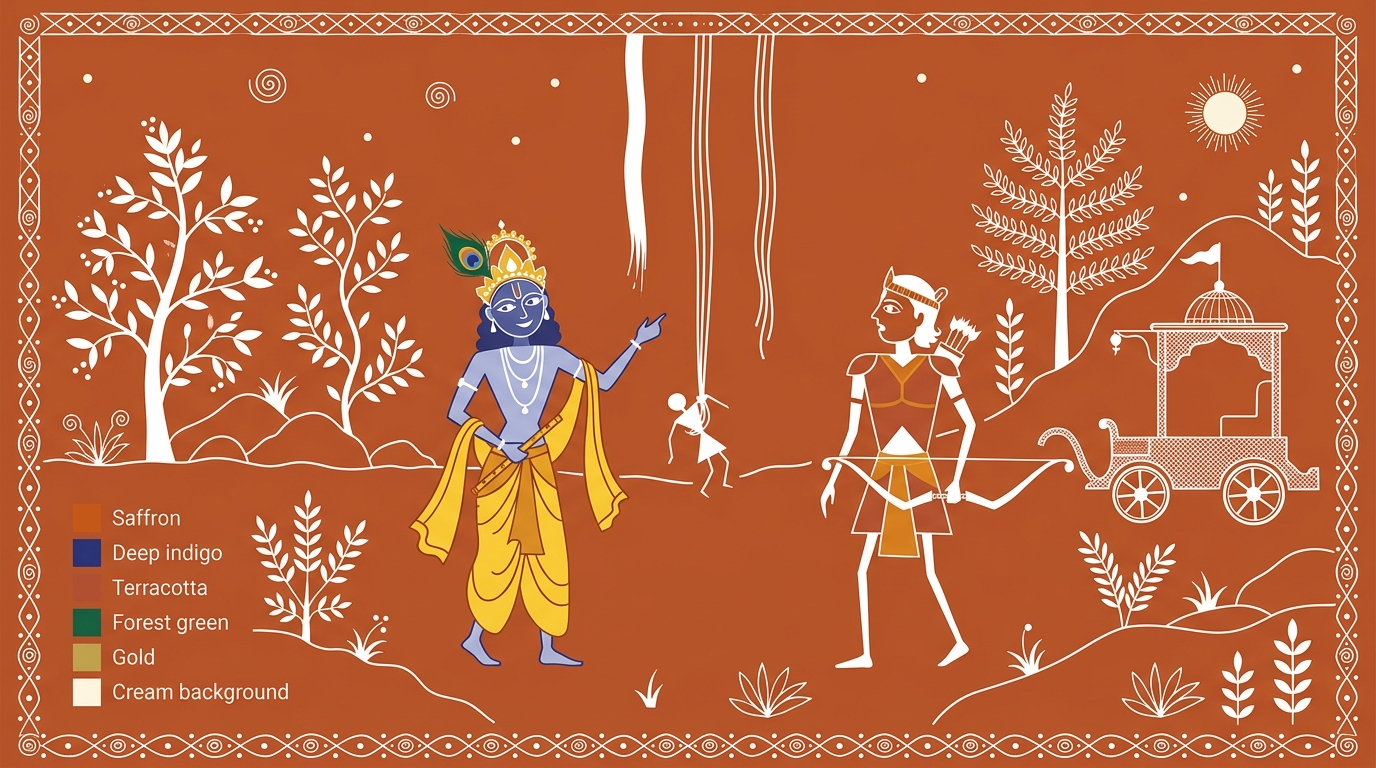
It was the kind of morning Jeeva loved best. The sun came up clean and gold
over the Warli hills, the air smelled of wet earth and woodsmoke, and the
whole village seemed to wake up smiling. Jeeva felt clear and happy and
strong, the way you do when you have slept well and nothing is wrong anywhere.
He found Aaji at the courtyard wall, painting a row of tiny white dancers in
a circle. He sat beside her and watched, and everything she did made perfect
sense to him — why the dancers held hands, why the circle never ended.
"Aaji," he said, "I feel wonderful today. My head is so clear. I understand
everything. I wish every single day could be exactly like this one."
Aaji dipped her bamboo stick in the white paste and smiled. "That feeling,"
she said, "is sattva — the bright thread. The cleanest, kindest of the three.
When sattva is strong in you, you feel calm and well, and your mind shines so
you can see things clearly. It is a good morning indeed."
"Then sattva is the best one!" said Jeeva. "I want to be full of it always."
Aaji painted another little dancer before she answered. "It is the loveliest
of the three," she agreed. "But listen, little one. Did you hear what you
just said? *I wish every day could be exactly like this. I want this feeling
always.*"
Jeeva nodded.
"There," said Aaji gently. "That is how even the bright thread ties you. Not
with anything rough or cruel. It ties you because you want to hold on to
feeling good, and you want to hold on to understanding everything. You start
to cling — to the happiness, and to the cleverness. And then, when a duller
morning comes, as it always will, you fight it and you grieve."
Jeeva looked at his clear, happy hands. He had not thought a good feeling
could be a kind of rope.
"A thread of light is still a thread," said Aaji. "A soft, golden rope can
hold you just as surely as a heavy one. Enjoy your bright morning, Jeeva.
Drink it in. But hold it the way you hold sunshine in your open hand — not
the way you grip a coin in your fist."
Jeeva opened both his hands and let the morning light rest on his palms, warm
and gold, without trying to keep it. And somehow, doing that, he felt even
freer than before.