Long ago, the great sage Maitreya wanted to understand one thing above all:
where do all the different living things come from? There were so many — so
very many — and they were all so different from one another.
So he sat with his teacher, the wise Parashara, beneath a spreading tree, and
he asked.
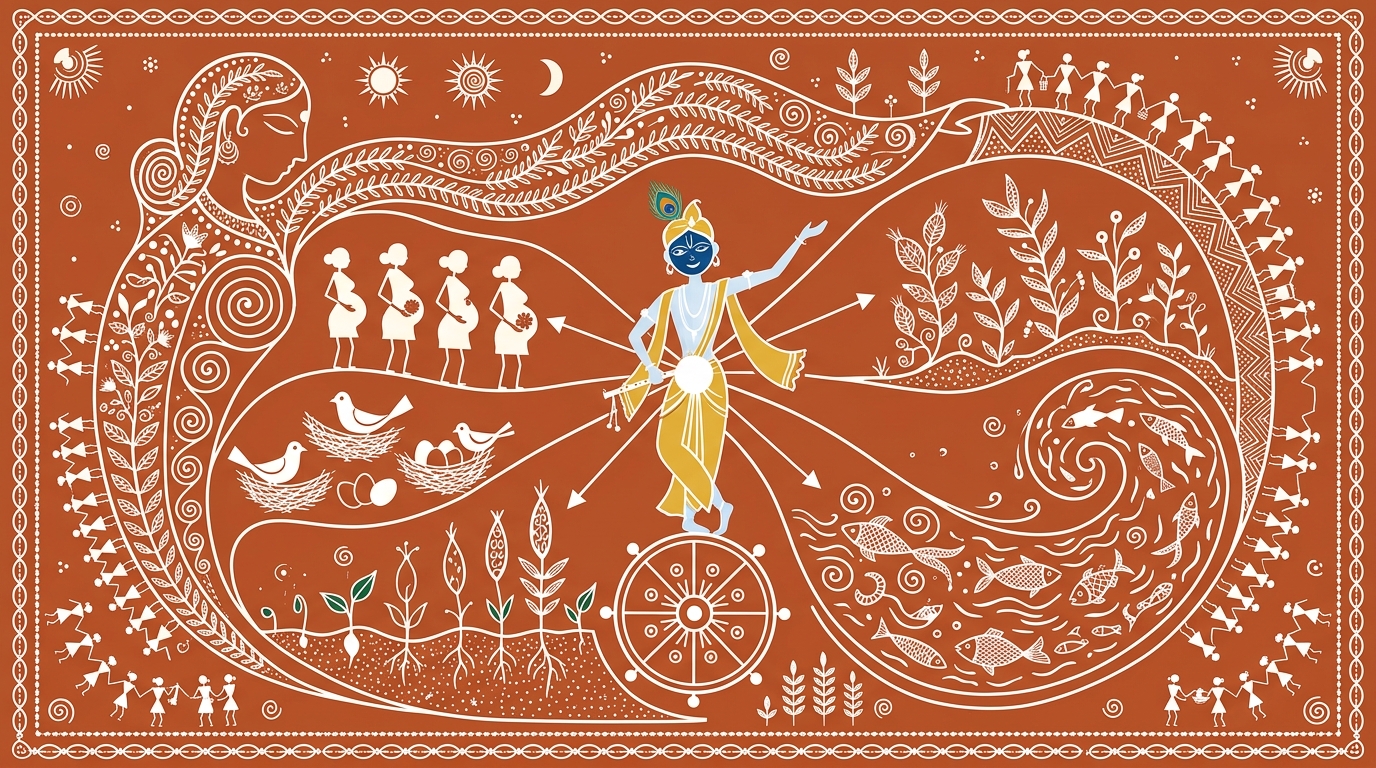
Parashara smiled and pointed first at a sparrow building a nest. "See the
little egg in her nest? A bird will hatch from it." Then he pointed to the
pond, where a fish flicked its tail among the reeds. "And there — that fish
will lay her eggs in the cool water." He pointed to the warm earth, where a
green shoot was pushing up. "And here, a seed split open in the soil, and a
whole tree is climbing out of it." He pointed, last, to a village mother
walking by with a baby on her hip. "And that little one grew inside his
mother and was born just months ago."
"So many different doorways into life," said Maitreya, wondering. "Eggs, and
seeds, and watery places, and mothers' arms."
"So many doorways," Parashara agreed. "Bird and fish, tree and child, beetle
and elephant — each one comes through its own kind of womb. The shapes are
endless. And yet—" he held up one finger, "—behind every single one of those
doorways stands the very same mother, and the very same father."
Maitreya leaned in.
"Great Nature is the mother of them all," said Parashara. "She is the vast
womb that holds and feeds and grows every shape there is — feathers, scales,
leaves, and skin. And the Lord himself is the father of them all. He gives
the spark, the tiny seed of life, into every womb there is. So whether you
are a sparrow or a fish, a banyan tree or a small girl, you have the same
enormous mother holding you and the same loving father who gave you your
first breath."
Maitreya looked around the clearing — at the bird, the fish, the shoot, the
passing child — and his eyes grew soft. They were all, every one of them,
brothers and sisters. They had simply come into the world through different
doors.