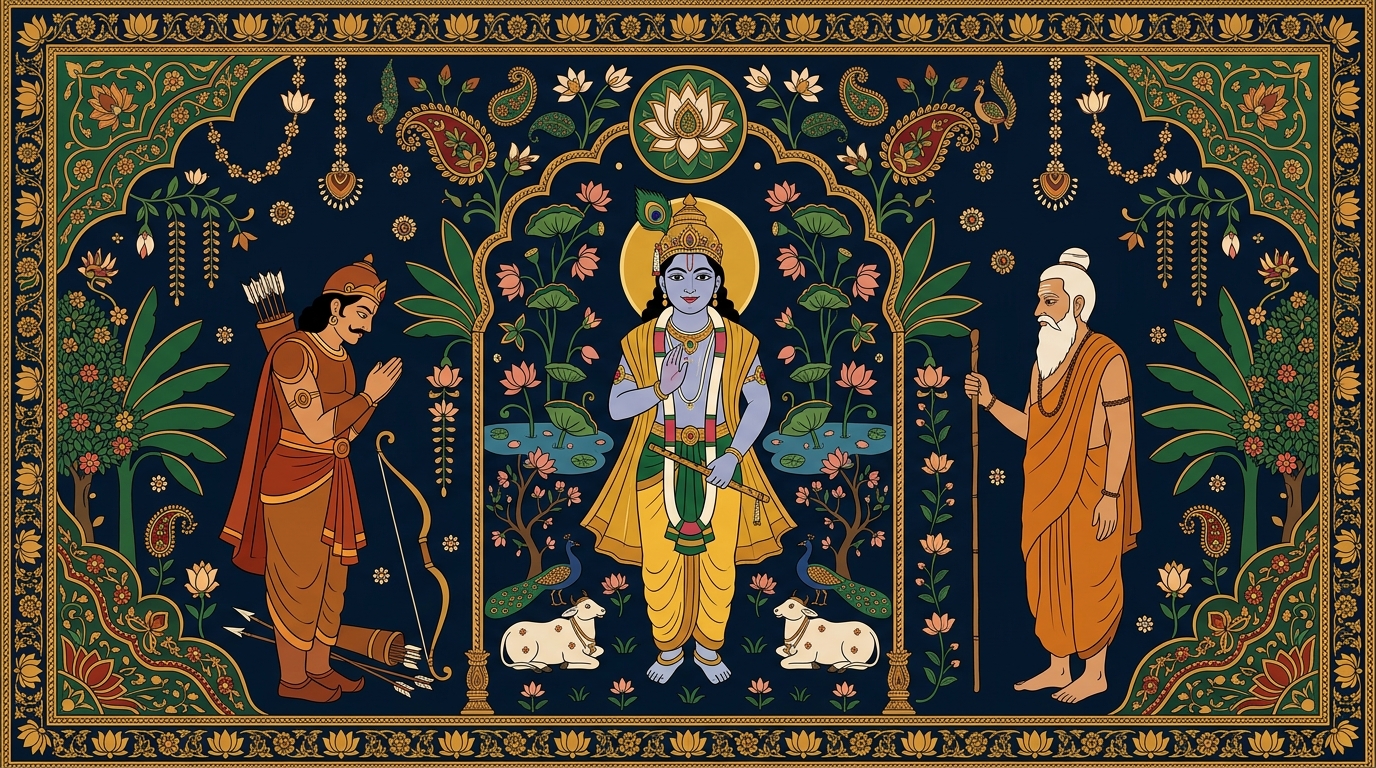
Arjuna's Sorrow
अर्जुनविषादयोग
The story begins on the battlefield of Kurukshetra. As the two great armies face each other, Arjuna asks Krishna to drive his chariot between them. When he sees his own family, teachers, and friends on both sides, his heart breaks. He drops his bow and refuses to fight. This chapter is about the courage it takes to face an impossible choice.
✶ Art Style: Pichwai from Rajasthan Learn more
Pichwai paintings are large cloth artworks that hang behind the idol of Shrinathji (a form of Krishna as a child) in temples of Nathdwara, Rajasthan. Each painting shows Krishna in different moods and seasons — playing in the rain, celebrating Holi, or dancing under the full moon. The style uses rich, deep colors on dark backgrounds, with incredibly detailed lotus flowers, cows, and gopis (milkmaids) arranged in symmetrical patterns around the central figure.
Signature Elements
- • Dark, jewel-toned backgrounds
- • Central figure of Krishna surrounded by devotees
- • Elaborate lotus ponds and flowering trees
- • Cows as recurring sacred motifs
Did you know?
A single Pichwai painting can take months to complete because every tiny detail — each petal on a lotus, each bead on a necklace — is painted by hand with brushes made from squirrel hair!
धर्मक्षेत्रे कुरुक्षेत्रे समवेता युयुत्सवः। मामकाः पाण्डवाश्चैव किमकुर्वत सञ्जय॥
DhritarashtraThe blind king Dhritarashtra asks his advisor Sanjaya: "On the sacred field of Kurukshetra, where my sons and the sons of Pandu have gathered to fight — tell me, Sanjaya, what did they do?"
दृष्ट्वा तु पाण्डवानीकं व्यूढं दुर्योधनस्तदा। आचार्यमुपसङ्गम्य राजा वचनमब्रवीत्॥
SanjayaSanjaya tells the king: "When Prince Duryodhana saw the Pandava army standing in perfect battle formation, he went straight to his teacher Dronacharya and spoke these words."
पश्यैतां पाण्डुपुत्राणामाचार्य महतीं चमूम्। व्यूढां द्रुपदपुत्रेण तव शिष्येण धीमता॥
DuryodhanaDuryodhana said to Drona: "Teacher, look at this mighty army of the Pandavas, arranged in battle formation by Dhrishtadyumna, the son of Drupada and your own clever student."
अत्र शूरा महेष्वासा भीमार्जुनसमा युधि। युयुधानो विराटश्च द्रुपदश्च महारथः॥
DuryodhanaDuryodhana continued: "In the Pandava army, there are mighty heroes and great archers who are as skilled as Bhima and Arjuna in battle — warriors like Satyaki, King Virata, and the great chariot-warrior King Drupada."
धृष्टकेतुश्चेकितानः काशिराजश्च वीर्यवान्। पुरुजित्कुन्तिभोजश्च शैब्यश्च नरपुङ्गवः॥
Duryodhana"There are also Dhrishtaketu, Chekitana, the brave King of Kashi, Purujit, Kuntibhoja, and Shaibya, all great warriors, each a bull among men."
युधामन्युश्च विक्रान्त उत्तमौजाश्च वीर्यवान्। सौभद्रो द्रौपदेयाश्च सर्व एव महारथाः॥
Duryodhana"And the courageous Yudhamanyu, the powerful Uttamaujas, Abhimanyu the son of Subhadra, and all five sons of Draupadi — every one of them is a great chariot warrior."
अस्माकं तु विशिष्टा ये तान्निबोध द्विजोत्तम। नायका मम सैन्यस्य संज्ञार्थं तान्ब्रवीमि ते॥
DuryodhanaDuryodhana said: "But now, O best of Brahmins, let me also tell you about the distinguished leaders on our side. I name them so you may know the commanders of my army."
भवान्भीष्मश्च कर्णश्च कृपश्च समितिञ्जयः। अश्वत्थामा विकर्णश्च सौमदत्तिस्तथैव च॥
Duryodhana"On our side there is yourself, Drona, and the mighty Bhishma, Karna, Kripa who always wins in battle, Ashwatthama, Vikarna, and Bhurishravas the son of Somadatta."
अन्ये च बहवः शूरा मदर्थे त्यक्तजीविताः। नानाशस्त्रप्रहरणाः सर्वे युद्धविशारदाः॥
Duryodhana"And there are many other heroes who are ready to lay down their lives for my sake. They are armed with all kinds of weapons and are all highly skilled in the art of warfare."
अपर्याप्तं तदस्माकं बलं भीष्माभिरक्षितम्। पर्याप्तं त्विदमेतेषां बलं भीमाभिरक्षितम्॥
Duryodhana"Our army, protected by Bhishma, is unlimited in strength. But their army, protected by Bhima, is limited." — Or does Duryodhana actually mean the opposite? This famous verse has a double meaning that scholars have debated for centuries.
अयनेषु च सर्वेषु यथाभागमवस्थिताः। भीष्ममेवाभिरक्षन्तु भवन्तः सर्व एव हि॥
DuryodhanaDuryodhana says: "All of you, standing at your assigned positions in the battle formation, must protect Bhishma from every side. This is the most important thing!" He is nervous and wants to make sure his strongest warrior stays safe.
तस्य सञ्जनयन्हर्षं कुरुवृद्धः पितामहः। सिंहनादं विनद्योच्चैः शङ्खं दध्मौ प्रतापवान्॥
SanjayaThen the mighty Bhishma, the oldest and most respected elder of the Kuru clan, roared loudly like a lion and blew his conch shell with a thunderous blast. The sound filled Duryodhana's heart with joy and courage.
ततः शङ्खाश्च भेर्यश्च पणवानकगोमुखाः। सहसैवाभ्यहन्यन्त स शब्दस्तुमुलोऽभवत्॥
SanjayaAfter Bhishma's conch, suddenly all the other instruments burst out together — conch shells, kettledrums, tabors, war drums, and cow-horn trumpets — all at once! The combined sound was tremendous and earth-shaking.
ततः श्वेतैर्हयैर्युक्ते महति स्यन्दने स्थितौ। माधवः पाण्डवश्चैव दिव्यौ शङ्खौ प्रदध्मतुः॥
SanjayaThen, on the Pandava side, Krishna and Arjuna, seated in a magnificent chariot drawn by white horses, blew their divine conch shells. This was the Pandava answer to the Kaurava war drums, and it came from just two people and two conches.
पाञ्चजन्यं हृषीकेशो देवदत्तं धनञ्जयः। पौण्ड्रं दध्मौ महाशङ्खं भीमकर्मा वृकोदरः॥
SanjayaKrishna blew his conch called Panchajanya. Arjuna blew his conch called Devadatta, meaning "given by the gods." And Bhima — the mighty warrior with the appetite of a wolf — blew his enormous conch called Paundra. Each conch had its own name and its own story.
अनन्तविजयं राजा कुन्तीपुत्रो युधिष्ठिरः। नकुलः सहदेवश्च सुघोषमणिपुष्पकौ॥
SanjayaKing Yudhishthira, the son of Kunti, blew his conch called Anantavijaya, which means "endless victory." The twins Nakula and Sahadeva blew their conches — Sughosha ("sweet-sounding") and Manipushpaka ("jewel-flower"). All five Pandava brothers were now sounding their conches together.
काश्यश्च परमेष्वासः शिखण्डी च महारथः। धृष्टद्युम्नो विराटश्च सात्यकिश्चापराजितः॥
SanjayaThe great archer King of Kashi, the mighty chariot-warrior Shikhandi, Dhrishtadyumna the bold and splendid, King Virata, and the invincible Satyaki — all these warriors were on the Pandava side, ready for battle.
द्रुपदो द्रौपदेयाश्च सर्वशः पृथिवीपते। सौभद्रश्च महाबाहुः शङ्खान्दध्मुः पृथक्पृथक्॥
SanjayaKing Drupada, the sons of Draupadi, and the mighty-armed Abhimanyu (son of Arjuna and Subhadra), all blew their conch shells, each one separately, one after another. Sanjaya is telling the blind king that the Pandava side had many great warriors joining in.
स घोषो धार्तराष्ट्राणां हृदयानि व्यदारयत्। नभश्च पृथिवीं चैव तुमुलो व्यनुनादयन्॥
SanjayaThat tremendous sound echoed through the sky and across the earth. It shattered the hearts of Dhritarashtra's sons. The Pandava war cry was so powerful that it pierced the courage of the Kauravas and filled them with fear.
अथ व्यवस्थितान्दृष्ट्वा धार्तराष्ट्रान् कपिध्वजः। प्रवृत्ते शस्त्रसम्पाते धनुरुद्यम्य पाण्डवः। हृषीकेशं तदा वाक्यमिदमाह महीपते॥
SanjayaThen Arjuna, whose chariot flew the flag of Hanuman, looked at the Kaurava army drawn up in battle formation. As the clash of weapons was about to begin, he raised his great bow Gandiva and spoke to Krishna: he was about to ask Krishna to drive his chariot between the two armies so he could see who he was about to fight.
अर्जुन उवाच। सेनयोरुभयोर्मध्ये रथं स्थापय मेऽच्युत॥
ArjunaArjuna said: "O Achyuta, O infallible Krishna, drive my chariot and place it between the two armies."
यावदेतान्निरीक्षेऽहं योद्धुकामानवस्थितान्। कैर्मया सह योद्धव्यमस्मिन् रणसमुद्यमे॥
Arjuna"I wish to see those who have come here to fight, those who are standing ready for battle. Let me know with whom I must contend in this great undertaking of war."
योत्स्यमानानवेक्षेऽहं य एतेऽत्र समागताः। धार्तराष्ट्रस्य दुर्बुद्धेर्युद्धे प्रियचिकीर्षवः॥
Arjuna"Let me see those who have assembled here, ready to fight, wishing to please the evil-minded son of Dhritarashtra (Duryodhana) in this battle."
सञ्जय उवाच। एवमुक्तो हृषीकेशो गुडाकेशेन भारत। सेनयोरुभयोर्मध्ये स्थापयित्वा रथोत्तमम्॥
SanjayaSanjaya said: "O descendant of Bharata (Dhritarashtra), thus addressed by Arjuna, Krishna drove the finest of chariots and stationed it in the middle, between the two armies."
भीष्मद्रोणप्रमुखतः सर्वेषां च महीक्षिताम्। उवाच पार्थ पश्यैतान् समवेतान् कुरूनिति॥
SanjayaKrishna said, in the presence of Bhishma, Drona, and all the rulers of the earth: "O Partha, behold all these Kurus assembled here."
तत्रापश्यत्स्थितान् पार्थः पितॄनथ पितामहान्। आचार्यान्मातुलान्भ्रातॄन्पुत्रान्पौत्रान्सखींस्तथा॥
SanjayaThere, Arjuna saw standing in both armies: fathers, grandfathers, teachers, maternal uncles, brothers, sons, grandsons, and friends.
श्वशुरान्सुहृदश्चैव सेनयोरुभयोरपि। तान्समीक्ष्य स कौन्तेयः सर्वान्बन्धूनवस्थितान्। कृपया परयाविष्टो विषीदन्निदमब्रवीत्॥
SanjayaHe also saw fathers-in-law and well-wishers in both armies. Seeing all these relatives standing ready for battle, Arjuna, the son of Kunti, was overwhelmed with deep compassion and spoke in great sorrow.
अर्जुन उवाच। दृष्ट्वेमं स्वजनं कृष्ण युयुत्सुं समुपस्थितम्। सीदन्ति मम गात्राणि मुखं च परिशुष्यति॥
ArjunaArjuna said: "O Krishna, seeing my own kinsmen standing here, eager to fight, my limbs are giving way and my mouth is drying up."
वेपथुश्च शरीरे मे रोमहर्षश्च जायते। गाण्डीवं स्रंसते हस्तात्त्वक्चैव परिदह्यते॥
Arjuna"My whole body is trembling, my hair is standing on end, my bow Gandiva is slipping from my hand, and my skin is burning all over."
न च शक्नोम्यवस्थातुं भ्रमतीव च मे मनः। निमित्तानि च पश्यामि विपरीतानि केशव॥
Arjuna"I am unable to stand still, my mind is spinning, and I see bad omens everywhere, O Keshava. I cannot foresee any good coming from killing my own kinsmen in battle."
न काङ्क्षे विजयं कृष्ण न च राज्यं सुखानि च। किं नो राज्येन गोविन्द किं भोगैर्जीवितेन वा॥
Arjuna"I do not desire victory, O Krishna, nor kingdom, nor pleasures. Of what use is a kingdom to us, O Govinda? Of what use are enjoyments, or even life itself?"
येषामर्थे काङ्क्षितं नो राज्यं भोगाः सुखानि च। त इमेऽवस्थिता युद्धे प्राणांस्त्यक्त्वा धनानि च॥
Arjuna"Those for whose sake we desire kingdom, enjoyments, and pleasures — they stand here in battle, having given up their lives and wealth."
आचार्याः पितरः पुत्रास्तथैव च पितामहाः। मातुलाः श्वशुराः पौत्राः श्यालाः सम्बन्धिनस्तथा॥
Arjuna"Teachers, fathers, sons, and also grandfathers, maternal uncles, fathers-in-law, grandsons, brothers-in-law, and other relatives —"
एतान्न हन्तुमिच्छामि घ्नतोऽपि मधुसूदन। अपि त्रैलोक्यराज्यस्य हेतोः किं नु महीकृते॥
Arjuna"These I do not wish to kill, O Madhusudana, even if they kill me — not even for the sovereignty of the three worlds, let alone for this earth."
निहत्य धार्तराष्ट्रान्नः का प्रीतिः स्याज्जनार्दन। पापमेवाश्रयेदस्मान्हत्वैतानाततायिनः॥
Arjuna"What pleasure can there be for us after killing the sons of Dhritarashtra, O Janardana? Only sin would come to us from slaying these aggressors."
तस्मान्नार्हा वयं हन्तुं धार्तराष्ट्रान्स्वबान्धवान्। स्वजनं हि कथं हत्वा सुखिनः स्याम माधव॥
Arjuna"Therefore, it is not proper for us to kill our own relatives, the sons of Dhritarashtra. How can we be happy after killing our own kinsmen, O Madhava?"
यद्यप्येते न पश्यन्ति लोभोपहतचेतसः। कुलक्षयकृतं दोषं मित्रद्रोहे च पातकम्॥
Arjuna"Even if they, whose minds are overpowered by greed, see no wrong in destroying a family and no crime in hostility to friends..."
कथं न ज्ञेयमस्माभिः पापादस्मान्निवर्तितुम्। कुलक्षयकृतं दोषं प्रपश्यद्भिर्जनार्दन॥
Arjuna"...why should we, who clearly see the evil in the destruction of a family, not turn away from this sin, O Janardana?"
कुलक्षये प्रणश्यन्ति कुलधर्माः सनातनाः। धर्मे नष्टे कुलं कृत्स्नमधर्मोऽभिभवत्युत॥
Arjuna"With the destruction of a family, the eternal family traditions perish. When dharma is destroyed, adharma, lawlessness, overtakes the entire family."
अधर्माभिभवात्कृष्ण प्रदुष्यन्ति कुलस्त्रियः। स्त्रीषु दुष्टासु वार्ष्णेय जायते वर्णसङ्करः॥
Arjuna"O Krishna, when adharma prevails, the women of the family become corrupted. And when women are corrupted, O descendant of Vrishni, there arises a confusion of social order (varna-sankara)." (Here Arjuna is speaking from the social fears and anxieties of his time. This is not a statement of fact, but a reflection of what he believed would happen when families and traditions were destroyed by war.)
सङ्करो नरकायैव कुलघ्नानां कुलस्य च। पतन्ति पितरो ह्येषां लुप्तपिण्डोदकक्रियाः॥
Arjuna"Such disorder brings only hell, for the destroyers of the family and for the family itself. The ancestors fall from their high place, deprived of the sacred offerings of rice and water."
दोषैरेतैः कुलघ्नानां वर्णसङ्करकारकैः। उत्साद्यन्ते जातिधर्माः कुलधर्माश्च शाश्वताः॥
Arjuna"By these sins of the family destroyers, which cause the breakdown of social order, the eternal duties of the community and the family are destroyed."
उत्सन्नकुलधर्माणां मनुष्याणां जनार्दन। नरकेऽनियतं वासो भवतीत्यनुशुश्रुम॥
Arjuna"O Janardana, I have heard that those whose family dharma has been destroyed must dwell in hell for an indefinite period of time."
अहो बत महत्पापं कर्तुं व्यवसिता वयम्। यद्राज्यसुखलोभेन हन्तुं स्वजनमुद्यताः॥
Arjuna"Alas! What a great sin we have resolved to commit: that we are prepared to kill our own kinsmen, driven by greed for the pleasures of a kingdom!"
यदि मामप्रतीकारमशस्त्रं शस्त्रपाणयः। धार्तराष्ट्रा रणे हन्युस्तन्मे क्षेमतरं भवेत्॥
Arjuna"It would be far better for me if the sons of Dhritarashtra, weapons in hand, were to kill me on the battlefield, unarmed and unresisting."
एवमुक्त्वार्जुनः सङ्ख्ये रथोपस्थ उपाविशत्। विसृज्य सशरं चापं शोकसंविग्नमानसः॥
SanjayaSanjaya said: "Having spoken thus on the battlefield, Arjuna cast aside his bow and arrows and sat down on the seat of his chariot, his mind overwhelmed with grief."
सञ्जय उवाच। एवमुक्त्वा हृषीकेशं गुडाकेशः परन्तपः। विषीदन्निव भारत संग्रामे न युयुत्सुरथ तस्थौ॥
SanjayaSanjaya said: "Having spoken thus to Hrishikesha (Krishna), Gudakesha (Arjuna), the scorcher of foes, sat down on the seat of his chariot in the middle of the battlefield, no longer wishing to fight, his mind overwhelmed with grief."