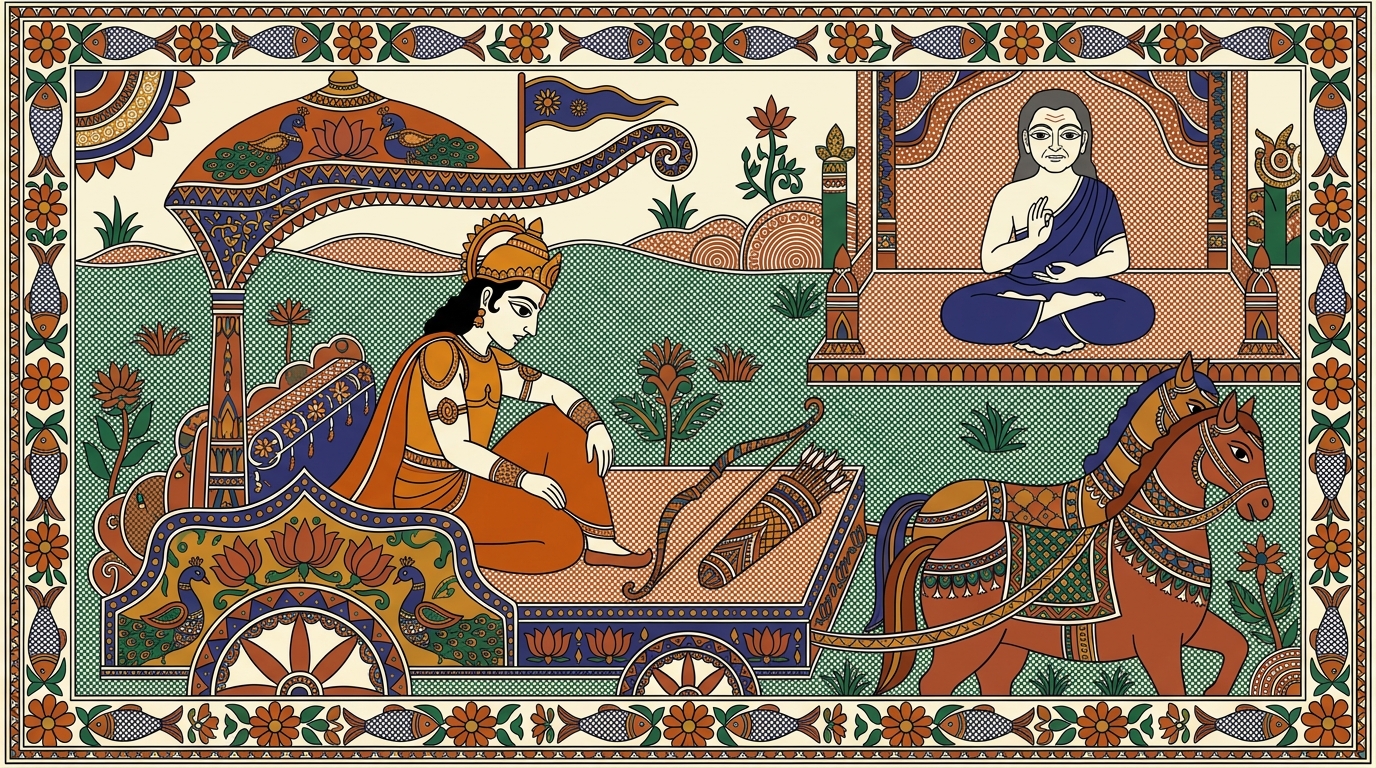
This is how it happened.
The Gandiva was the most famous bow in the world. It had been made
by Brahma himself, carried by Soma the moon god for a thousand years,
then by Varuna the lord of waters for a thousand more, before it came
to Arjuna. It was as tall as a man, curved like the crescent moon,
and when Arjuna drew its string back to his ear, the sound it made
was not a twang but a roar, a deep, rolling thunder that shook the
air and told every soldier on the field that the greatest archer who
had ever lived was about to release.
Arjuna had held that bow since he was sixteen. He had carried it
across forests and mountains, through exile and war, through fire
and flood. His palm knew every groove in its grip. The calluses on
his fingers had been shaped by its string. The Gandiva was not a
tool he used. It was a part of his body, an extension of his arm,
as natural as breathing.
And now he let it go.
Not gently. Not carefully. He let it fall the way you let go of
something that has become unbearable to hold, the way you drop a
coal that is burning your hand. The great bow slipped from his
fingers, struck the wooden floor of the chariot, and the sound it
made was small. That was the strange thing. After all the thunder,
after all the roaring, the Gandiva hitting the chariot floor made a
sound no louder than a book falling from a table. A dull, wooden
knock. And then silence.
The arrows spilled from his quiver. They rolled across the chariot
floor like scattered pencils, their steel tips catching the late
afternoon light. One rolled to the edge and fell over the side,
landing in the dust below with a soft click that nobody heard.
Arjuna sat down.
Not on a throne. Not on a cushion. On the floor of his war chariot,
between the fallen bow and the scattered arrows, his back against
the side panel, his knees drawn up, his head bowed. The greatest
warrior in the Pandava army, the man whose name alone could make
enemy soldiers turn pale, sat down like a child who has been walking
too long and cannot take another step.
Around him, the battlefield roared. Conch shells screamed. War drums
pounded. Elephants trumpeted and horses stamped and a million men
shouted battle cries that shook the earth. But inside the chariot,
there was only Arjuna and his grief and the terrible stillness of
a man who has understood something that the rest of the world has
not caught up to yet.
Krishna did not speak. He held the reins of the four white horses
and watched. He did not say "Pick up your bow." He did not say "Be
brave." He did not say anything at all. He simply waited, the way
a doctor waits for a fever to break, the way a farmer waits for
rain, because he knew that this collapse was not the end of the
story. It was the beginning.
Years later, when the war was over and the dead were counted and
the kingdom was won at a cost too terrible to name, people would
remember this moment. Not the battles. Not the victories. Not the
celestial weapons that split the sky. They would remember the
moment the bow hit the floor. Because that small, dull sound,
wood striking wood, was the sound of a man choosing to feel when
it would have been easier to fight. It was the sound of the heart
overruling the hand. It was the crack through which the light of
the entire Bhagavad Gita would pour in.
Every great teaching in history begins with someone stopping.
The Buddha sat under a tree and refused to move. Mahavira put down
his possessions and walked into the forest with nothing. Gandhi
stopped a march to pick up salt from the sea. And Arjuna — the
greatest archer the world had ever known — dropped his bow on the
floor of a chariot and said, with his body and his silence, what
his words could no longer say: I will not do this.
He did not know, sitting there with his grief pressing down on him
like a stone on his chest, that Krishna was about to speak. He did
not know that the seven hundred verses of the Bhagavad Gita, the
song that would be sung for five thousand years, the teaching that
would cross oceans and centuries and reach into the hearts of people
not yet born, were waiting on Krishna's tongue, ready to begin.
All he knew was that he could not lift the bow. And that was enough.
Sometimes the most powerful thing a person can do is stop. Not
because they are weak. Not because they are afraid. But because
they have seen something so clearly, felt something so deeply,
that moving forward in the old way has become impossible. The
warrior who stops is not less than the warrior who fights. He is
more. Because stopping requires you to feel everything that fighting
lets you ignore.
The Gandiva lay on the chariot floor. The arrows lay scattered
around it. And Arjuna sat in the stillness, his mind drowning in
sorrow, and waited, without knowing it, for the voice that would
change everything.