Dadi's photo albums were kept in a steel trunk under her bed, wrapped
in old newspaper and tied with jute string. She rarely opened them.
But the week before the family court hearing, she pulled them out.
Vikram was twelve, and his parents were getting divorced. Not the
screaming kind — the quiet kind, where conversations became shorter
and shorter until the house filled with a silence so thick you could
almost touch it. His father had already moved to a flat across the
city. His mother worked late most nights, and Vikram ate dinner
with Dadi, his grandmother, who lived in the small room at the back
of the house.
"Come here," Dadi said that evening. She sat on her bed with the
album open on her lap, the pages yellowed and cracked, the photos
held in place with gummy corner tabs that had mostly come unstuck.
Vikram sat beside her. The first photo was black and white: a tall
man with a thick moustache standing beside a woman in a heavy
Banarasi sari. "Your great-grandparents," Dadi said. "Your Nana's
parents." She turned the page. A group of children squinting into
the sun outside a haveli. "Your grandfather is the short one on the
left. That tall boy beside him? That is your great-uncle Mohan, who
we don't talk to anymore." Another page: a wedding. "Your mother's
parents. See how young they are?"
Page after page, face after face. Dadi did not explain why she was
showing him this. She did not say "These are the people who love
you" or "Family is important." She just turned the pages and said
their names: Kamla Bua. Suresh Mama. Chhoti Nani. Pappu — nobody
remembers his real name, he was always just Pappu.
By the last page, Vikram's throat was tight. These were not
strangers. They were the people whose blood ran in his veins, whose
habits he had inherited without knowing — the way he cracked his
knuckles was exactly like the great-uncle in the photo, the one
nobody talked to anymore.
"Why are you showing me this, Dadi?"
She closed the album and placed her hand, papery and warm, on top
of his. "Because before anything changes," she said, "you should
see where you come from. All of it. The good parts and the broken
parts. So you know that whatever happens with your Ma and Papa,
you are not alone. You never were."
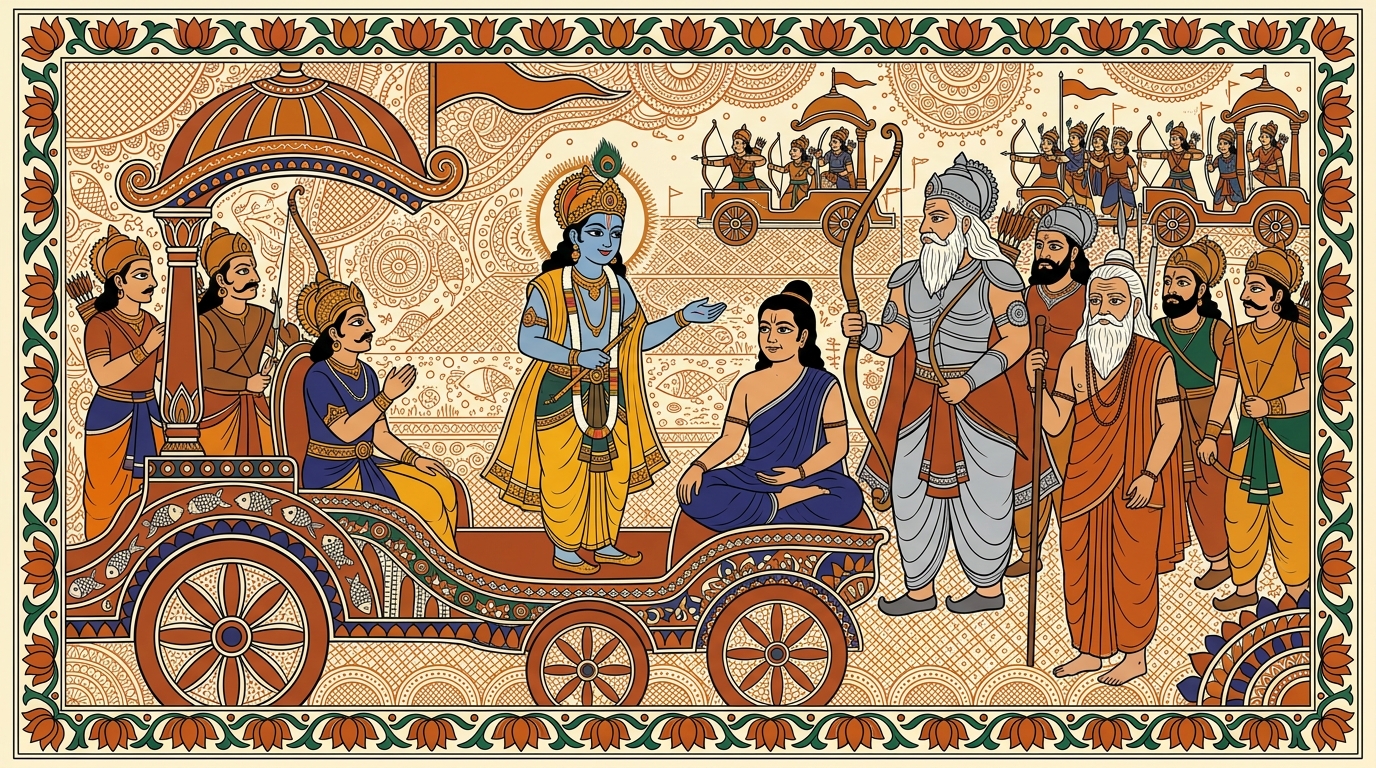
Krishna says just two words to Arjuna: "Paśya" — look. "Kurūn" —
at these Kurus. Your people. Your blood. He does not say "This
will be hard" or "Be brave." He simply says: look at them. The
looking will do the rest.