The bonfire had been Arjun's idea.
It was the last night of the school camping trip in Manali, and the
ninth-graders had gathered in a clearing behind the main campsite,
away from the teachers' tents. Someone had smuggled in firecrackers,
the big Lakshmi brand rockets with the red and green wrappers,
and the plan was to set them off over the river valley at midnight.
Everyone was excited. Everyone said it would be legendary. Everyone
said the teachers would never know.
Arjun sat on a log near the fire and watched the sparks spiral
upward into the pine trees. The forest was dry. It had not rained
in Manali for eleven days, and the needles on the ground crackled
like paper when you walked on them. He noticed this. He noticed the
wind, too, blowing downhill toward the tree line.
Nobody else seemed to notice.
"Bro, you're lighting the first one," Karan said, pressing a rocket
into Arjun's hand. The cardboard tube was warm from sitting near the
fire. The wick was short.
Arjun looked at the rocket. He looked at the trees. He looked at the
dry needles carpeting the ground in every direction. He thought about
forest fires he had seen on the news — the ones in Uttarakhand last
summer, where the smoke had blocked the sun for three days and the
animals had run downhill in a blind, terrified flood. He thought
about the village at the bottom of this valley, where a woman at the
chai stall had smiled at him that morning and called him "beta."
"I don't think we should do this," he said.
Silence. The kind of silence that is louder than noise. Twelve faces
turned toward him in the firelight. Karan's smile faded.
"What?"
"The forest is dry. The wind is blowing toward the trees. If a spark
catches—"
"Dude, relax. It's one rocket."
"It's a dry pine forest in May. One spark is all it takes."
Karan laughed. Others joined in, the way people laugh when they want
to make someone feel small. "You're overthinking it, yaar. Don't be
such a—"
"I'm not lighting it," Arjun said. He set the rocket down on the
log, stood up, and walked away from the fire. He walked back to his
tent, his footsteps loud on the dry pine needles, his face hot with
embarrassment and something else, something that felt strange and
unfamiliar but also solid, like a stone lodged in the centre of his
chest. Later, he would recognize it as the weight of doing the right
thing when the right thing is the unpopular thing.
The other boys did not light the rockets that night. Not because of
Arjun's words — they had dismissed those easily enough. But because
when Arjun walked away, the mood broke. The excitement had needed
everyone to participate. One person's refusal created a crack, and
through that crack, doubt seeped in. Karan looked at the trees. He
looked at the dry needles. And quietly, without admitting it, he put
the rockets back in his bag.
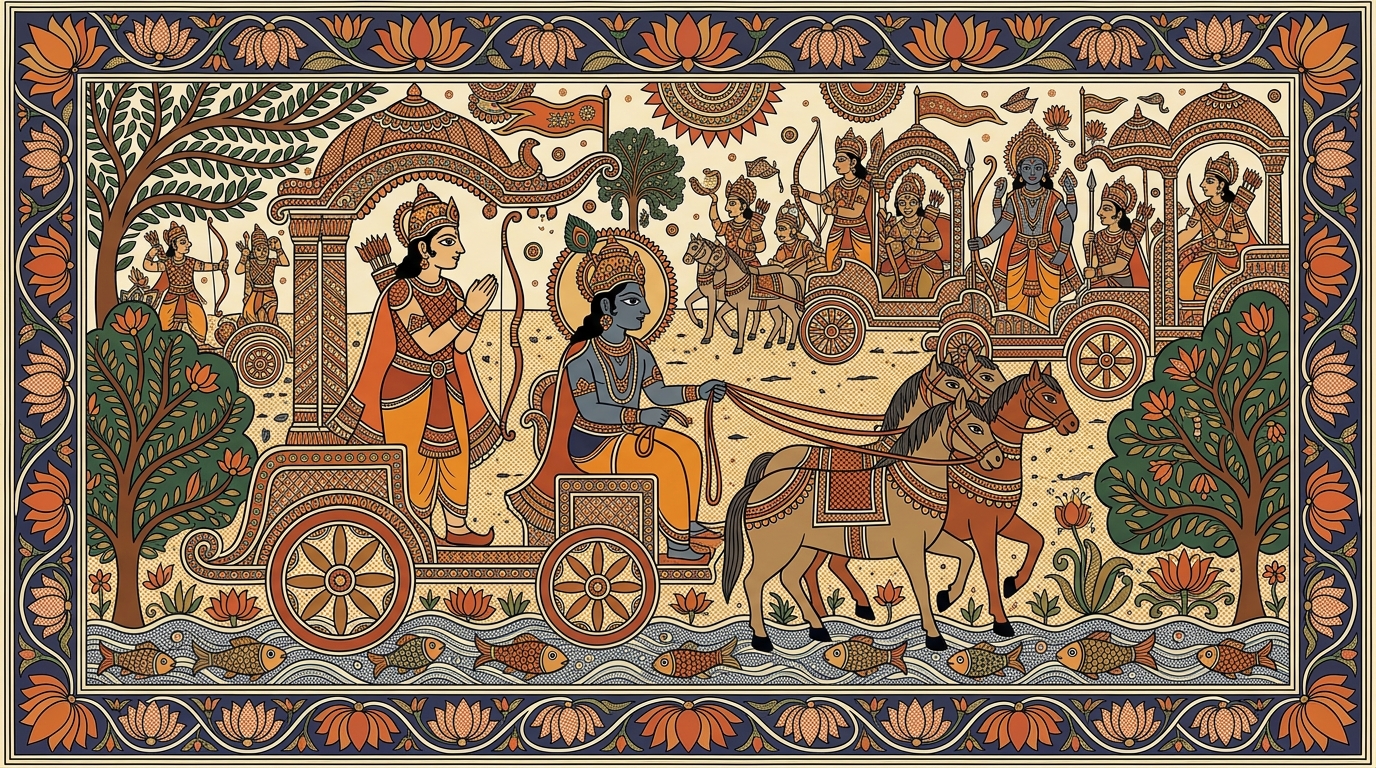
Arjuna says to Krishna: "We can clearly see the evil. Why should we
not have the wisdom to turn away?" Seeing the evil is the first
step. But seeing is not enough. You must also have the courage to
act on what you see — to set down the rocket, to stand up from the
log, to walk away from the fire — even when every voice around you
is telling you to stay.