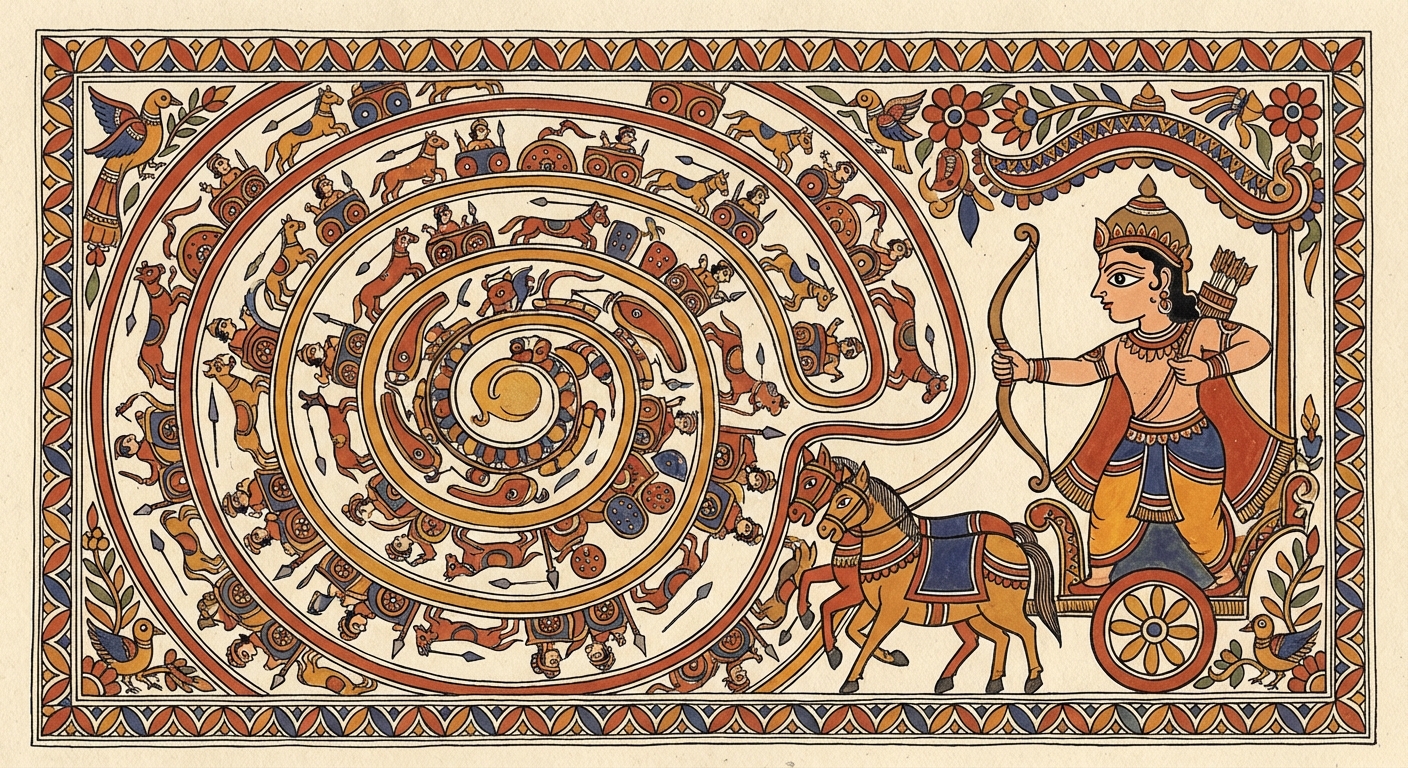
The war drums hammered so loud that Abhimanyu felt them in his ribs.
He was sixteen years old. His chariot horses — two white mares named
Suvarna and Megha — tossed their heads and whinnied as the Kaurava
army shifted into the Chakravyuha: a spinning, tightening spiral of
soldiers, chariots, and war elephants, designed to swallow anyone who
entered and crush them at the center.
No one on the Pandava side knew how to break through it. No one except
Abhimanyu.
He had learned the secret before he was born. His father Arjuna had
once described the Chakravyuha to his mother Subhadra — how to read
the rotating rings of soldiers, where to strike to open the first
gate, then the second, then the third. But Subhadra had fallen asleep
before Arjuna explained how to break back out. The unborn child in
her womb heard the way in. He never heard the way home.
Abhimanyu knew this. He knew exactly what he was walking into — a
labyrinth with no exit that anyone had taught him. And he chose to
enter anyway. Not because he was reckless, and not because he did not
understand the danger, but because his people needed someone to go
first, and he had the courage to be that person.
"I will enter," Abhimanyu told his uncles. His voice did not shake.
The first ring of the Chakravyuha was a wall of shields. Abhimanyu
drew his bow — his father's spare, almost too heavy for his arms — and
fired three arrows in a single breath. The shields split. Megha and
Suvarna surged forward through the gap, and the spiral swallowed him.
Inside, the noise was deafening. Elephants trumpeted. Chariot wheels
scraped and shrieked against each other like iron nails on stone.
Dust rose so thick that the sun became a pale coin overhead. Abhimanyu
could taste grit between his teeth, feel the heat of passing arrows
on his cheeks.
He fought through the second ring, and the third, and the fourth. He
broke the axle of Drona's chariot with a single well-placed shot.
He disarmed Karna — Karna! — sending the great warrior stumbling
backward. Soldiers twice his age fell back when they saw him coming,
this boy with his father's eyes and a bow that sang.
But behind him, the spiral closed. Jayadratha, guarding the gate,
sealed the entrance so that no Pandava reinforcements could follow.
Abhimanyu was alone inside the labyrinth.
He fought on. His bowstring snapped; he grabbed a chariot wheel and
used it as a shield. His sword broke; he picked up a mace from a
fallen soldier. One by one, his weapons ran out. But he did not stop.
It was not enough. Six of the greatest Kaurava warriors surrounded
him at once — a circle inside the circle. Abhimanyu fell, still
swinging, still fighting, still sixteen years old.
That evening, the battlefield was quiet. The wind carried the smell
of dust and iron. Somewhere, a horse stood alone beside an empty
chariot, waiting for a driver who would not return.
Duryodhana had feared Abhimanyu because he saw in the boy the fire of
his father Arjuna. He was right to be afraid. Even the Chakravyuha
could not dim that fire — it could only end it.
But fire, once lit, does not disappear. For generations after
Kurukshetra, warriors and mothers and children told the story of the
boy who rode into the labyrinth knowing he might not ride out — and
fought anyway, with everything he had, down to his bare hands. Arjuna
carried his son's courage like a lamp inside his chest for the rest of
the war, and when the grief threatened to drown him, it was
Abhimanyu's fearlessness that reminded him what it meant to stand up.
Some lives are not measured by their length, but by the light they
leave behind.