Neel's neighbour Mrs. Sharma had the meanest dog in the colony.
That was what everyone said, anyway. Rocky was a big German Shepherd
with a bark that rattled the windows. He paced behind the iron gate
all day, his nails clicking on the cement driveway, his ears flat
against his skull. The younger children crossed the street to avoid
Mrs. Sharma's house. Even the postman left her letters at the gate
pillar instead of walking up to the door.
"Vicious animal," Neel's mother said, pulling him away from the
fence one afternoon. "Mrs. Sharma keeps him half-starved. That's
why he's so angry."
Neel believed this for two years. Rocky was the enemy dog. The
dangerous one. The one you never looked at directly.
Then one evening during a power cut, Neel climbed onto the terrace
to escape the heat and happened to look down into Mrs. Sharma's
backyard. The old woman was sitting on a plastic chair under a neem
tree, and Rocky was lying beside her with his head in her lap. She
was stroking his ears and talking to him in a low, gentle voice.
Every few seconds, Rocky's tail thumped against the ground — not
the aggressive bark-and-lunge Rocky that Neel had always seen, but
a tired old dog who liked having his ears scratched.
Then Mrs. Sharma pulled a steel bowl from beside her chair and set
it down. It was full of rice and dal and pieces of chicken. Rocky
ate slowly, almost politely, and when he was done, Mrs. Sharma wiped
his muzzle with a cloth. "Good boy," she said. "Good boy."
Neel sat on the terrace for a long time after the lights came back
on, feeling a strange ache in his chest. He had spent two years
hating Rocky — or rather, hating the idea of Rocky that he had
built in his mind. The real Rocky was a guard dog who did his job
during the day and ate rice and dal from a steel bowl at night. He
was not evil. He was not half-starved. He was just a dog behind a
fence.
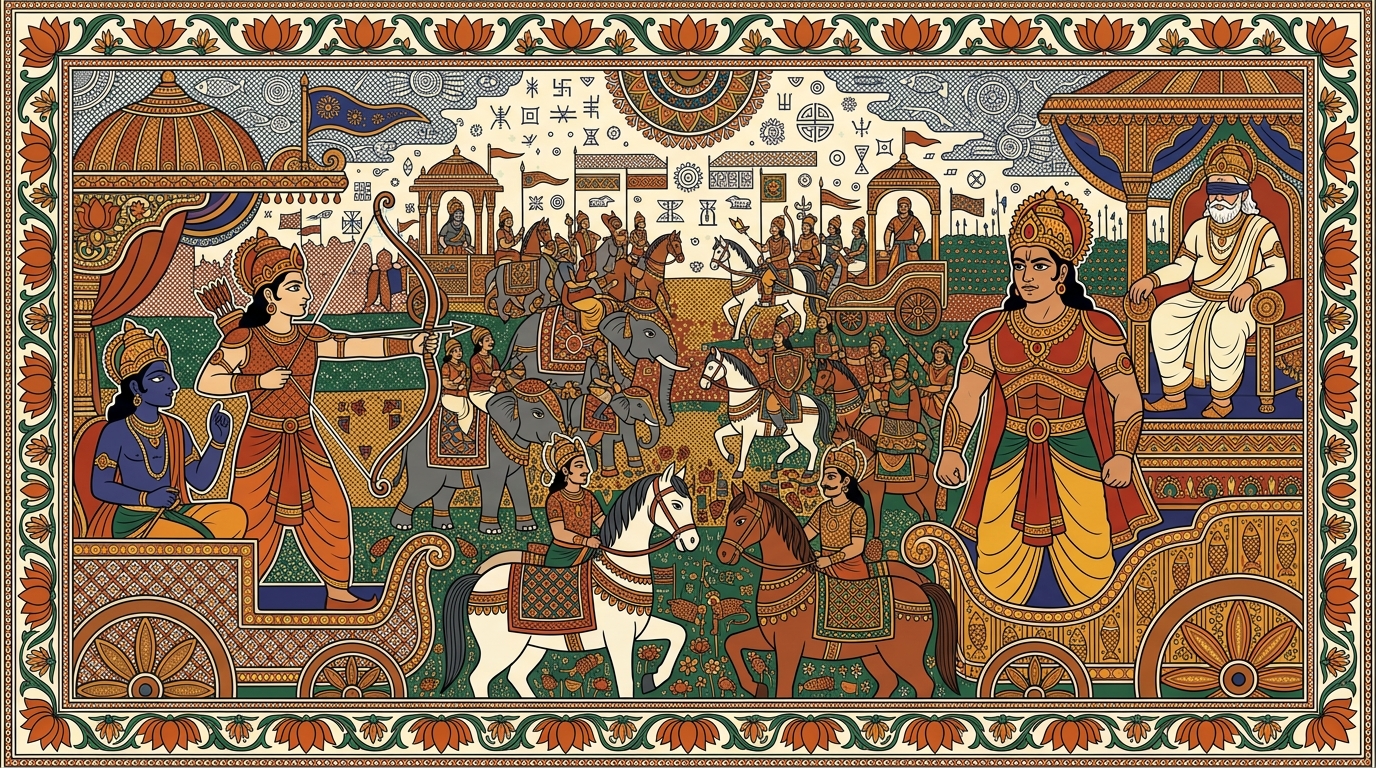
Arjuna asks to see the warriors who have gathered to please
Duryodhana. He calls Duryodhana "durbuddhi" — evil-minded. But
even as he uses that word, he wants to look at the men who follow
Duryodhana. He wants to see them as they are, not as he has
imagined them to be.
When we are about to fight, we make the other side
into something less than human — a name, a label, a bark behind
a fence. Arjuna refused to do that. He said: before I raise my bow,
let me see their faces. Let me see who they really are.