The lake at the edge of Nirmala's village was perfectly still.
It was early morning — so early that the sun had not yet cleared the
neem trees on the eastern bank — and the water lay flat and silver
like a sheet of polished steel. Nirmala could see everything
reflected in it: the trees, the sky, the temple gopuram on the far
side, even the crows perched on the washing stones where the women
came to beat their clothes in the afternoon. The whole world,
doubled and inverted, held in a disc of water.
She picked up a stone. It was smooth and grey and warm from sitting
in the mud. She turned it over in her palm, feeling its weight,
not heavy, not light, just the weight of a small, ordinary stone.
She threw it.
The stone struck the centre of the lake with a sound like a single
clap. And from the point of impact, circles rippled outward. The
first circle was small and tight, barely wider than Nirmala's fist.
But it pushed a second circle, and the second pushed a third, and
the third a fourth, each one wider and flatter than the last, until
the ripples reached the edges of the lake and the reflected world
shattered into a thousand trembling pieces. The temple broke apart.
The trees dissolved. The crows became streaks of black paint smeared
across the water. Everything that had been clear and whole was now
fractured and chaotic.
From one stone.
Nirmala's grandmother, who had been washing her face at the water's
edge, straightened up and watched the ripples reach the far bank.
"You see?" she said, wiping her hands on her sari. "That is how
destruction works. It does not stay where you put it."
Nirmala thought about this for a long time. She thought about it
when she heard that the textile mill at the edge of town was closing
because the owner had cheated his partners. The mill employed four
hundred people. When it closed, four hundred families lost their
income. The market shrank because those families stopped buying
vegetables and clothes and sweets. The school lost students because
families moved away to find work elsewhere. The temple priest left
because there was no one left to offer donations. Within two years,
a thriving village had become a quiet, half-empty place where old
people sat on porches and remembered what used to be.
One stone. A thousand ripples.
She thought about it again when her cousin Meera's family fell apart
after her uncle started drinking. First it was just him — the
shouting, the broken dishes, the silence that followed. Then Meera's
mother, who had always been the strong one, stopped going to the
women's self-help group meetings. She stopped teaching rangoli to
the neighbourhood children. She stopped singing during Pongal.
Then Meera herself changed — quieter, smaller, her shoulders
hunched like someone trying to take up less space in the world. And
then Meera's younger brother, who had always been bright and loud,
began failing his classes and picking fights at school.
One stone. One act of destruction at the centre of a family. And
the ripples moved outward — from the person who threw the stone to
the people closest to them, and from those people to the people
around them — until the whole fabric of the community was trembling.
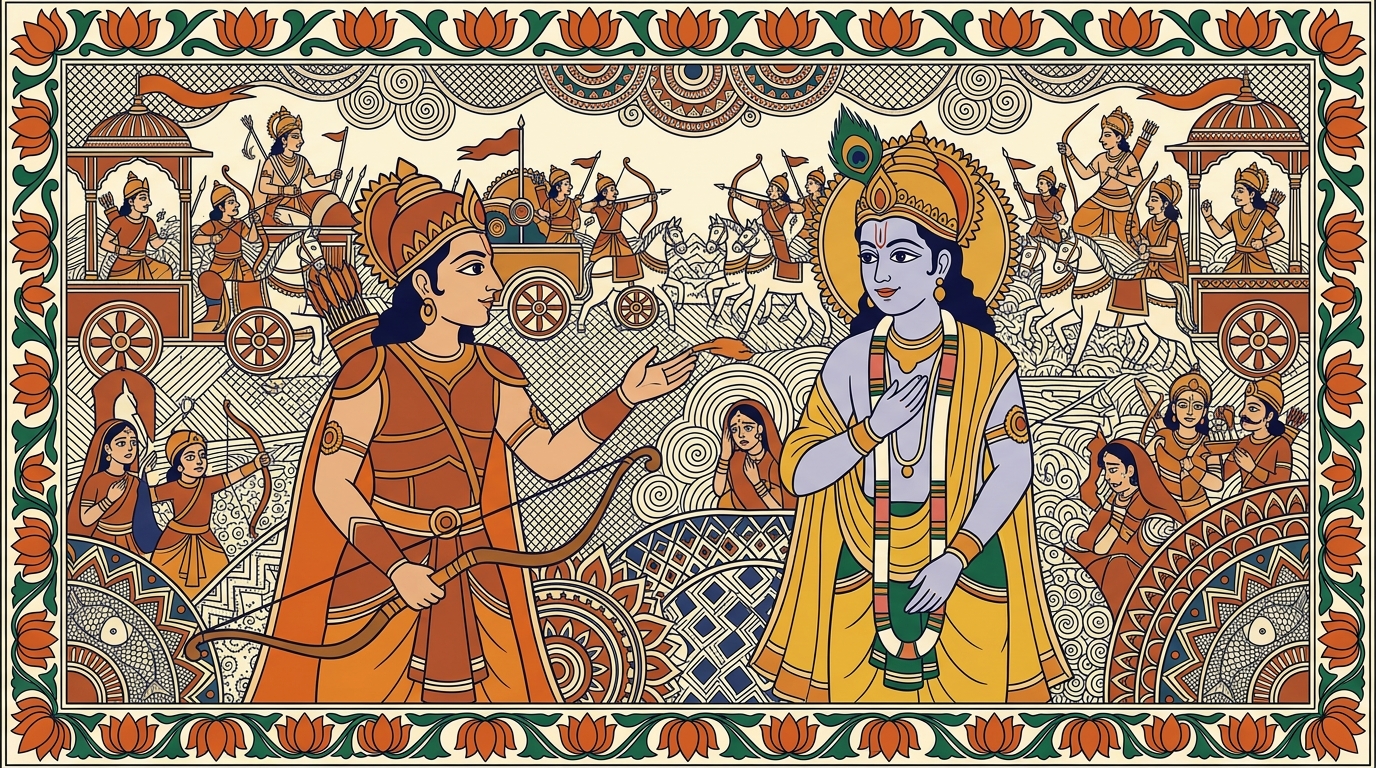
Arjuna is not thinking only of the battle. He is thinking of what
comes after. When a family is destroyed, the destruction does not
stop at the battlefield. It ripples outward through generations —
through the women left behind, through the children who grow up
without elders to guide them, through the traditions that die, the
values that erode, the social bonds that unravel. One act of
violence creates circles of harm that widen and widen until they
reach places the original stone-thrower never imagined.
But Nirmala's grandmother told her something else that morning,
something she almost missed. "It works the other way too," she said
quietly. "Throw a good stone and watch." A single act of courage, a
single person who stands firm and says "this stops here" — that
creates ripples too. Ripples of repair. Arjuna sees only the dark
circles now, and the Gita does not ask him to look away from them.
But it will teach him, in time, that the same water that carries
destruction can carry healing — and that recognizing the ripples is
itself the first brave step toward stopping them.