In a village called Kondapalli, near the Krishna River in Andhra Pradesh,
there was a temple so old that nobody could agree when it had been built.
Some said five hundred years. Some said a thousand. The temple itself
offered no answer. Its stone walls had been worn smooth by centuries
of monsoon rain, and the inscriptions near the entrance had been rubbed
away by thousands of hands touching them for blessings on the way in.
But the bell was not old. The bell was replaced every forty years,
because that was how long it took for the bronze to thin from daily
ringing. The Naidu family had made every bell for as far back as anyone
could remember. Not the whole family — one person. The eldest child
of the eldest child, trained from the age of seven, spending decades
learning the precise mixture of copper and tin, the exact temperature
of the furnace, the shape of the mould carved from river clay.
Ramayya Naidu was the current bellmaker. He was seventy-three. His
hands shook now when he held a cup of tea, but when he held his
casting tools, they went steady, as if the craft itself calmed the
tremor. Every morning at four, the temple priest pulled the rope, and
Ramayya's bell rang out across the village — a sound so deep and pure
that farmers in the fields would stop and stand still for a moment
before bending back to their work.
Ramayya had one son, Srikanth, who had moved to Hyderabad fifteen
years ago to work in a software company. Srikanth sent money home
every month, called on Sundays, visited during Sankranti. He was a
good son. But he had never learned to make a bell.
"Come home," Ramayya said during one Sunday phone call. "I will teach
you. It takes ten years. We should start now."
"Nanna, I have a job. EMIs. The children are in school here."
"I know. But the bell —"
"You are still strong. There is time."
There was not time. Ramayya died on a Tuesday in April, quietly, in
his sleep, with his casting tools arranged neatly on the shelf above
his bed. Srikanth came home for the funeral. The whole village came.
The priest rang the bell a hundred and eight times, and its voice
carried Ramayya's name across the fields one last time.
Forty years later, the bell cracked. It happens — bronze thins,
the clapper wears a groove, and one morning the ring turns into a
flat, dead clunk. The priest called Srikanth, who was now sixty-two,
retired, living in a flat in Hyderabad. "We need a new bell."
Srikanth came to Kondapalli. He opened his father's workshop, which
had been locked since the funeral. The tools were there — the ladle,
the crucible, the hand-carved clay moulds. He picked up the copper
ingot and held it. He had no idea what to do with it. The knowledge
was not in the tools. It had been in his father's hands, and his
father's father's hands, and it had died with them.
The temple in Kondapalli has a new bell now. It was ordered from a
factory in Moradabad. It rings every morning, and it sounds fine.
Fine. Not pure, not deep, not the sound that made farmers stop in
their fields. Just fine.
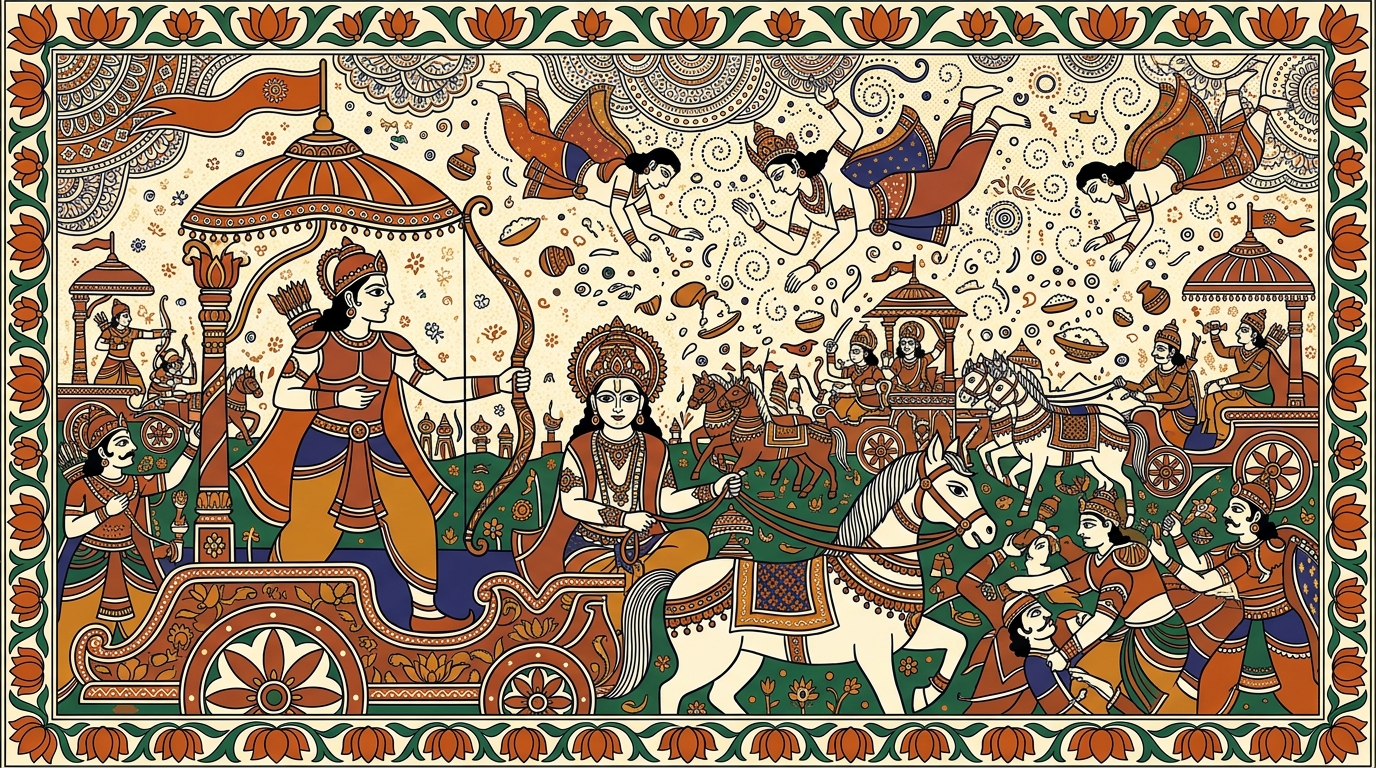
When Arjuna says the ancestors fall because the offerings stop, he
is not only talking about rice balls and water poured at a shrine.
He is talking about the thread that connects one generation to the
next: the knowledge, the craft, the ritual, the sound of a bell
that only one family knew how to make. When that thread is cut, the
ancestors do not simply die. They fade, and something irreplaceable
grows quiet.
But threads, even thin ones, do not always break completely. In
villages like Kondapalli, something is stirring. Young people who
left are coming back with questions. A few old apprentices who once
watched the bellmakers work are teaching what they remember. The
knowledge is incomplete, a fragment here, a technique there, but
knowledge that has once existed leaves traces in the world, like
grooves worn into a stone path. Srikanth's grandson, it is said,
has begun asking questions about copper and tin. The thread is thin.
But recognizing that it is thin is the first step toward making it
strong again.