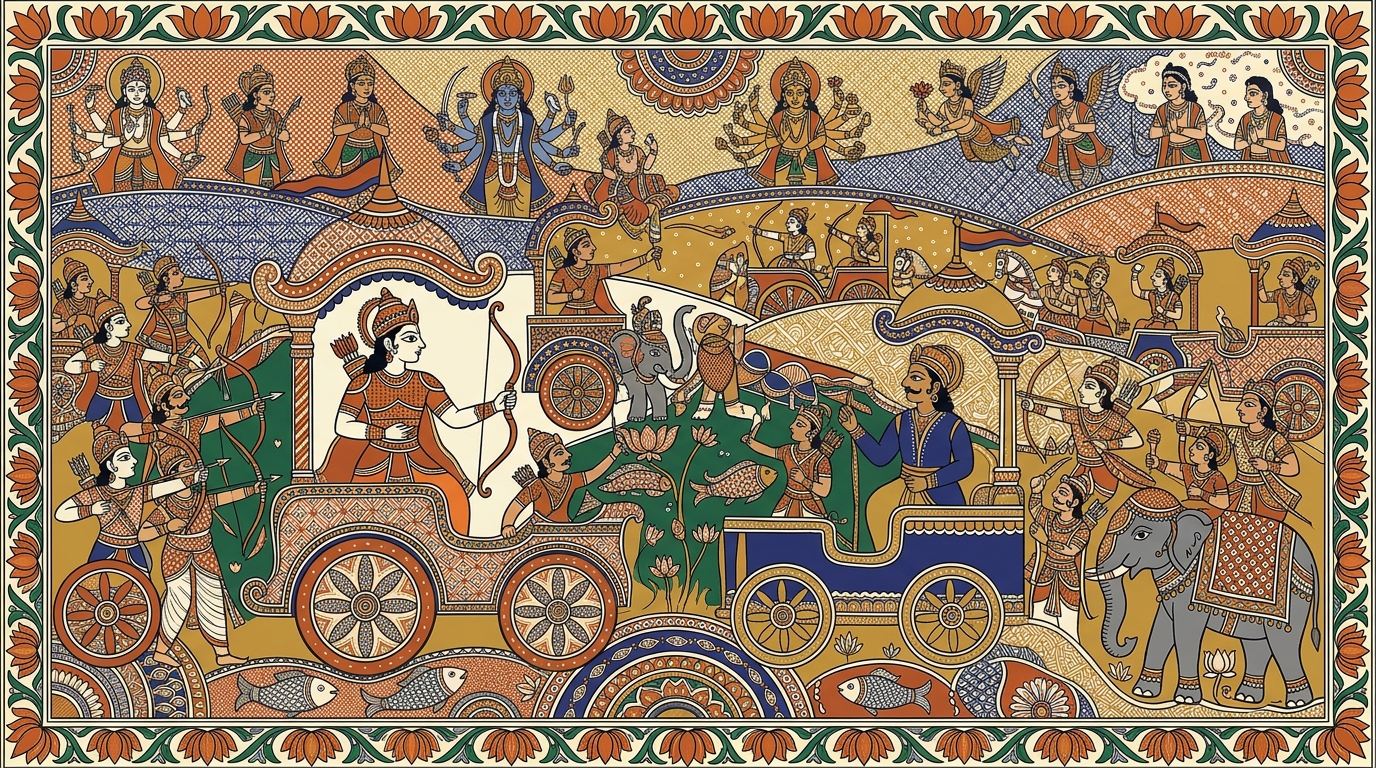
Krishna's own city fell. Not to an enemy army, not to a siege, not
to a foreign invasion — but to itself.
Dwaraka was the golden city, built on an island in the western sea,
its towers rising like flames above the water. Krishna had founded
it as a refuge for the Yadava clan after they fled the tyrant
Jarasandha. For generations it prospered. The Yadavas were warriors,
merchants, scholars, a proud people with ancient traditions of
governance and worship, of river rituals and fire offerings, of the
songs their mothers had taught them and their mothers before them.
But slowly, from within, something curdled. The young Yadavas grew
arrogant. They mocked the sages who visited the city. One day, as
a cruel joke, they dressed up Samba, Krishna's own son, as a
pregnant woman and brought him before the visiting rishis. "Tell
us," they laughed, "what child will this woman bear?" The sages
saw through the disguise instantly. Their eyes went cold. "She
will bear an iron mace," they said, "and that mace will destroy
your entire clan."
The Yadavas ground the mace to powder and scattered it in the sea.
They thought they had outsmarted fate. But the powder washed ashore
and grew into sharp iron reeds along the coastline — the same
coastline where the Yadavas held their festivals.
The destruction came during a feast. The Yadavas drank too much.
Old grudges surfaced. Words became insults, insults became blows,
and when they reached for weapons and found none, they tore the
iron reeds from the shore and turned them on each other. Brother
killed brother. Cousin killed cousin. The eternal traditions of
the Yadava clan, their rituals, their duties, their community
bonds, dissolved in a single afternoon of madness.
Krishna watched. He did not stop it. The story says he sat beneath
a tree at the edge of the slaughter and let it happen, because
the rot had gone too deep. The mockery of the sages, the arrogance,
the forgetting of dharma — these were not sudden failures. They
were the end of a long decay, a chain of small neglects that
finally snapped.
Arjuna, standing at Kurukshetra, is terrified of exactly this
future. He can see the pattern: war destroys families, destroyed
families lose their traditions, lost traditions leave communities
without a moral compass, and without a compass, even the noblest
clans tear themselves apart with reeds pulled from the shore. The
Yadava destruction had not yet happened when Arjuna spoke these
words, but the fear in his voice sounds like prophecy, because
that is precisely how it would end. Even Krishna's own people
were not immune.