King Shantanu first saw Satyavati on the bank of the Yamuna river,
where she rowed a small ferryboat through the evening mist. She was
a fisherwoman's daughter, and the river breeze should have carried
the smell of fish and wet rope. But it didn't. Instead, a fragrance
drifted from her skin: the scent of blue lotus flowers, impossibly
sweet, as if a garden were blooming on the water. A sage had blessed
her with that divine perfume years ago, and it reached Shantanu before
her voice did.
He fell in love before she spoke a word.
But Satyavati's father would not allow the marriage unless the king
promised that only Satyavati's sons would inherit the throne. Shantanu
could not make that promise — he already had a son, the brilliant
young prince Devavrata.
When Devavrata learned why his father had grown so quiet, so sad, he
went to Satyavati's father himself. The court gathered in the great
hall, torches flickering along the stone walls. Devavrata stood before
them all — tall, barely twenty, already the finest warrior in the
kingdom — and spoke in a voice that carried to every corner.
"I give up my right to the throne. Forever."
A murmur swept through the court. But Devavrata was not finished. He
drew his sword, and the steel rang as it left the scabbard. Then he
knelt and laid it on the stone floor at his father's feet.
"I will never marry. I will never have children. No descendant of mine
will ever challenge Satyavati's sons for the crown."
The hall went silent, the kind of silence that feels like the world
holding its breath. Even the torches seemed to stop flickering.
Flowers fell from the sky, dropped by gods who were watching, stunned
by a sacrifice so complete. From that day, Devavrata was called
Bhishma — "the one of the terrible vow" — and the gods granted him
the power to choose the moment of his own death.
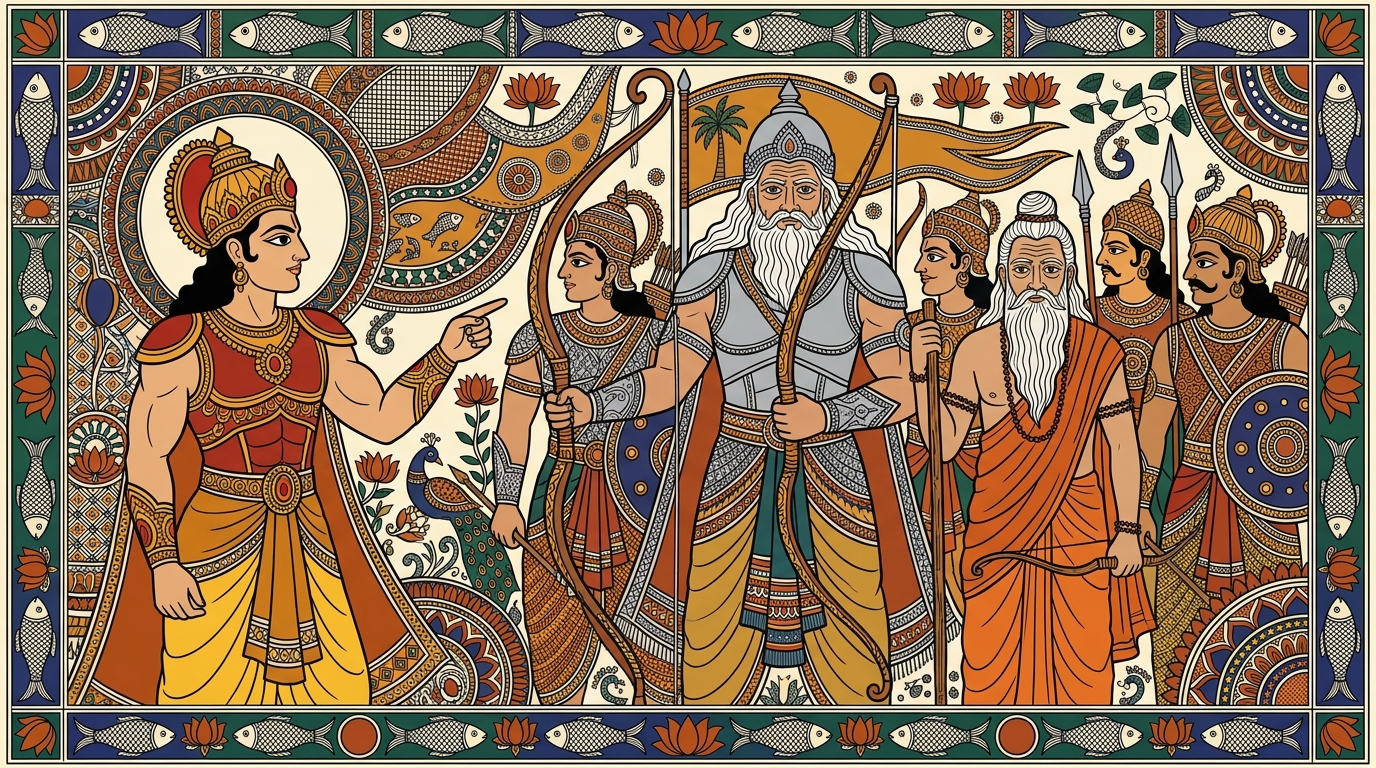
Decades passed. When Duryodhana named Bhishma on the battlefield of
Kurukshetra, the old warrior stood in his chariot with silver hair
that fell past his shoulders, a body still hard as teak wood, and
eyes that had seen four generations of kings rise and fall. He was
ancient but unshakeable, like a mountain that the wind has battered
for a thousand years without moving a single stone.
And yet, Bhishma stood on the wrong side. His vow bound him to the
throne — not to the person sitting on it, but to the throne itself.
He knew the Pandavas were right. He loved them. But his promise was
older than their quarrel, and he would not break it.
A lifetime of sacrifice, and this was where it led — fighting against
the people his own heart believed in.
And yet, Bhishma's honor was not wasted. Even standing on the wrong
side, he showed everyone watching what it looked like to hold yourself
with dignity in an impossible situation. When the war ended and the
truth prevailed — as he always knew it would — people did not remember
Bhishma as a man who chose the wrong army. They remembered him as a
man whose word was unbreakable, whose sacrifice was so complete that
even the gods had wept. Sometimes the deepest teaching comes not from
the people who win, but from the people who stand firm and let their
example speak across the centuries.