The school music teacher, Mrs. D'Souza, pushed her glasses up her
nose and stared at the five students standing in front of her. The
annual inter-school choir competition was in three weeks, and this
was what she had to work with: five kids from five different grades
who had been thrown together because nobody else had signed up.
"Let's hear what we've got," she said. "One at a time. You first."
Aditya, the oldest, sang first. His voice was deep and steady, like
a cello — solid and warm, but slow. He could hold a note longer than
anyone Mrs. D'Souza had ever taught, but he could not speed up to
save his life.
Then Priya. Her voice was high and clear as a glass bell, perfect
for melody, but so quiet that it disappeared the moment anyone else
started singing.
Rahul was loud. Really loud. He could fill a room with sound, but he
wandered off-key so often that Mrs. D'Souza's left eye twitched
every time he opened his mouth.
The twins, Isha and Rohan, were mirror images. Isha sang sweet,
flowing phrases that curled and dipped like a river. Rohan sang
sharp, staccato bursts — bright and punchy, like firecrackers. Apart,
each one sounded incomplete. But when they sang together, something
clicked. Isha's flow softened Rohan's edges. Rohan's punch gave
Isha's melody a backbone.
"All right," Mrs. D'Souza said, pressing her palms together. "Here
is what we're going to do. Aditya, you are our foundation. You hold
the bass note underneath everything. Priya, you carry the melody —
but only when the others go quiet. You are the voice we lean in to
hear. Rahul, I am giving you the rhythm. Clap, stamp, hum — but no
high notes, understood?"
Rahul grinned. "I can be loud?"
"You can be loud."
"And the twins fill the middle," she finished. "Isha on the low
harmony, Rohan on the high."
They rehearsed every day for three weeks. The first week sounded like
five people singing five different songs in the same room. The
second week, the edges began to blur — Aditya's bass note gave
everyone a foundation to stand on, and Priya's melody floated above
like a kite. By the third week, something magical happened: the five
voices stopped being five separate sounds and became one voice with
five colors in it.
They won.
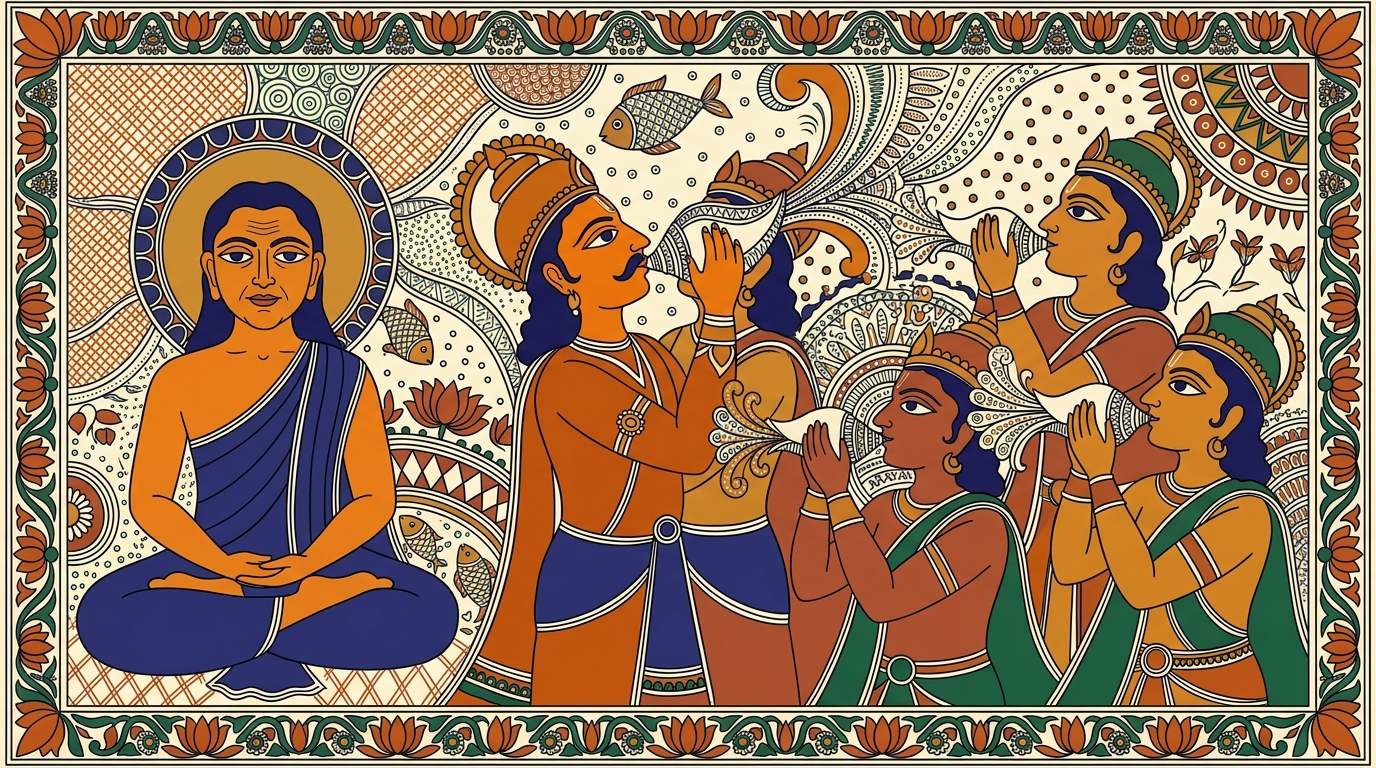
The five Pandava brothers were like that choir. Yudhishthira was
the steady foundation. Bhima was the thunder. Arjuna was the
piercing melody. The twins — Nakula and Sahadeva — filled in the
spaces between. When they blew their five conches together, it
was not just noise. It was harmony. Each brother had a different
voice, a different conch, a different name, but together, they
made a single sound that no one brother could have made alone.