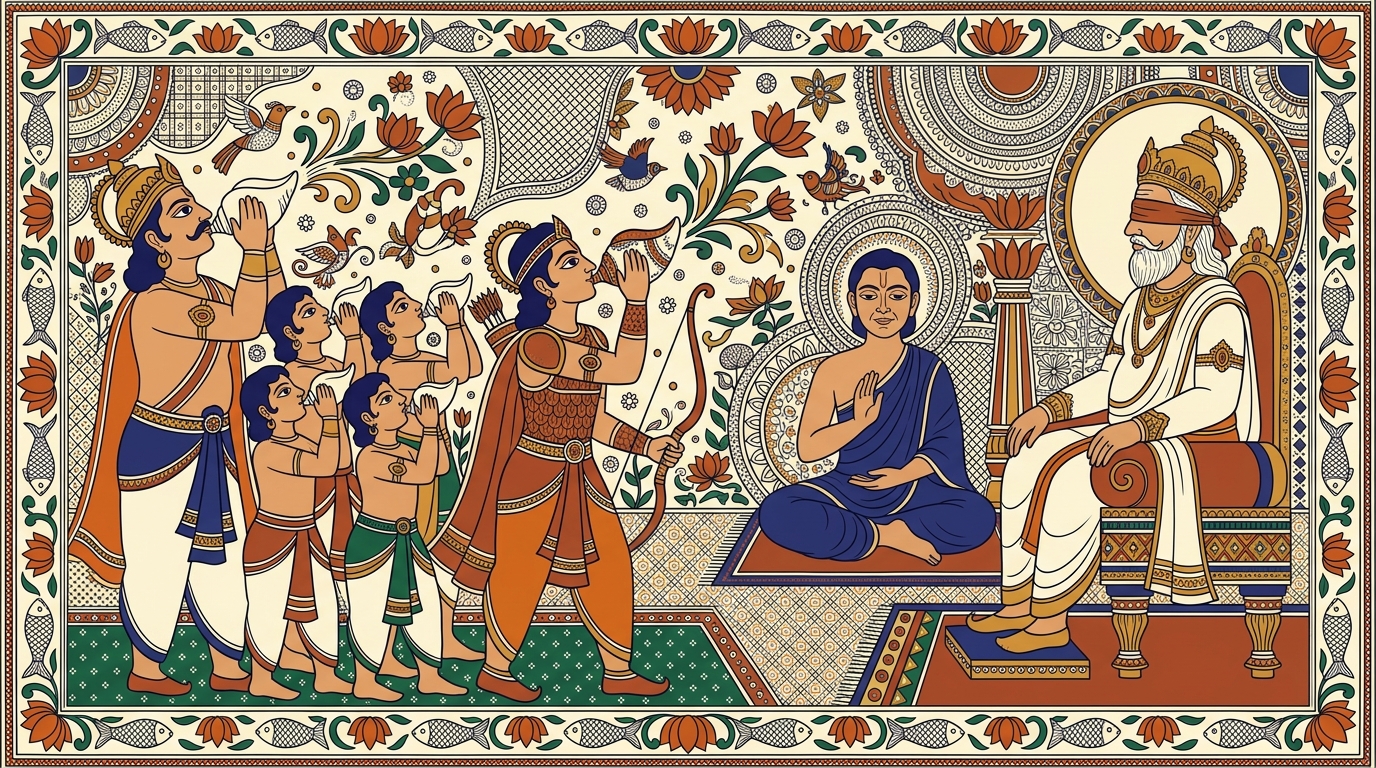
Abhimanyu was sixteen years old, and everyone on the battlefield
knew his name.
It was not because of anything he had done in the war — the war
had not started yet. It was because of who he was: Arjuna's son,
Krishna's nephew, the boy who had been born with the blood of
heroes in his veins like ink soaked into paper. People expected
greatness from him the way they expected the sun to rise.
The night before the war, Abhimanyu sat alone on a flat stone near
the Pandava camp, polishing his conch shell. The camp stretched
behind him — rows of tents glowing amber from the fires inside,
the clink of armor being repaired, the low hum of thousands of
men talking in voices too quiet to carry. The air smelled of
woodsmoke, horse sweat, and dal cooking somewhere.
His mother, Subhadra, found him there. She sat down beside him
without speaking. For a while, they just listened to the night
sounds — crickets, a distant horse nickering, the snap of a
tent flap in the wind.
"Are you scared?" she asked finally.
Abhimanyu turned the conch in his hands. It was smaller than his
father's Devadatta, smooth and cream-colored with a spiral that
wound inward to a dark center. "Everyone keeps telling me how
brave my father is," he said. "How my uncle Krishna is a god.
How my grandfather Drupada once held a whole kingdom together
through sheer stubbornness."
"That is not what I asked."
He looked at her. In the firelight, her face was half gold, half
shadow. "Yes," he said. "I am scared. Not of dying. I am scared
of being the one who does not belong. Every conch on that field
tomorrow has a legend behind it. What legend do I have? I am
sixteen. I have never fought in a real battle."
Subhadra took the conch from his hands, held it up to the
firelight, and turned it slowly. "When you were still inside
me," she said, "your father told you the story of how to break
into the Chakravyuha — the spinning wheel formation. He spoke
to my belly, and you listened. You were not even born yet, and
you were already learning."
She placed the conch back in his hands. "You do not need a
legend from the past, Abhi. You will make your own tomorrow."
The next morning, when the Pandava conches sounded one after
another — Panchajanya, Devadatta, Paundra, Anantavijaya,
Sughosha, Manipushpaka — Abhimanyu waited until the last echo
faded. Then he lifted his own conch and blew.
The sound was not the loudest. But it was there. His voice among
the voices. His note in the chord. And that, for a sixteen-year-old
standing among legends, was enough.
The Gita says they blew "pṛthak pṛthak" — each one separately.
Not blending, not hiding inside the group, but each voice distinct,
each one saying: I am here. I am part of this. Even the youngest.