There is a wall in Nani's house that tells the story of a family.
It is not a special wall. It is just the long stretch of plaster in
the corridor between the kitchen and the back bedroom of a two-room
flat in Indore, painted the same pale green it has been for thirty
years. But every inch of it is covered with photographs. They hang
in mismatched frames — wooden, plastic, brass, one held together
with tape — and they go from the ceiling down to the height where a
small child might reach on tiptoes.
Twelve-year-old Aisha knows every face on that wall.
In the top left corner, sepia-toned and slightly crooked, is her
great-grandfather, Bade Abba, in a white kurta and round glasses,
standing outside a schoolhouse in a village that no longer exists. He
was a teacher. Below him, in a black-and-white photo with scalloped
edges, is his son, Aisha's Nana, young and thin, holding a
cricket bat outside a university hostel. Next to that, a colour
photo from the 1980s: Nana and Nani on their wedding day, marigold
garlands thick around their necks, Nani's eyes bright with nervous
laughter. Then the family multiplies. Nani's brother, Aisha's
grand-uncle, with his arm around his wife. Aisha's mother as a girl
with two missing teeth. Her Mamu, her mother's younger brother,
holding baby Aisha in the hospital on the day she was born, his face
ridiculous with joy.
And then the newer photos. Aisha's cousin Zara at her school play.
Her father's parents, Dada and Dadi, at a temple in Ujjain. Her
Phupha, her aunt's husband, teaching Aisha to ride a bicycle in the
park. Her baby brother Imaad, red-faced and screaming, in his first
photograph.
Teachers. Fathers. Sons. Grandfathers. Uncles. In-laws. Grandchildren.
The wall does not sort them by importance. It does not separate them
into sides. They are all just — family. Tangled together, bound by
blood and marriage and love and the peculiar stubbornness of people
who refuse to let go of each other even when they disagree about
everything from politics to pickle recipes.
One evening, Aisha heard her mother and Mamu arguing on the phone.
Something about property. Something about Nani's flat and who would
pay for the repairs. Voices rose. Words were said that could not be
unsaid. The phone was hung up. Silence filled the kitchen like smoke.
Aisha walked to the wall of photographs and looked at the picture
of Mamu holding her in the hospital. His face, ridiculous with joy.
She thought: how do you fight someone whose face looks like that when
they hold you?
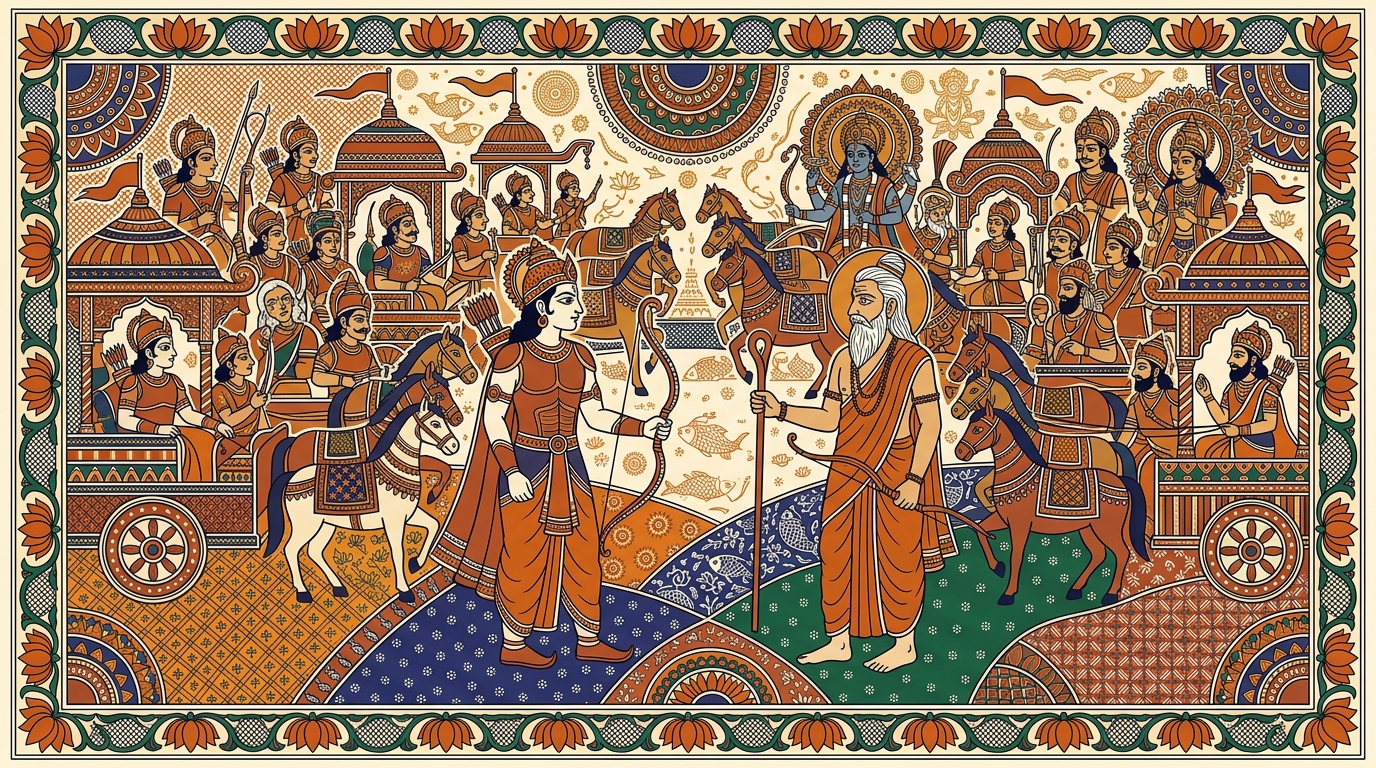
When Arjuna lists the people on the battlefield — teachers, fathers,
sons, grandfathers, uncles, in-laws, grandsons — he is not reciting
a catalogue. He is walking down a wall of photographs in his mind,
touching each frame, remembering each face. And every face is a
reason to put down his bow.
But those same faces are also reasons to find a way forward. Every
person on that wall once faced something that seemed impossible —
Bade Abba building a school in a village with no road, Nana leaving
home with nothing but a cricket bat and a train ticket, Nani
laughing on her wedding day despite everything that frightened her.
Their stubbornness, their courage, their refusal to be defeated —
all of it lives in Aisha's blood. The wall of photographs holds grief, but it holds resilience too. And resilience,
once inherited, does not disappear just because the phone call
ended badly.