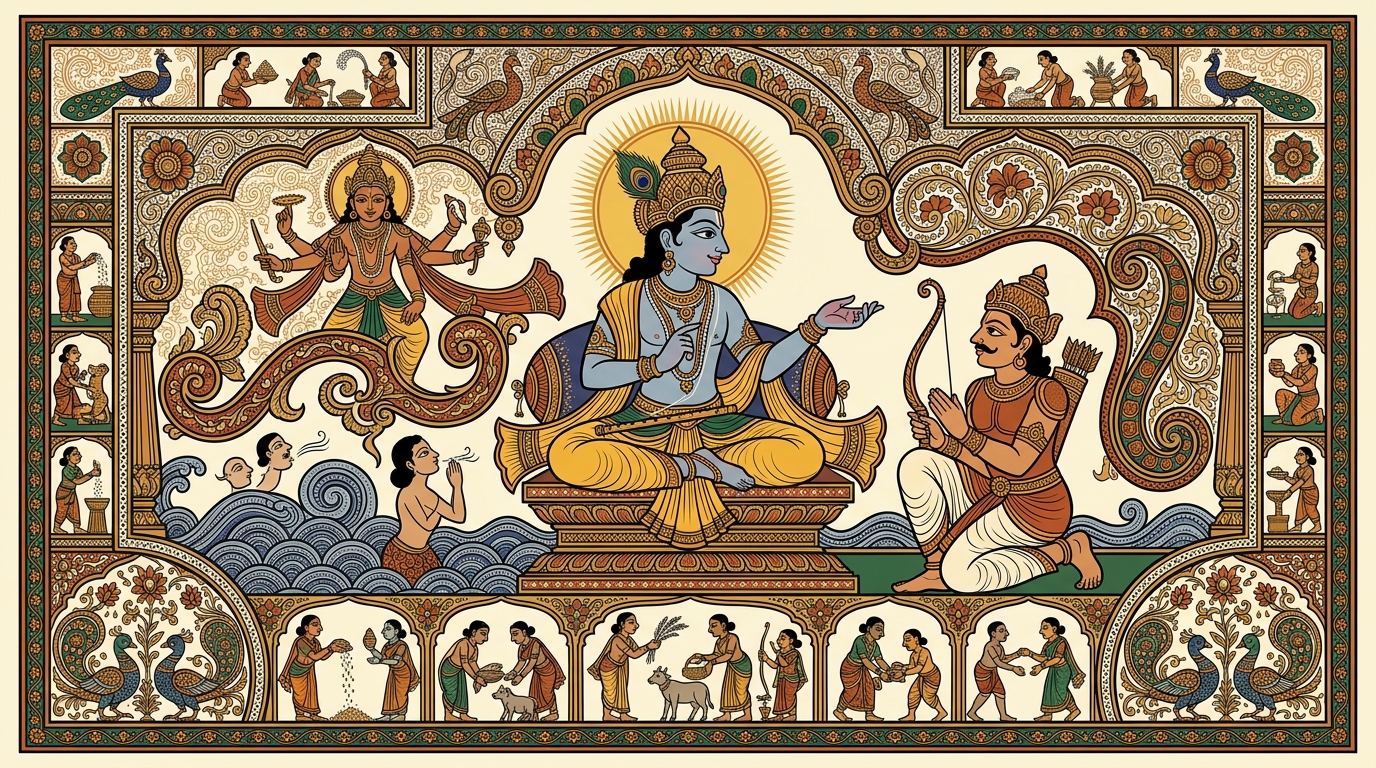
The Yoga of Action
कर्मयोग
Krishna explains that nobody can sit perfectly still and do nothing — even breathing is an action! The secret is to do your best work without being greedy for rewards. When you help others just because it's the right thing to do, that's the beautiful path of Karma Yoga.
✶ Art Style: Pattachitra from Odisha Learn more
Pattachitra means "cloth painting" in Odia, and this art has been practised in Odisha for over a thousand years. Artists called chitrakars prepare their own canvases by layering cloth with a paste of chalk and tamarind seed gum, creating a smooth surface. Then they paint mythological stories using bold black outlines and vibrant natural colors. The most striking feature is the intricate border — three or four nested frames of flowers and geometric patterns surround every scene, like looking through decorated windows into the world of the gods.
Signature Elements
- • Bold black outlines with fine internal detailing
- • Multi-layered ornamental borders (3-4 nested frames)
- • Horror vacui — every space filled with patterns
- • Narrative panel compositions
Did you know?
Pattachitra artists traditionally make their own colors from natural materials — white from conch shells, red from a local stone called hingula, yellow from the urine of cows that eat mango leaves, and black from burnt coconut shells!
ज्यायसी चेत्कर्मणस्ते मता बुद्धिर्जनार्दन। तत्किं कर्मणि घोरे मां नियोजयसि केशव॥
ArjunaArjuna is confused and frustrated. He says to Krishna: "If You think that understanding and wisdom are better than action, then why are You pushing me into this terrible battle? It feels like You're telling me two different things at the same time: be wise AND fight."
व्यामिश्रेणेव वाक्येन बुद्धिं मोहयसीव मे। तदेकं वद निश्चित्य येन श्रेयोऽहमाप्नुयाम्॥
ArjunaArjuna pleads: "Your words seem to pull me in two directions at once, and my mind is getting tangled. Please, just tell me ONE clear path — the single thing I should do that will lead me to what is good. I need certainty, not more riddles."
लोकेऽस्मिन्द्विविधा निष्ठा पुरा प्रोक्ता मयानघ। ज्ञानयोगेन साङ्ख्यानां कर्मयोगेन योगिनाम्॥
KrishnaKrishna answers calmly: "Long ago, I taught that there are two paths in this world. The path of knowledge is for those who love to think and understand. The path of selfless action is for those who love to do and serve. Both set out toward the same truth, two rivers flowing to one ocean, though the path of action reaches it by first making the mind clear and steady, so that knowledge can dawn."
न कर्मणामनारम्भान्नैष्कर्म्यं पुरुषोऽश्नुते। न च संन्यसनादेव सिद्धिं समधिगच्छति॥
KrishnaKrishna teaches a simple but powerful truth: you cannot find freedom by simply refusing to do anything. Avoiding all action does not free you from action's hold: it only leaves you stuck. And just giving up everything on the outside doesn't make you perfect on the inside. True freedom grows as your heart becomes clear and unselfish through right action, not by running away from action.
न हि कश्चित्क्षणमपि जातु तिष्ठत्यकर्मकृत्। कार्यते ह्यवशः कर्म सर्वः प्रकृतिजैर्गुणैः॥
KrishnaKrishna says that nobody — not a single person — can stop acting for even one moment. Nature itself forces everyone to act. Your body breathes, your eyes blink, your mind thinks. Even when you try to sit perfectly still, the forces of nature inside you keep working. Stillness on the outside is never truly stillness.
कर्मेन्द्रियाणि संयम्य य आस्ते मनसा स्मरन्। इन्द्रियार्थान्विमूढात्मा मिथ्याचारः स उच्यते॥
KrishnaKrishna gives a warning: someone who controls their body on the outside — sitting still, looking calm — but whose mind is secretly racing with desires and daydreams, is only pretending. That kind of self-control is fake. It's like locking the front door of your house but leaving every window wide open.
यस्त्विन्द्रियाणि मनसा नियम्यारभतेऽर्जुन। कर्मेन्द्रियैः कर्मयोगमसक्तः स विशिष्यते॥
KrishnaKrishna describes the truly great person: someone who controls their senses from the inside — with a steady mind — and then acts in the world without clinging to results. This person does their work fully and freely. They are far better than someone who only pretends to be calm. Real mastery is action with a still heart.
नियतं कुरु कर्म त्वं कर्म ज्यायो ह्यकर्मणः। शरीरयात्रापि च ते न प्रसिद्ध्येदकर्मणः॥
KrishnaKrishna gives a direct command: do your duty! Action is always better than inaction. Even keeping your body alive — eating, breathing, moving — requires effort. If you refuse to act at all, you cannot even take care of yourself. So get up and do what needs to be done.
यज्ञार्थात्कर्मणोऽन्यत्र लोकोऽयं कर्मबन्धनः। तदर्थं कर्म कौन्तेय मुक्तसङ्गः समाचर॥
KrishnaKrishna reveals the secret of free action: when you do your work as an offering — like pouring ghee into a sacred fire, giving without expecting anything back — that work sets you free. But when you act only for yourself, wanting praise or reward, that same work becomes a chain that binds you. Act freely, without clinging.
सहयज्ञाः प्रजाः सृष्ट्वा पुरोवाच प्रजापतिः। अनेन प्रसविष्यध्वमेष वोऽस्त्विष्टकामधुक्॥
KrishnaKrishna tells Arjuna an ancient truth: at the very beginning of creation, the Creator brought beings into the world together with the gift of sacrifice: the spirit of giving. He said, "Through this giving, you will grow and flourish, and it will grant you everything you wish for, like a magical cow that gives endless milk."
देवान्भावयतानेन ते देवा भावयन्तु वः। परस्परं भावयन्तः श्रेयः परमवाप्स्यथ॥
KrishnaKrishna says: nourish the world around you, and it will nourish you back. When people take care of each other — giving and receiving like a circle with no beginning and no end — everyone reaches the highest good. Nobody wins alone.
इष्टान्भोगान्हि वो देवा दास्यन्ते यज्ञभाविताः। तैर्दत्तानप्रदायैभ्यो यो भुङ्क्ते स्तेन एव सः॥
KrishnaKrishna says: when you take care of the world through your efforts, the world gives you wonderful things in return. But someone who enjoys all these gifts without giving anything back — that person is nothing but a thief. Even if nobody catches them, the universe knows.
यज्ञशिष्टाशिनः सन्तो मुच्यन्ते सर्वकिल्बिषैः। भुञ्जते ते त्वघं पापा ये पचन्त्यात्मकारणात्॥
KrishnaKrishna says: good people eat only after sharing. They take what is left over after others have been fed, and this frees them from all wrongdoing. But selfish people who cook only for themselves, who never think of anyone else at their table — they are really eating sin.
अन्नाद्भवन्ति भूतानि पर्जन्यादन्नसम्भवः। यज्ञाद्भवति पर्जन्यो यज्ञः कर्मसमुद्भवः॥
KrishnaKrishna reveals a beautiful chain: all living beings depend on food. Food grows because of rain. Rain comes because of sacrifice, the giving cycle. And sacrifice is born from action. Everything is connected in one great wheel. Pull out one link and the whole chain breaks.
कर्म ब्रह्मोद्भवं विद्धि ब्रह्माक्षरसमुद्भवम्। तस्मात्सर्वगतं ब्रह्म नित्यं यज्ञे प्रतिष्ठितम्॥
KrishnaKrishna traces a chain: rightful action (karma) arises from the Vedas, and the Vedas arise from the Imperishable (Akshara), the eternal Brahman that is everywhere and in everything. This all-pervading Brahman is forever established in the spirit of sacrifice. In other words, the whole universe rests on giving.
एवं प्रवर्तितं चक्रं नानुवर्तयतीह यः। अघायुरिन्द्रियारामो मोघं पार्थ स जीवति॥
KrishnaKrishna warns: this great wheel of mutual giving has been spinning since the beginning of creation. Anyone who refuses to do their part — who only takes and never gives, who lives only for their own pleasure — that person lives a wasted, purposeless life, Arjuna. They break the wheel for everyone.
यस्त्वात्मरतिरेव स्यादात्मतृप्तश्च मानवः। आत्मन्येव च सन्तुष्टस्तस्य कार्यं न विद्यते॥
KrishnaKrishna describes a rare kind of person: someone who finds all their joy within themselves, who is completely satisfied in their own soul, who needs nothing from the outside world to feel content. For such a person, there is no duty they are forced to do. They have gone beyond obligations because they have gone beyond wanting.
नैव तस्य कृतेनार्थो नाकृतेनेह कश्चन। न चास्य सर्वभूतेषु कश्चिदर्थव्यपाश्रयः॥
KrishnaKrishna continues describing this extraordinary soul: such a person has nothing to gain by acting and nothing to lose by not acting. They do not depend on any being in the world for anything. They are completely free — not because they have everything, but because they need nothing.
तस्मादसक्तः सततं कार्यं कर्म समाचर। असक्तो ह्याचरन्कर्म परमाप्नोति पूरुषः॥
KrishnaKrishna gives Arjuna a clear instruction: always do the work that needs to be done, but do it without clinging to what you might get from it. Working this way slowly clears and steadies the mind, and in that clear mind the wisdom that frees a person can dawn. This is how unselfish action leads, step by step, to the highest goal of all.
कर्मणैव हि संसिद्धिमास्थिता जनकादयः। लोकसंग्रहमेवापि सम्पश्यन्कर्तुमर्हसि॥
KrishnaKrishna reminds Arjuna that even great kings like Janaka reached perfection not by running away to sit in silence, but right in the middle of their duties. They ruled their kingdoms, made hard decisions, and served their people. Selfless action like theirs clears the heart so that wisdom can grow, and the wise, once free, still go on working for the good of all. Krishna says: you too should act for the welfare of the world.
यद्यदाचरति श्रेष्ठस्तत्तदेवेतरो जनः। स यत्प्रमाणं कुरुते लोकस्तदनुवर्तते॥
KrishnaWhatever a respected person does, others copy. Whatever standard they set by their actions, the rest of the world follows. This means that people who are looked up to — parents, teachers, older siblings, leaders — carry a special responsibility, because their behaviour quietly becomes everyone else's behaviour too.
न मे पार्थास्ति कर्तव्यं त्रिषु लोकेषु किञ्चन। नानवाप्तमवाप्तव्यं वर्त एव च कर्मणि॥
KrishnaKrishna reveals something astonishing to Arjuna: "There is nothing in all the three worlds that I need to do. There is nothing I haven't already obtained, and nothing I still need to gain. And yet — I keep working." This is God himself saying that he chooses to act, not because he needs anything, but because the world needs him to.
यदि ह्यहं न वर्तेयं जातु कर्मण्यतन्द्रितः। मम वर्त्मानुवर्तन्ते मनुष्याः पार्थ सर्वशः॥
KrishnaKrishna tells Arjuna something that makes his voice drop low: "If I were to stop acting, even for a moment, all of humanity would follow my example. People walk the path I walk. If I sat down and did nothing, the whole world would sit down too." This is why even God continues to work — because everyone is watching.
उत्सीदेयुरिमे लोका न कुर्यां कर्म चेदहम्। सङ्करस्य च कर्ता स्यामुपहन्यामिमाः प्रजाः॥
KrishnaKrishna continues his warning: if he stopped working, all the worlds would collapse. He would be the cause of terrible chaos, and all living beings would be destroyed. Even God cannot afford to stop, because the whole universe depends on his action to keep running.
सक्ताः कर्मण्यविद्वांसो यथा कुर्वन्ति भारत। कुर्याद्विद्वांस्तथासक्तश्चिकीर्षुर्लोकसंग्रहम्॥
KrishnaPeople who do not understand work with attachment — they get excited when things go well and upset when they don't. The wise person does the same work, but without that clinging. They act because the world needs them to, not because they are chasing a reward. Same actions, completely different hearts.
न बुद्धिभेदं जनयेदज्ञानां कर्मसङ्गिनाम्। जोषयेत्सर्वकर्माणि विद्वान्युक्तः समाचरन्॥
KrishnaA wise person should never confuse or unsettle people who are not yet ready to understand detachment. Instead of lecturing, the wise should simply do their own work beautifully and joyfully. People learn best not from speeches but from watching someone who loves what they do.
प्रकृतेः क्रियमाणानि गुणैः कर्माणि सर्वशः। अहङ्कारविमूढात्मा कर्ताहमिति मन्यते॥
KrishnaAll actions are really performed by the forces of nature, the three gunas that make everything in the world move and change. The soul itself does not act at all; it is nature (prakriti) that acts through the body and mind. But a person blinded by ego thinks, "I did this! It was all me!" — not seeing the vast web of forces that drive every action.
तत्त्ववित्तु महाबाहो गुणकर्मविभागयोः। गुणा गुणेषु वर्तन्त इति मत्वा न सज्जते॥
KrishnaKrishna tells Arjuna that a person who truly understands reality sees something others miss: it is not "I" who acts, but the forces of nature working upon nature. The eyes see, the hands move, the mind thinks — all of these are nature's qualities doing their work. The wise person sees this clearly and does not get tangled up in thinking "I did this."
प्रकृतेर्गुणसम्मूढाः सज्जन्ते गुणकर्मसु। तानकृत्स्नविदो मन्दान्कृत्स्नविन्न विचालयेत्॥
KrishnaPeople who don't see the bigger picture get attached to their actions and their results: they think "I" am doing everything. Krishna says something surprising here: the wise person should not shake or disturb the faith of those who are not yet ready to understand. Everyone grows at their own pace.
मयि सर्वाणि कर्माणि संन्यस्याध्यात्मचेतसा। निराशीर्निर्ममो भूत्वा युध्यस्व विगतज्वरः॥
KrishnaThis is one of the most powerful moments in Chapter 3. Krishna commands Arjuna: surrender every action to Me. Let go of desire and the feeling of "mine." And then — fight. Not with anger, not with grief, not with the fever of anxiety, but with a calm and steady spirit. Do what must be done, and let it rest in the Lord who is the Self at your own centre.
ये मे मतमिदं नित्यमनुतिष्ठन्ति मानवाः। श्रद्धावन्तोऽनसूयन्तो मुच्यन्ते तेऽपि कर्मभिः॥
KrishnaKrishna makes a promise: those who follow this teaching — doing their duty without clinging to results — with genuine faith and without envy, they will be freed from the chains of karma. It is less about being perfect than about practising with an honest heart.
ये त्वेतदभ्यसूयन्तो नानुतिष्ठन्ति मे मतम्। सर्वज्ञानविमूढांस्तान्विद्धि नष्टानचेतसः॥
KrishnaKrishna gives a warning here. Those who reject this teaching — not because they've thought carefully about it, but simply out of envy or stubbornness — lose their way. When someone refuses to learn because they resent the teacher, they end up confused about everything, not just this one lesson.
सदृशं चेष्टते स्वस्याः प्रकृतेर्ज्ञानवानपि। प्रकृतिं यान्ति भूतानि निग्रहः किं करिष्यति॥
KrishnaEven wise people act according to their own nature. It is built into every living being. Trying to crush your nature by force does not work. Krishna is saying: don't fight who you are. Instead, understand your nature and work with it. A fish cannot climb a tree, and a tree cannot swim. Each has its own path.
इन्द्रियस्येन्द्रियस्यार्थे रागद्वेषौ व्यवस्थितौ। तयोर्न वशमागच्छेत्तौ ह्यस्य परिपन्थिनौ॥
KrishnaKrishna reveals something important about how our senses work. Every time our eyes see, ears hear, or tongue tastes, two invisible guards are standing at the door: Raga (desire, wanting more) and Dvesha (dislike, pushing away). These two twist our experience and become our enemies. The wise person walks between them, controlled by neither.
श्रेयान्स्वधर्मो विगुणः परधर्मात्स्वनुष्ठितात्। स्वधर्मे निधनं श्रेयः परधर्मो भयावहः॥
KrishnaThis is one of the Gita's most famous verses, and Krishna is direct: it is better to do your own duty — even if you do it imperfectly — than to do someone else's duty perfectly. Your path is yours, even when it is hard. Copying someone else's path, no matter how successful it looks, is dangerous because it takes you away from who you really are.
अथ केन प्रयुक्तोऽयं पापं चरति पूरुषः। अनिच्छन्नपि वार्ष्णेय बलादिव नियोजितः॥
ArjunaAfter listening to Krishna's teachings, Arjuna asks an honest question: if doing the right thing is so important, then why do people sometimes do wrong even when they don't want to? What invisible force pushes a person toward bad choices, as if some powerful hand were shoving them from behind? This is not a philosopher's question but the cry of someone who has struggled with himself.
काम एष क्रोध एष रजोगुणसमुद्भवः। महाशनो महापाप्मा विद्ध्येनमिह वैरिणम्॥
KrishnaKrishna finally names the real enemy. It is not a warrior on the other side of the battlefield but desire and anger, two forces that live inside every person. They are born from rajas, the restless energy of passion, and they are never satisfied. The more you feed them, the hungrier they become. Know them as your true enemy.
धूमेनाव्रियते वह्निर्यथादर्शो मलेन च। यथोल्बेनावृतो गर्भस्तथा तेनेदमावृतम्॥
KrishnaKrishna gives three pictures to explain how desire hides our inner wisdom. Smoke covers a fire but the fire is still there, just wave the smoke away. Dust covers a mirror and needs a good wipe. But a baby wrapped in the womb cannot free itself at all. Desire covers our knowledge in the same three degrees — sometimes lightly, sometimes so deeply that we cannot see the truth without help.
आवृतं ज्ञानमेतेन ज्ञानिनो नित्यवैरिणा। कामरूपेण कौन्तेय दुष्पूरेणानलेन च॥
KrishnaKrishna warns Arjuna that desire is the eternal enemy of the wise. Even people who know what is right can be blinded by it. Desire is like a fire that can never be satisfied — the more fuel you throw in, the higher the flames leap. It is never full. It always wants more.
इन्द्रियाणि मनो बुद्धिरस्याधिष्ठानमुच्यते। एतैर्विमोहयत्येष ज्ञानमावृत्य देहिनम्॥
KrishnaKrishna reveals where desire hides: it has three strongholds inside you. The first is the senses: your eyes, ears, tongue. The second is the mind, where thoughts swirl. The third is the intellect, your power to decide what is right. Through these three, desire covers your wisdom and fools you into thinking its voice is your own.
तस्मात्त्वमिन्द्रियाण्यादौ नियम्य भरतर्षभ। पाप्मानं प्रजहि ह्येनं ज्ञानविज्ञाननाशनम्॥
KrishnaKrishna gives a battle plan: start by controlling your senses. They are the outermost gate. Once you have a grip on what your eyes chase and what your tongue craves, you have the power to fight desire itself. Destroy this enemy, because it ruins both your understanding of what is right and your ability to live by that understanding.
इन्द्रियाणि पराण्याहुरिन्द्रियेभ्यः परं मनः। मनसस्तु परा बुद्धिर्यो बुद्धेः परतस्तु सः॥
KrishnaKrishna reveals a ladder of power inside every person. The senses are stronger than the body. The mind is stronger than the senses. The intellect is stronger than the mind. And above them all — the soul. Each level commands the one below it. If you can reach the highest rung, you are the master of everything beneath.
एवं बुद्धेः परं बुद्ध्वा संस्तभ्यात्मानमात्मना। जहि शत्रुं महाबाहो कामरूपं दुरासदम्॥
KrishnaThis is the final verse of Karma Yoga — Krishna's battle cry. Now that you know the soul stands above everything else, steady your restless mind by anchoring it to that highest self. And from that unshakeable place, destroy the enemy called desire. It is formidable, yes. But you are greater. You are the soul.